
 KSCN
KSCN
Search
- Page Path
- HOME > Search
Research Articles
- [Korean]
- Effects of night eating on oral health characteristics and symptoms of poor oral health in adolescents: a cross-sectional study using the 18th Korea Youth Risk Behavior Survey
- Seung–Hee Hong
- Korean J Community Nutr 2025;30(2):150-162. Published online April 29, 2025
- DOI: https://doi.org/10.5720/kjcn.2025.00038
-
 Abstract
 PDF
PDF - Objectives
To determine the association between night eating habits and oral health in adolescents.
Methods
Data from the 18th Korea Youth Risk Behavior Survey conducted in 2022 were analyzed. The study included 51,850 middle and high school students and assessed the frequency of night eating per week, dietary habits, oral health characteristics, and factors affecting the presence of symptoms of poor oral health.
Results
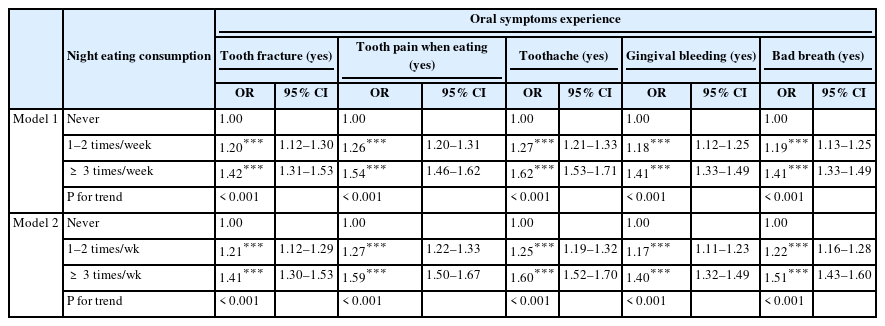
Almost thirty-seven percent (36.6%) of Korean adolescents have eaten at night one to two times per week and 23.0% more than three times per week. An increased frequency of night eating was associated with poor dietary habits. Adolescents who consumed more at night were less likely to have breakfast, drink water, and eat fruit, while their consumption of fast food, sweet drinks, and high-caffeine drinks increased (P < 0.001). An increased frequency of night eating was also associated with poor oral health. In a logistic regression analysis, more frequent night eaters were significantly less likely to brush their teeth at least three times per day (odds ratio [OR], 0.78; 95% confidence interval [CI], 0.75–0.82; P for trend < 0.001), and brush their teeth before going to sleep (OR, 0.70; 95% CI, 0.65–0.75; P for trend < 0.001), while they were more likely to experience sealant (OR, 1.19; 95% CI, 1.13–1.26). More frequent night eaters were significantly more likely to have tooth fracture (OR, 1.41; 95% CI, 1.30–1.53; P for trend < 0.001), tooth pain when eating (OR, 1.59; 95% CI, 1.50–1.67; P for trend < 0.001), toothache (OR, 1.60; 95% CI, 1.52–1.70), and bad breath (OR, 1.51; 95% CI, 1.43–1.60).
Conclusion
Our findings suggest that frequent night eating is linked to symptomatically poor oral health in adolescents. Therefore, oral health education programs related to dietary habits are necessary to reduce the potential of night eating to negatively influence dietary habits and oral health. -
Citations
Citations to this article as recorded by
- Association between Sleep Quality and Perceived Oral Health among Adolescents: Analysis of the 2024 Korea Youth Risk Behavior Survey
Bo Young Park, Eun Bi Sim
Journal of Dental Hygiene Science.2025; 25(4): 370. CrossRef
- Association between Sleep Quality and Perceived Oral Health among Adolescents: Analysis of the 2024 Korea Youth Risk Behavior Survey
- 3,535 View
- 83 Download
- 1 Crossref

- [English]
- Understanding the charactersitics and types of single-person households based on food purchase frequencies in Korea: a cross-sectional study using the 2023 Consumer Behavior Survey for Foods
- So-Yun Kim, Youngmin Nam, Jong-Youn Rha, Haerang Lee
- Korean J Community Nutr 2025;30(1):27-39. Published online February 28, 2025
- DOI: https://doi.org/10.5720/kjcn.2025.00031

-
Abstract
PDF
- Objectives
This study investigated the differences in food purchase frequency among single-person households by gender and age group and explored the characteristics of single-person household groups according to their food purchase patterns.
Methods
Utilizing data from the 2023 Consumer Behavior Survey for Foods conducted by the Korea Rural Economic Institute, this study examined food purchase frequencies among 966 single-person households. Data were analyzed using Rao-Scott chi-square tests, ANCOVA, ANOVA, and K-modes hierarchical cluster analysis.
Results
Significant differences were observed in the food purchase frequencies of single-person households for fresh and convenient food. Women displayed higher purchase frequencies for fish, vegetables, and fruits, whereas men showed higher purchase frequencies for convenient foods (P < 0.005). Single-person households aged 39 years and younger exhibited lower purchase frequencies for vegetables (P < 0.005) and fish (P < 0.001) and substantially higher frequencies of convenient food purchases (P < 0.001). Additionally, this study identified three distinct single-person household groups based on food purchase pattern: the “nutrition-conscious” group, which exhibited high purchase frequency for fresh foods; the “convenience-seeking” group, which showed high purchase frequency for all types of convenient foods; and the “passive food consumer” group, which displayed relatively low purchase frequency for both fresh foods and convenient foods. The socio-demographic characteristics of single-person households differed significantly across these three groups, with the “passive food consumer” group and “convenience-seeking” group exhibiting lower healthy eating competency (MN(nutrition-conscious group) = 3.68, MP(passive-food-consumer group) = 3.40, MC(convenience-seeking group) = 3.52, P < 0.001), safe eating competency (MN = 3.87, MP = 3.57, MC = 3.77, P < 0.001), and satisfaction (MN = 3.36, MP = 3.23, MC = 3.25, P = 0.04) than the “nutrition-conscious” group.
Conclusion
This study underscores the need for targeted nutrition programs to address the unique needs of single-person households depending on their characteristics. Specifically, this study highlights the importance of targeted interventions for “convenience-seeking” and “passive food consumer” to promote dietary competency and encourage healthy dietary behavior. -
Citations
Citations to this article as recorded by- Dietary behaviors and food waste typologies in single-person households using nationally representative data in South Korea
Wonwi Moon, Sunny Ham, Yonghee Suk
Waste Management.2026; 216: 115446. CrossRef - Cut-Specific Phospholipid Content and Distribution in Commonly Consumed Beef and Pork in Korea
Sunyoung Lim, Heon-Woong Kim, Jung-Ah Shin
Journal of the Korean Society of Food Science and Nutrition.2026; 55(4): 360. CrossRef - Secular trends in dietary patterns among Korean adults: using data from the 2007–2022 Korea National health and nutrition examination survey
Eunyoung Tak, Juhae Kim, Heejin Lee, Minji Kang
Nutrition Journal.2025;[Epub] CrossRef - 남성의 조리문해력이 식생활만족도에 미치는 영향: 조리관심도의 매개효과를 중심으로
진영 장, 지영 윤
Korean Journal of Food and Cookery Science.2025; 41(6): 430. CrossRef
- Dietary behaviors and food waste typologies in single-person households using nationally representative data in South Korea
- 13,369 View
- 133 Download
- 4 Crossref
- [Korean]
- Effects of watching Mukbang and Cookbang videos on adolescents’ dietary habits and mental health: cross-sectional study using the 18th Korea Youth Risk Behavior Survey
- Seung-Hee Hong
- Korean J Community Nutr 2024;29(2):156-170. Published online April 24, 2024
- DOI: https://doi.org/10.5720/kjcn.2024.29.2.156
-
Abstract
PDF
- Objectives
This study aimed to investigate the association between how often Korean adolescents watch Mukbang and Cookbang videos and their dietary habits.
Methods
Data from the 18th Korea Youth Risk Behavior Survey conducted in 2022 was analyzed for this study. The study included 51,850 middle and high school students and assessed various aspects, including demographics, frequency of watching Mukbang and Cookbang videos per week, dietary habits, health behaviors, and mental health factors.
Results
Nearly a third (29.3%) of Korean adolescents watched Mukbang and Cookbang videos one to four times a week, while 13.5% watched them more than five times weekly. Females, those with lower academic achievement, and those from lower socioeconomic backgrounds were significantly more likely to be frequent viewers (P < 0.001). Increased viewing frequency was associated with poorer dietary habits. Adolescents who watched more frequently were less likely to eat breakfast and consume fruits and milk, while their consumption of fast food, high-caffeine drinks, sugary drinks, and late-night snacks increased (P < 0.001). Higher viewing frequency correlated with increased feelings of stress, depression, and loneliness (P < 0.001). Logistic regression analysis confirmed these associations. More frequent viewers were significantly less likely to eat breakfast (odds ratio (OR), 0.63; 95% confidence interval (CI), 0.58–0.68), and more likely to consume fast food (OR, 1.85; 95% CI, 1.69–2.02), high-caffeine drinks (OR, 1.43; 95% CI, 1.30–1.56), sugary drinks (OR, 1.54; 95% CI, 1.41–1.67), and late-night snacks (OR, 1.37; 95% CI, 1.25–1.51).
Conclusions
Our findings suggest that frequent exposure to Mukbang and Cookbang content is linked to unhealthy dietary habits in adolescents. Educational programs may be necessary to mitigate the potential for these videos to negatively influence dietary choices. -
Citations
Citations to this article as recorded by- Association Between the Consumption of Sugar-Sweetened Beverages and High-Caffeine Drinks and Self-Reported Mental Health Conditions Among Korean Adolescents
Seung Jae Lee, Yeseul Na, Kyung Won Lee
Nutrients.2025; 17(16): 2652. CrossRef - Mediating Effects of Mukbang and Cookbang Viewing on the Association Between SNS Use and Adolescents’ Food-Related Lifestyle
Soo Jin Lee
Journal of the Korean Society of Food Science and Nutrition.2025; 54(11): 986. CrossRef - 성인 남녀의 먹방 시청시간에 따른 식행동에 대한 연구
하얀 남, 복미 정, 은례 전
Korean Journal of Food and Cookery Science.2024; 40(4): 275. CrossRef
- Association Between the Consumption of Sugar-Sweetened Beverages and High-Caffeine Drinks and Self-Reported Mental Health Conditions Among Korean Adolescents
- 4,915 View
- 149 Download
- 3 Crossref
- [Korean]
- Comparative study on the health and dietary habits of Korean male and female adults before and after the coronavirus disease 2019 pandemic: utilizing data from the 8th Korea National Health and Nutrition Examination Survey (2019–2021)
- Chaemin Kim, Eunjung Kim
- Korean J Community Nutr 2024;29(1):65-80. Published online February 29, 2024
- DOI: https://doi.org/10.5720/kjcn.2024.29.1.65
-
Abstract
PDF
- Objectives
This study aims to compare changes in physical factors, health behaviors, eating habits, and nutritional intake among Korean male and female adults over a period of three years (2019–2021) before and after the outbreak of coronavirus disease 2019 (COVID-19).
Methods
This study utilized raw data from the 8th Korea National Health and Nutrition Examination Survey (2019–2021). The participants in this study included 6,235 individuals in 2019, 5,865 individuals in 2020, and 5,635 individuals in 2021. Individuals whose daily energy intake was less than 500 kcal or exceeded 5,000 kcal were excluded from the study.
Results
In comparison to 2019, overweight/obesity rates, weight, waist circumference, weekend sleep hours, and resistance exercise days/week increased in both male and female during the COVID-19 pandemic. Regarding eating habits, the proportions of people skipping breakfast, not eating out, consuming health supplements, and recognizing nutritional labels increased in 2020 and 2021, whereas the rate of skipping dinner decreased. Total energy intake has continued to decrease for the two years since 2019. A comparison of nutrient intake per 1,000 kcal before and after the outbreak of COVID-19 revealed that intake of nutrients, including protein, phosphorus, iron, vitamin A, riboflavin, and niacin increased, while folic acid intake decreased. In male, calcium, phosphorus, riboflavin, and niacin intakes increased, whereas iron, vitamin C, and folic acid intakes decreased. In female, phosphorus, iron, vitamin A, and riboflavin intake increased significantly, while protein and niacin intake decreased significantly.
Conclusions
After COVID-19, the obesity rate, breakfast skipping rate, health supplement intake, and nutritional label use increased, while the frequency of eating out, dinner skipping rate, and total energy intake decreased. These environmental changes and social factors highlight the need for nutritional education and management to ensure proper nutritional intake and reduce obesity rates in the post-COVID-19 era. -
Citations
Citations to this article as recorded by- Status of Use of Protein Supplement Products according to the Health Concerns of Adults in Their 20s and 30s
Cho-In Oh, Bok-Mi Jung
Journal of the East Asian Society of Dietary Life.2025; 35(1): 9. CrossRef - A study on regional differences in dietary behaviors and satisfaction in Korea focusing on urban and rural comparisons: a cross-sectional study
Jong-Youn Rha, Sohyun Kim, Hae-Rang Lee, Juhyeon Kil
Korean Journal of Community Nutrition.2025; 30(2): 140. CrossRef - How Did the Dietary Behavior of Older Korean Adults Change During the COVID-19 Pandemic?
Yong-Seok Kwon, Dasol Kim, Hee-Sook Lim
Nutrients.2025; 17(12): 1973. CrossRef - Intake of energy and macronutrients according to household income among elementary, middle, and high school students before and during the COVID-19 pandemic: a cross-sectional study
Chae-Eun Jeong, Heejin Lee, Jung Eun Lee
Korean Journal of Community Nutrition.2024; 29(3): 234. CrossRef - 성인 남녀의 먹방 시청시간에 따른 식행동에 대한 연구
하얀 남, 복미 정, 은례 전
Korean Journal of Food and Cookery Science.2024; 40(4): 275. CrossRef
- Status of Use of Protein Supplement Products according to the Health Concerns of Adults in Their 20s and 30s
- 6,946 View
- 96 Download
- 5 Crossref
- [Korean]
- A comparison of serum lipid concentration by drinking habits based on the 7th Korea National Health and Nutrition Examination Survey (KNHANES VII) : a cross-sectional study
- Chang–Yun Park, Hyung-Sook Kim
- Korean J Community Nutr 2023;28(5):404-413. Published online October 31, 2023
- DOI: https://doi.org/10.5720/kjcn.2023.28.5.404
-
Abstract
PDF
- Objectives
This study compared serum lipid concentration according to drinking habits.
Methods
We analyzed data from the 7th Korea National Health and Nutrition Examination Survey (KNHANES VII). The study included 8,525 adults (3,651 males and 4,874 females), aged 30 – 59 years.
Results
There were differences in age, gender, education level, smoking status, physical activity, and waist circumference between drinkers and abstainers. The serum low-density lipoprotein-cholesterol (LDL-C) level of the drinkers was lower than those of the abstainers (P < 0.05). The serum triglyceride (TG) and high-density lipoprotein-cholesterol (HDL-C) concentrations were highest in the group that consumed alcohol ‘more than twice a week’ relative to the other groups (P < 0.001). The LDL-C and atherogenic index (AI) levels were lowest in the ‘more than twice a week’ drinking group compared to the other groups (P < 0.001). The serum TG and HDL-C concentrations were the highest in the ‘7 glasses/time’ group (P < 0.001). The serum LDL-C concentration was the lowest in the ‘7 glasses/time’ group (P < 0.001). Notably, the higher the frequency of binge drinking (7 glasses or more), the higher the concentration of TG (P < 0.001). The serum HDL-C concentration was significantly higher in the ‘no binge’ and ‘more than once a week’ groups compared to the other groups (P < 0.001). The serum LDL-C concentration and AI score were the lowest in the ‘more than once a week’ group (P < 0.001).
Conclusions
As the quantity and frequency of drinking increased, the serum TC concentration increased. Moreover, an increase in the serum HDL-C concentration led to a decrease in AI. The factors exacerbating cardiovascular disease increased simultaneously due to drinking. Our results suggest that for individuals with hypertriglyceridemia and patients with low HDL-cholesterolemia, separate guidelines based on the quantity and frequency of alcohol consumption are warranted.
- 2,241 View
- 31 Download
- [Korean]
- Health behaviors and eating habits in people’s 20s and 30s according to food content usage level on social media: a cross-sectional study
- Seo-Yeon Bang, Bok-Mi Jung
- Korean J Community Nutr 2023;28(5):392-403. Published online October 31, 2023
- DOI: https://doi.org/10.5720/kjcn.2023.28.5.392
-
Abstract
PDF
- Objectives
This study was intended to investigate adults’ health behaviors and eating habits according to their levels of social media use.
Methods
From May 27 to July 11, 2022, an online survey was conducted of 452 male and female social media users in their 20s and 30s, and their eating habits and health behaviors were compared and analyzed according to their degree of social media use. For each of the three levels of food content use, the frequency of social media content use, and the total score range of average social media viewing time per day were divided into three parts, and a group with a score of less than 2 points was classified as low-use; a group with a score of 2 or more and less than 3 points was classified as middle-use; and a group with a score of 3 points or more was classified as high-use.
Results
The use of food content was higher in women than in men (P < 0.001), and higher in those in their 20s than in those in their 30s (P < 0.001). The group with a high level of food content use showed a higher rate of post-use hunger than the group with a low level (P < 0.01). The experience of eating after using food content was also higher in the group with a high level of use than in the group with a low level of use (P < 0.001). The group with a normal or high level of food content use had more negative eating habits than the group with a low level.
Conclusions
The study highlighted the need to provide desirable food content to people in their 20s and 30s with negative eating habits and to promote them so that they can use the right healthy nutrition–related content. -
Citations
Citations to this article as recorded by- Eating Habits and Health Behaviors According to Long-Form and Short-Form Mukbang Viewing of Adults in Their 20s and 30s
Seogyong Go, Bok-Mi Jung, Yun-Jung Bae, Mi-Kyeong Choi
Journal of the East Asian Society of Dietary Life.2025; 35(6): 597. CrossRef - The relationship between smartphone usage and eating behavior for elementary school students in Gangneung, South Korea: cross-sectional study
Minji Kim, Meera Jang
Korean Journal of Community Nutrition.2024; 29(4): 278. CrossRef
- Eating Habits and Health Behaviors According to Long-Form and Short-Form Mukbang Viewing of Adults in Their 20s and 30s
- 5,989 View
- 174 Download
- 2 Crossref
- [English]
- Changes in dietary habits and chronic diseases before and after COVID-19 by regions using data from the 2018-2020 Korea Community Health Survey and Consumer Behavior Survey for Foods: a cross-sectional study
- Surim Park, Eun-hee Jang, Seungmin Lee
- Korean J Community Nutr 2023;28(2):124-140. Published online April 30, 2023
- DOI: https://doi.org/10.5720/kjcn.2023.28.2.124
-
Abstract
PDF
- Objectives
This study examined the changes in dietary habits, the prevalence of chronic diseases, and mental health problems in the regional areas of the Republic of Korea before and after the COVID-19 pandemic to provide evidence of the status of regional health inequalities.
Methods
This study analyzed Korean adults aged 19 or older who participated in the Korea Community Health Survey (n = 686,708) and Consumer Behavior Survey for Foods (n = 19,109) from 2018 to 2020. The participants were classified according to their residence area (Seoul metropolitan area, Metropolitan cities, Provinces); 2018-2019 were defined as before COVID-19, and 2020 as after COVID-19. The dietary behaviors, chronic diseases, and mental health problems were measured using a self-report questionnaire.
Results
After COVID-19, the eating-out usage rate in the Seoul metropolitan area and Provinces decreased compared to before COVID-19 (P < 0.001), and when responding that they eat out, the frequency of eating out with household members in the Seoul metropolitan area increased (P = 0.024). The deliveries/takeout usage rate in the Provinces decreased after COVID-19 compared to before (P < 0.001). After COVID-19, the prevalence of obesity decreased in all regions (P < 0.001), and the prevalence of hypertension increased significantly in the Provinces (P = 0.015). The prevalence of diabetes mellitus increased continuously before and after COVID-19 in all regions (P < 0.002). High-risk subjective stress levels increased significantly in the Seoul metropolitan area (P < 0.001), and sleep duration significantly increased in all regions (P < 0.001). Major depressive disorder was reduced significantly in Metropolitan cities (P = 0.042) and Provinces (P < 0.001).
Conclusions
After the COVID-19 pandemic, the prevalence of chronic diseases and mental health problems showed regional differences along with changes in dietary habits. It is necessary to reflect the regional differences in dietary habits in future policies resolving regional health inequalities.
- 1,708 View
- 18 Download
- [Korean]
- Association between eating habits, sweet taste assessment, and high-sugar food consumption among elementary school students in Daegu: a descriptive study
- Min-Jung Kim, Eun-Kyung Shin, Yeon-Kyung Lee
- Korean J Community Nutr 2023;28(2):104-113. Published online April 30, 2023
- DOI: https://doi.org/10.5720/kjcn.2023.28.2.104
-
Abstract
PDF
- Objectives
The purpose of this study was to analyze high-sugar food consumption habits frequency among elementary school students, and their correlations with eating habits and sweet taste assessment.
Methods
The participants of the study were 164 elementary school students in Daegu, in the fifth or sixth grade, along with their parents. A questionnaire investigated eating habits, high-sugar food consumption habits and frequency, and sweet taste assessment.
Results
The average eating habits score for elementary school students was determined to be 71.7 out of 100. Students with higher eating habits scores had lower high-sugar food consumption habits and frequency compared to those with lower eating habits scores. Sweet taste assessment revealed that students who preferred less sweetness chose a 5% sugar concentration, those with a preference for normal sweetness chose a 10% sugar concentration, and those who preferred sweeter tastes chose a 20% sugar concentration. Sweet taste assessment showed that students who tended to prefer less sweetness had the highest eating habits scores and the lowest scores for high-sugar food consumption habits and frequency. In addition, eating habits scores were found to be negatively correlated with high-sugar food consumption habits, high-sugar food consumption frequency, and sweet taste assessment. The sweet taste assessment was positively correlated with high-sugar food consumption habits and frequency.
Conclusions
Our results indicate that students with good eating habits had more desirable overall sugar intake habits, and when the preference for sweetness was high, the frequency of high-sugar food consumption was also high. Our study highlights the importance of educating elementary school students and their parents about the harmful effects of excessive sugar consumption, as well as the benefits of adopting healthy eating habits and creating supportive environments.
- 1,511 View
- 44 Download
Research Note
- [Korean]
- A Qualitative Study of the Awareness and Influencing Factors of the Dietary Habits of the Male and Female Workers' at a Manufacturing Facility in Gwangju
- Ji Suk Yim, Young-Ran Heo
- Korean J Community Nutr 2022;27(1):12-26. Published online February 28, 2022
- DOI: https://doi.org/10.5720/kjcn.2022.27.1.12
-
Abstract
PDF
- Objectives
This paper aimed to provide an in-depth analysis of the factors influencing the dietary habits of male and female workers at a facility in Gwangju and their awareness of the same.
Methods
A total of 32 workers were divided into eight groups based on work type, gender, and age, and focus group interviews (FGIs) were conducted. The FGIs included cognitive, behavioral, and environmental questionnaires based on dietary habits and the social cognitive theory. The interviews were analyzed by subject and sub-subject using audio recordings and transcriptions.
Results
Male workers in the concerned company favored meat while female workers preferred vegetables, yet by and large, the preferences were irregular. Male workers living alone frequently ate ready meals and female workers often skipped meals. An analysis of the factors influencing the study subjects’ dietary habits from the cognitive, behavioral, and environmental perspectives showed that the main factors negatively affecting their dietary habits were shiftwork, living alone, and drinking. Workers were unaware of these factors and their poor eating habits. Instead, male workers complained of poor cooking skills, while female workers complained of loneliness. Workers thus appeared to need the support of nutrition education and a counseling assistant to cope with this situation.
Conclusions
The study identified the fact that the absence of nutrition education left the workers unaware of their poor eating habits. The workers would need counseling and support to help them build healthy dietary habits. It would also be necessary to focus on raising the workers’ cognitive awareness of dietary habits and enhancing their behavioral ability to cope with bad eating habits through nutrition education that reflects the reality of their situation. -
Citations
Citations to this article as recorded by- Effectiveness of a mobile health intervention on weight loss and dietary behavior changes among employees with overweight and obesity: a 12-week intervention study investigating the role of engagement
Imhuei Son, Jiyoun Hong, Young-Hee Han, Bo Jeong Gong, Meng Yuan Zhang, Woori Na, Cheongmin Sohn, Taisun Hyun
Korean Journal of Community Nutrition.2023; 28(2): 141. CrossRef
- Effectiveness of a mobile health intervention on weight loss and dietary behavior changes among employees with overweight and obesity: a 12-week intervention study investigating the role of engagement
- 1,867 View
- 28 Download
- 1 Crossref
Research Articles
- [English]
- The Study of Dietary Habits and Health Behaviors according to Physical Activity Type in Korean Adults -Based on the 2016~2018 Korea National Health and Nutrition Examination Survey-
- Jin-A Kim, Sim-Yeol Lee
- Korean J Community Nutr 2021;26(2):122-133. Published online April 30, 2021
- DOI: https://doi.org/10.5720/kjcn.2021.26.2.122
-
Abstract
PDF
- Objectives
This study evaluated the dietary habits and health behaviors of Korean adults according to their physical activity. Methods: Adults aged 19~64 years, who participated in the 2016~2018 National Health and Nutrition Examination Survey, were enrolled in this study. The subjects were classified into the physical inactivity group, aerobic physical activity group, strength exercise group, and combined exercise group. Results: Significant differences in skipping breakfast, frequency of eating out, dietary supplements, and alcohol drinking status were observed among physical activity groups (P < 0.001). The combined exercise group had the highest % KDRI of protein, vitamin A, thiamin, riboflavin, niacin, calcium, potassium, and iron (P < 0.001). The physical inactivity group had the highest obesity rate (35.1%), and they perceived their body image type to be obese. In the combined exercise group, 47.8% of respondents said they were in good health (P < 0.001). The health-related quality of life score of the physical inactivity group was the lowest, with a score of 0.94. The metabolic syndrome risk rate of the combined exercise group was lower at 0.62 times (95% CI, 0.51-0.75) than the physical inactivity group. Conclusions: The physical activity type was associated with metabolic syndrome. These results can be useful for supporting dietary education and physical activity programs for adults. -
Citations
Citations to this article as recorded by- Impact of Dietary Habits, Physical Activity, and Perceived Health Status on Health‐Related Quality of Life by Household Characteristics of Patients With Chronic Diseases: The Korea Community Health Survey (KCHS)
Soyean Kang, Hae Sagong, Juyoung Lee
Public Health Nursing.2025; 42(3): 1182. CrossRef - The Association between the Type and Level of Physical Activity and Metabolic Syndrome in Korean Adults Aged 40 Years and over: Results from the Eighth Korea National Health and Nutrition Examination Survey (2019–2021)
Namkuk Son
The Korean Journal of Sports Medicine.2024; 42(2): 145. CrossRef - Consumption of protein supplements/protein-fortified foods among young adults in Jeju
Hyoju Lee, Youjeong Jang, Sumin Kim, Kyungho Ha
Journal of Nutrition and Health.2024; 57(2): 261. CrossRef - 고령자의 신체건강 및 식생활 행태가 영양소 섭취량에 미치는 영향
하리 임, 다솔 김, 나미 주
Korean Journal of Food and Cookery Science.2023; 39(6): 518. CrossRef - Association of Dietary Quality with Subjective Health-Related Perception and Chronic Diseases According to Age Segmentation of Korean Elderly
Sojeong Lee, Seungmin Lee
Korean Journal of Community Nutrition.2021; 26(5): 363. CrossRef
- Impact of Dietary Habits, Physical Activity, and Perceived Health Status on Health‐Related Quality of Life by Household Characteristics of Patients With Chronic Diseases: The Korea Community Health Survey (KCHS)
- 2,258 View
- 21 Download
- 5 Crossref
- [English]
- The Changes in Obesity Prevalence and Dietary Habits in Korean Adults by Residential Area during the Last 10 Years – Based on the 4th (2007-2009) and the 7th (2016-2018) Korea National Health and Nutrition Examination Survey Data
- Da-Mee Kim, Kyung-Hee Kim
- Korean J Community Nutr 2021;26(1):37-47. Published online February 28, 2021
- DOI: https://doi.org/10.5720/kjcn.2021.26.1.37
-
Abstract
PDF
- Objectives
The purpose of this study was to discover the changes in obesity prevalence and dietary habits in Korean adults residing in various residential areas during the last 10 years. Methods: Data on Korean adults aged 19 years and above was obtained from the 4th (2007-2009) and the 7th (2016-2018) Korea National Health and Nutrition Examination Survey. The subjects were classified into metropolitan 4th : n=5,977, 7th : n=6,651), urban (4th : n=4,511, 7th : n=5,512) and rural (4th : n=3,566, 7th : n=2,570) based on their residence. The general characteristics, nutrient intake, intake amount, food groups, and healthy dietary factors were analyzed. The association between residential areas and obesity prevalence were analyzed by multiple logistic regression. Results: In urban and rural areas, the obesity rate increased in the 7th survey compared to the 4th survey, excluding the metropolitan area. The carbohydrate intake decreased, and lipid intake increased in the 7th survey compared to the 4th survey. Over the same period, the intake of cereals and vegetables decreased, and the intake of meat and processed foods increased. Rural residents had a higher intake of cereals and vegetables, and a lower intake of milk and processed foods than those in metropolitan areas and urban residents. The proportion of subjects who practiced a healthy diet increased in the 7th survey compared to the 4th survey. In the 4th survey, there was no relationship seen between the prevalence of obesity and the subject’s residential area, but in the 7th survey, the odds ratio of obesity was higher in rural areas than in the metropolitan areas, confirming the regional gap (OR: 1.16, 95% CI=1.00-1.36, p=0.044). Conclusions: This study showed that the obesity prevalence increased in rural residents compared to metropolitan residents, indicating a gap between the regions. The nutrient intake and intake of food groups changed in the 10 years under consideration, and there were differences seen between regions. Therefore, it is necessary to formulate a policy that will reduce obesity prevalence and health inequalities between regions. -
Citations
Citations to this article as recorded by- Association between chemotherapy and the risk of developing breast cancer-related lymphedema: a nationwide retrospective cohort study
Sung Hoon Jeong, Seong Min Chun, Hyunji Lee, Miji Kim, Mira Choi, Ja-Ho Leigh
Supportive Care in Cancer.2025;[Epub] CrossRef - Quality Characteristics and Antioxidant Activities of Morning Bread with the Addition of Whole Citron (Citrus junos seib) Powder
Eun Jung Kwak, Hyun-Joo Lee
The Korean Journal of Community Living Science.2025; 36(3): 417. CrossRef - Long-Term Cancer Incidence Trends in Korea (2001–2020): An Age–Period–Cohort and Joinpoint Analysis with a Focus on Younger Cohorts
Hyungho Lee, Mingyu Kim, Geehyun Song, Jae Young Joung, Hokyung Seo, Jin-Ha Yoon, Jinsoo Chung
Medicina.2025; 61(12): 2179. CrossRef - Ultra-processed food intake and dietary behaviors in Korean adolescents: a cross-sectional study based on the 2019–2023 Korea National Health and Nutrition Examination Survey
Jin-A Kim, Sim-Yeol Lee
Korean Journal of Community Nutrition.2025; 30(6): 410. CrossRef - Risk of Pancreatic Cancer After Acute Pancreatitis: A Retrospective Analysis of the Korean National Sample Cohort
Sung Hoon Jeong, Kyungduk Hurh, Eun-Cheol Park, Ja-ho Leigh, Seung Hoon Kim, Sung-In Jang
Journal of Korean Medical Science.2024;[Epub] CrossRef - Association of ultra-processed food with diabetes and impaired fasting glucose in elderly populations (urban and rural): a cross-sectional study
Seung Jae Lee, Mi Sook Cho
Korean Journal of Community Nutrition.2024; 29(1): 51. CrossRef - Association of heavy metal complex exposure and neurobehavioral function of children
Minkeun Kim, Chulyong Park, Joon Sakong, Shinhee Ye, So young Son, Kiook Baek
Annals of Occupational and Environmental Medicine.2023;[Epub] CrossRef - Anti-Obesity Activity of Ethanol Extract of Veronica peregrina L.
Su Min Kim, Cheol Park, Yung Hyun Choi, Hye Jin Hwang
Journal of the Korean Society of Food Science and Nutrition.2023; 52(4): 350. CrossRef - Effect of Type of Nutrition Labeling on the Healthfulness Evaluation and Purchase Intentions of Home Meal Replacements (HMR) in South Korea
Mee-Young Joe
Korean Journal of Community Nutrition.2022; 27(5): 387. CrossRef - Blood Biochemical Characteristics, Dietary Intake, and Risk Factors Related to Poor HbA1c Control in Elderly Korean Diabetes Patients: Comparison between the 4th(2007-2009) and the 7th(2016-2018) Korea National Health and Nutrition Examination Surveys
Sung-Won Oh, Sook-Bae Kim
Korean Journal of Community Nutrition.2022; 27(5): 406. CrossRef - Interactions between red and processed meat consumption and APOA5 gene variants associated with the incidence of metabolic syndrome in Korean adults
Woo Jeong Choi, Dayeon Shin
Genes & Nutrition.2022;[Epub] CrossRef - Association of Dietary Quality with Subjective Health-Related Perception and Chronic Diseases According to Age Segmentation of Korean Elderly
Sojeong Lee, Seungmin Lee
Korean Journal of Community Nutrition.2021; 26(5): 363. CrossRef - Regional Disparity in Adult Obesity Prevalence, and Its Determinants
Bongjeong Kim
Journal of Health Informatics and Statistics.2021; 46(4): 410. CrossRef - Obese Frailty and Combined Exercise
Hae Sung Lee, Jong-Hee Kim
Exercise Science.2021; 30(4): 419. CrossRef
- Association between chemotherapy and the risk of developing breast cancer-related lymphedema: a nationwide retrospective cohort study
- 1,956 View
- 16 Download
- 14 Crossref
- [English]
- Relationship between Dietary Habits, Life Stress and Nutrition Knowledge of High School Students in Gyeonggi Area
- Kyung Ae Park, Hongmie Lee, Kyunghee Song
- Korean J Community Nutr 2020;25(2):126-136. Published online April 30, 2020
- DOI: https://doi.org/10.5720/kjcn.2020.25.2.126
-
Abstract
PDF
- Objectives
This study was performed to examine dietary habits, life stress, and nutrition knowledge among high school students in Gyeonggi area.
Methods
A total of 431 high school students (210 males, 221 females) in Gyeonggi area participated in this study from November to December of 2011. The study was a questionnaire-based survey that included dietary habits, dietary attitudes, life stress, and nutrition knowledge.
Results
Body weight, height, and body mass index were all higher in male students than in female students (P < 0.001, respectively). For dietary habits, the average score (P < 0.01) and scores for considering combination of food groups (P < 0.05), eating green and orange vegetables (P < 0.05), eating meat, fish, eggs, or beans everyday (P < 0.05), drinking milk (P < 0.001), and eating seaweed (P < 0.01) were higher in male students than in female students. For dietary attitudes, the average score (P < 0.05) and scores for the five items were significantly different between male and female students. Male students showed a significantly lower nutrition knowledge score than female students (P < 0.05). Life stress score of students largely was attributable to academic factors, and female students showed higher stress score for academic, personal, and surrounding environmental (P < 0.05, respectively) factors than male students. Dietary habit score (P < 0.01) and nutrition knowledge score (P < 0.05) in female students as well as dietary attitude score (P < 0.05) in male students were negatively correlated with life stress score. Dietary habit scores in male and female students were positively correlated with dietary attitude score (P < 0.01, respectively). Need for nutrition education was significantly higher in female students than in male students (P < 0.05).
Conclusions
This study provides basic information on dietary habits, dietary attitudes, life stress, and nutrition knowledge according to sex and suggests gender-specific practical nutrition education programs to address undesirable dietary habits and attitudes in students with higher stress levels. -
Citations
Citations to this article as recorded by- Application and effectiveness of a nutrition education program based on the 2020 Dietary Reference Intakes for Koreans for undergraduates in Gyeongsangnam-do and Gyeonggi-do
Mijoo Choi, Hyein Jung, Nayoung Kim, Sangah Shin, Taejung Woo, Eunju Park
Journal of Nutrition and Health.2023; 56(6): 730. CrossRef - Relationship among Health Interest, Depression and Dietary Habits of College Students according to Sex in Seoul and Gyeonggi Areas
Kyung Ae Park, Jiwon Kim, Onjeong Cho, Kyunghee Song
Journal of the East Asian Society of Dietary Life.2021; 31(4): 213. CrossRef
- Application and effectiveness of a nutrition education program based on the 2020 Dietary Reference Intakes for Koreans for undergraduates in Gyeongsangnam-do and Gyeonggi-do
- 1,698 View
- 26 Download
- 2 Crossref
Original Articles
- [English]
- Home Meal Replacement Use and Eating Habits of Adults in One-Person Households
- Mi Kyeong Choi, Eun Sun Park, Mi Hyun Kim
- Korean J Community Nutr 2019;24(6):476-484. Published online December 31, 2019
- DOI: https://doi.org/10.5720/kjcn.2019.24.6.476
-
Abstract
PDF
- OBJECTIVES
The rise of one-person households may have consequences for food consumption patterns, and eating habits. This study investigated the home meal replacement (HMR) use and eating habits among adults in their 20s-30s living in one-person households.
METHODS
A total of 247 adults aged 26–39 years participated in this study. The subjects were divided into three group according to the household type; one-person households (n=80), two-person households (n=49), and multi-family (three and more members) households (n=118). Their use of HMRs (classified as ready-to-eat, ready-to-cook, and fresh convenience foods) and their eating habits were all compared.
RESULTS
The mean age of the subjects was 30.5 years, 47.8% were male, and there was no significant difference in age, gender, occupation, and monthly income according to the type of household. The intake frequency of total HMR and ready-to-eat foods was significantly higher in one-person households among the three groups. People in one-person households consumed more HMRs alone, and spent more money to buy HMRs. Undesirable dietary habit scores like unbalanced eating (p<0.05) and eating salty foods (p<0.05) were significantly higher in the one-person households. Among the total subjects, the unbalanced eating scores showed a significant positive correlation with the intake frequency of ready-toeat foods, while the unbalanced eating scores showed negative correlation with the preference of fresh convenience foods. The scores for eating salty foods showed a significant positive correlation with the intake frequency and preference of ready-to-eat foods and ready-to-cook foods, while there was negative correlation with the intake frequency and preference of fresh convenience foods.
CONCLUSIONS
Adults in their 20s–30s in one-person households consumed more ready-to-eat foods than those in multi-family households. In addition, people with one-person households had more unbalanced diets and ate more salty foods, and these undesirable eating habits showed a significant positive correlation with the use of ready-to-eat or ready-to-cook foods. These results should be addressed for producing healthier ready-to-eat/ready-to-cook foods and implementing nutrition education for making healthy food choices of one-person households, which are steadily increasing. -
Citations
Citations to this article as recorded by- Comparison of dietary behaviors and nutrient intake by gender and household type among older Koreans: a cross-sectional study using data from the 8th Korea National Health and Nutrition Examination Survey
Dana Park, Soo-Kyung Lee
Korean Journal of Community Nutrition.2026; 31(1): 87. CrossRef - Understanding the charactersitics and types of single-person households based on food purchase frequencies in Korea: a cross-sectional study using the 2023 Consumer Behavior Survey for Foods
So-Yun Kim, Youngmin Nam, Jong-Youn Rha, Haerang Lee
Korean Journal of Community Nutrition.2025; 30(1): 27. CrossRef - Application of a living lab model to an evidence-based reduced-sodium healthy eating practice program in Korea: a pre-post study
Jung-Hyun Kim, Eugene Shim, Min Sook Kyung, Sooyoun Kwon, Hyoung su Park, Jae-Heon Kang
Korean Journal of Community Nutrition.2025; 30(1): 53. CrossRef - Dietary status and the relationship between dietary competencies, cooking skills, and nutrition quotient of middle-aged adults living alone in Korea
Sooyoun Kwon, Youngmi Lee, Yun-Jung Bae
Nutrition Research and Practice.2025; 19(2): 257. CrossRef - Maternal home meal replacement use and attitudes, and young children’s preferences by usage frequency in meals for young children: a cross-sectional study
Bo-Yeon Kim, Mi-Hyun Kim, Jee-Young Yeon
Korean Journal of Community Nutrition.2025; 30(2): 163. CrossRef - Comparative study on eating habits and health of single-person and multi-person households
Haerang Lee, Seon-Jip Kim, Minji Kang, Mi-So Shim
PLOS One.2025; 20(7): e0327763. CrossRef - Eating behaviors, home meal replacement consumption, and nutrition quotient: a comparative study of male shift and non-shift workers in Chungcheong, Korea
Yeon Jin Lee, Munkyong Pae
Nutrition Research and Practice.2025; 19(5): 758. CrossRef - 광주 · 전라지역 성인의 식생활 라이프스타일 유형별 식품안전에 대한 인식
의진 박, 복미 정
Korean Journal of Food and Cookery Science.2025; 41(1): 50. CrossRef - 가정간편식 수산 제품 인식정도에 따른 가정간편식 수산 제품 이용실태 조사
정은 이, 복미 정
Korean Journal of Food and Cookery Science.2024; 40(4): 284. CrossRef - Diabetes Nutritional Management for Single-Person Households
Min Young Noh
The Journal of Korean Diabetes.2024; 25(4): 236. CrossRef - Development of Functional Material by Using Bacillus
subtilis Harboring α-Amylase and Protease
Enzyme Activity
Jae-Hyuk Lee, Gi-Seong Moon
Current Topic in Lactic Acid Bacteria and Probiotics.2023; 9(2): 81. CrossRef - The frequency of convenience food consumption and attitude of sodium and sugar reduction among middle and high school students in Seoul: a descriptive study
Seoyeon Park, Yeonhee Shin, Seoyeon Lee, Heejung Park
Korean Journal of Community Nutrition.2023; 28(4): 269. CrossRef - Problems Encountered in Analyzing the Market Size, Purchase, and Consumption of HMR in the Republic of Korea
Sung Ok Kwon, Injoo Choi, Yoojeong Joo, Jihyun Yoon
Korean Journal of Community Nutrition.2022; 27(6): 480. CrossRef - Qualities of rice-based home meal replacement products upon
microwave cooking
Gi-Un Seong, Yu Mi Kim, Jun-Hyeon Cho, Ji-Yoon Lee, Sais-Beul Lee, Dongjin Shin, Dong-Soo Park, Kwang-Sup Youn, Ju-Won Kang
Korean Journal of Food Preservation.2022; 29(5): 715. CrossRef - Comparison of Dietary Behaviors and the Prevalence of Metabolic Syndrome in Single- and Multi-Person Households among Korean Adults
Kyung Won Lee, Dayeon Shin
Healthcare.2021; 9(9): 1116. CrossRef - Relationship between Eating Behavior and Healthy Eating Competency of Single-Person and Multi-Person Households by Age Group
Seung-Hee Hong, Ji-Myung Kim
Korean Journal of Community Nutrition.2021; 26(5): 337. CrossRef - Analysis of Contamination of Total Aerobic Bacteria and Foodborne
Pathogens in Home Meal Replacement (HMR) and the Importance of Food Hygiene
Management
Hyun Jin Cho, Jeeyeon Lee
Resources Science Research.2021; 3(2): 63. CrossRef - Studies of Selection Attributes for Lunch Boxes (Dosirak) Using Conjoint Analysis among Single Men
A Reum Han, Sung Suk Chung, Jeong Ok Rho
Journal of the Korean Society of Food Science and Nutrition.2021; 50(8): 884. CrossRef - Healthy Eating Capability of One-person Households-The Effects of Eating Alone, Meal Types, and Dietary Lifestyles
Seonglim Lee, Ilsook Choi, Junghoon Kim
Family and Environment Research.2020; 58(4): 483. CrossRef
- Comparison of dietary behaviors and nutrient intake by gender and household type among older Koreans: a cross-sectional study using data from the 8th Korea National Health and Nutrition Examination Survey
- 2,568 View
- 25 Download
- 19 Crossref
- [English]
- Sleep Quality and Its Association with the Dietary Behavior and Lifestyle of University Students in Cheongju
- Sewhan Jin, Munkyong Pae
- Korean J Community Nutr 2019;24(5):395-407. Published online October 31, 2019
- DOI: https://doi.org/10.5720/kjcn.2019.24.5.395
-
Abstract
PDF
- OBJECTIVES
This study examined the association of the sleep quality and patterns with the dietary behavior, including snack and beverage consumption, taste preferences, as well as lifestyle of university students.
METHODS
The subjects were 406 university students in Cheongju, Korea, and the data were collected using a self-administered questionnaire. They were divided into two groups according to the Pittsburgh Sleep Quality Index (PSQI): good-quality sleepers (PSQI score ≤ 5) and poor-quality sleepers (PSQI score > 5). The data were analyzed using a χ2-test, independent t-test, and analysis of covariance using the SPSS 25.0 program.
RESULTS
Fifty-two percent of university students were categorized as poor-quality sleepers by the PSQI. Students classified as poor-quality sleepers had delayed bedtimes, and a shorter duration in bed and total sleep hours than the good-quality sleepers did. Poor-quality sleepers were more prevalent among those who were female, having irregular mealtimes, or frequent late night meals. They also consumed fast food frequently, such as fried chicken and hamburgers, and noodles when adjusted for gender. In addition, drinks with caffeine over milk were dominant among poor-quality sleepers. Furthermore, the preferences for spicy and salty tastes and longer smartphone usage were more prevalent in those with poor-sleep quality.
CONCLUSIONS
These results showed that more than 50% of university students reported disturbed sleep and poor quality sleep was associated with less desirable snack consumption and taste preference, more smartphone usage, and others. Therefore, nutrition education program along with lifestyle changes promoting sufficient sleep are encouraged to provide for university students, particularly those who have poor sleep quality. -
Citations
Citations to this article as recorded by- Relationship of sleep quality, BMI, Dietary, and socioeconomic attributes among young adults: A systematic review
Seohyun Ahn, Wan Safwani Binti Wan Kamarul Zaman, Sim-Kuan Goh, Chow-Khuen Chan
Journal of Health Psychology.2026; 31(5): 1771. CrossRef - Health Behaviors and Dietary Habits according to Sleep Duration in Korean Adults Based on the 2013–2015 Korea National Health and Nutrition Examination Survey
Jin-A Kim, Sim-Yeol Lee
Korean Journal of Health Promotion.2019; 19(4): 237. CrossRef
- Relationship of sleep quality, BMI, Dietary, and socioeconomic attributes among young adults: A systematic review
- 3,002 View
- 28 Download
- 2 Crossref
- [English]
- Relationship between Dietary Behaviors and Life Stress of Middle School Students in Gyeonggi Area
- Kyung Ae Park, Myoung Sook Lee, Kyung Hee Song
- Korean J Community Nutr 2019;24(5):384-394. Published online October 31, 2019
- DOI: https://doi.org/10.5720/kjcn.2019.24.5.384
-
Abstract
PDF
- OBJECTIVES
The study was performed to examine the dietary behaviors and life stress of middle school students in the Gyeonggi area.
METHODS
A total of 580 middle school students (295males, 285 females) in the Gyeonggi area participated in the study between July and August in 2011. The study was a questionnaire-based survey that included dietary habits, dietary behaviors, and life stress.
RESULTS
For dietary habits, the score for drinking milk was higher in male students than in female students, whereas the score for eating fruits was higher in female students compared to male students. There were significant differences in foods eaten and preferred under stress between male and female students. Male students showed significantly less changes in the number of meals, amount of meal intake, number of snacks, snack intake, frequency of overeating, and appetite during stress than female students. Life stress score of students largely came from academic factors, and female students showed higher stress levels in personal and surrounding environment factors than male students. Life stress score was significantly lower in students with high and moderate levels of dietary habits than in students with a low level of dietary habits. Total score for dietary habits and scores for eating adequate amounts of foods for each meal, considering a combination of food groups at each meal and eating green and orange vegetables, were significantly negatively correlated with life stress score. Life stress score was significantly negatively correlated with meal regularity and positively with the level of overeating.
CONCLUSIONS
This study may provide basic information on dietary habits and life stress according to gender and the relationship between dietary behaviors and life stress of middle school students, and it suggests gender-based nutrition education programs to solve undesirable dietary habits and dietary behaviors in students with higher stress. -
Citations
Citations to this article as recorded by- Study on the Eating Out Behavior and the Status of Meal Delivery and Take-Out Consumption according to the Food-related Lifestyles of Adolescents : Using the Consumption Behavior Survey for Food in 2020
Eun Jung Lee, Hyeon Min Yang, Yeong Ju Lee, Sun A Choi, Jeong Ok Rho
Journal of the East Asian Society of Dietary Life.2024; 34(4): 284. CrossRef - Life stress, dietary attitudes, and frequency of snack intake for college students in Seoul and Gyeonggi area: the difference between male and female students
Hyun Seung Oh, Yu bin Kim, Soyoung Park, Kyunghee Song
Nutrition Research and Practice.2023; 17(1): 91. CrossRef
- Study on the Eating Out Behavior and the Status of Meal Delivery and Take-Out Consumption according to the Food-related Lifestyles of Adolescents : Using the Consumption Behavior Survey for Food in 2020
- 1,941 View
- 5 Download
- 2 Crossref
- [English]
- A Study on Personality Characteristics, Eating Habits and Food Neophobia of High School Students
- Sun Young Lee, Jin A Kim, Sim Yeol Lee
- Korean J Community Nutr 2019;24(1):38-46. Published online February 28, 2019
- DOI: https://doi.org/10.5720/kjcn.2019.24.1.38
-
Abstract
PDF
- OBJECTIVES
This study examined the relationship among personality characteristics, eating habits and food neophobia of high school students.
METHODS
A self-administered questionnaire was applied to 512 students who were in the first and second grade in four different high schools in Gyeong-gi-province. The questionnaire was designed to examine the personality characteristics, eating habits, and food neophobia.
RESULTS
The personality characteristics of both boys and girls had intimacy, openness/intelligence, extroversion, sincerity, and emotional stability from highest to lowest. The girls (2.00) had better eating habits than the boys (1.90)(p < 0.05). To examine the level of food neophobia using the FNS (Food Neophobia Scale), girls tended to score higher in the FNS than boys (36.36 vs. 34.06). The relationship between the personal characteristics and eating habits showed a positive correlation (p < 0.01). The relationship between the personal characteristics and food neophoia revealed a negative correlation with all personal characteristics (p < 0.01).
CONCLUSIONS
The findings of the study confirmed the relationship among personal characteristics, eating habits, and food neophobia. This study is expected to provide ways to teach teenagers how to support their proper eating habits and personality characteristics. -
Citations
Citations to this article as recorded by- Understanding upcycled food acceptance among young female consumers in South Korea: the role of perceived consumption values, food neophobia and environmental awareness
Mavis Esi Afari-Agyapong, Borham Yoon
Nutrition Research and Practice.2026; 20(2): 346. CrossRef - Influence of Food Neophobia Levels on Recognition, Experience, Liking and Willingness‐to‐Try Foods of Varying Familiarity
Cho‐Long Lee, Ji‐sun Hwang, Han Sub Kwak
Journal of Sensory Studies.2025;[Epub] CrossRef
- Understanding upcycled food acceptance among young female consumers in South Korea: the role of perceived consumption values, food neophobia and environmental awareness
- 2,006 View
- 6 Download
- 2 Crossref
- [English]
- Dietary Factors Associated with Attention Deficit Hyperactivity Disorder (ADHD) in School-aged Children
- Minji An, Hyojin An, Hwang Hyo Jeong, Ho Jang Kwon, Mina Ha, Yun Chul Hong, Soo Jong Hong, Se Young Oh
- Korean J Community Nutr 2018;23(5):397-410. Published online October 31, 2018
- DOI: https://doi.org/10.5720/kjcn.2018.23.5.397
-
Abstract
PDF
- OBJECTIVES
An association between dietary patterns and mental health in children has been suggested in a series of studies, yet detailed analyses of dietary patterns and their effects on ADHD (attention deficit hyperactivity disorder) are limited.
METHODS
We included 4569 children who had dietary intake data as part of the CHEER (Children's Health and Environmental Research) study conducted nationwide from 2005 to 2010. We assessed ADHD (Attention Deficit Hyperactivity Disorder) by the DuPaul's ADHD Rating Scales and dietary intake by a semi-quantitative food frequency questionnaire. Using intake data, we constructed five dietary patterns: “Plant foods & fish,â€â€œSweets,â€â€œMeat & fish,â€â€œFruits & dairy products,†and “Wheat based.†RESULTS: The overall proportion of ADHD was 12.3%. Boys (17.8%) showed a higher rate of ADHD than girls (6.5%). The total intake of calories (85 kcal) and plant fat (2g) in the ADHD group was significantly higher than that of the normal group. ADHD was significantly negatively associated with dietary habits such as having breakfast and meal frequency, and positively associated with eating speed, unbalanced diet, overeating, and rice consumption. Regarding dietary patterns, the “Sweets†category was relevant to high ADHD risk (OR 1.59, 95% CI: 1.18, 2.15 for Q5 vs. Q1) in a linear relationship. An inverse, non-linear association was found between “Fruits & dairy products†and ADHD (OR 0.55, 95% CI: 0.39, 0.76 for Q4 vs. Q1).
CONCLUSIONS
Our study confirms both positive and negative associations between diet and ADHD in elementary school age children. Moreover, linear or nonlinear associations between diet and ADHD draw attention to the possible threshold role of nutrients. Further studies may consider characteristics of diet in more detail to develop better intervention or management in terms of diet and health. -
Citations
Citations to this article as recorded by- Correlation of attention deficit hyperactivity disorder with gut microbiota according to the dietary intake of Korean elementary school students
Tae-Hwan Jung, Hyo-Jeong Hwang, Kyoung-Sik Han, Regis Moreau
PLOS ONE.2022; 17(9): e0275520. CrossRef - Awareness and Practice of Sugar Reduction in School Foodservice and the Practice of Nutrition Education in Daegu
Suhyang Jang, Kilye Kim, Yeon-Kyung Lee
Korean Journal of Community Nutrition.2021; 26(3): 167. CrossRef - Effect of Nutrition Education on Reduced Sugar Intake in Elementary School Students
Young-Mi Seo, Ok-Jin Park, Min-June Lee
Journal of the East Asian Society of Dietary Life.2021; 31(1): 14. CrossRef - Analysis of the consumer perception and related education effect on the reduction of sugar for elementary school students in Seoul and Gyeonggi-do
Ki Nam Kim, Jung Sug Lee, Jee-Seon Shim, Hae Kyung Chung, Hae Rang Chung, Moon-Jeong Chang
Journal of Nutrition and Health.2020; 53(3): 303. CrossRef
- Correlation of attention deficit hyperactivity disorder with gut microbiota according to the dietary intake of Korean elementary school students
- 2,733 View
- 24 Download
- 4 Crossref
- [English]
- Current Status and Suggested Future Directions of Nutrition Intervention using Healthy School Tuck Shops: the Teenage Perspective
- Suhyun Oh, Kirang Kim, Ji Yun Hwang
- Korean J Community Nutr 2018;23(3):226-233. Published online June 30, 2018
- DOI: https://doi.org/10.5720/kjcn.2018.23.3.226
-
Abstract
PDF
- OBJECTIVES
This study was conducted to investigate the current status and to suggest future directions for health management of teenagers who use healthy school tuck shops to improve teenagers' eating habits while reducing and preventing obesity.
METHODS
A total of 29 students (16 middle school students and 13 high school students) took part in the interview for this study, and the interview was conducted for each school's focus group by using qualitative research methodology.
RESULTS
The current status of using healthy school tuck shops and suggested future directions were divided into two categories. Personal barriers such as discrepancies between personal perceptions and behaviors and lack of food choice suitable to individual tastes can be solved by rebuilding the operating system to provide intuitive promotion of behavior and customized products through improvements in existing products and new product development. A lack of consistent management from low utilization convenience and difficulty in maintaining a constant purchase price can be handled by establishing a solution to restricted physical access for products, as well as seeking profit by improving distribution costs via continuous cooperation between the school and community.
CONCLUSIONS
Continuous funding and a system that reflects the needs and preferences of healthy school tuck shop users should be applied for sustainable operation of healthy school tuck shops to improve teenagers' eating habits. -
Citations
Citations to this article as recorded by- Eating Out Status according to Skipping and Type of Breakfast among Male High School Students in Incheon
Eun-Jin Choi, Mi-Kyeong Choi
Korean Journal of Community Nutrition.2020; 25(2): 102. CrossRef
- Eating Out Status according to Skipping and Type of Breakfast among Male High School Students in Incheon
- 1,992 View
- 5 Download
- 1 Crossref
- [English]
- Effect of Nutrition Education on the Eating Habits and Quality of Life of Gastric Cancer Outpatients Undergoing Gastrectomy
- YoonHee Jung, Joomin Lee
- Korean J Community Nutr 2018;23(2):162-173. Published online April 30, 2018
- DOI: https://doi.org/10.5720/kjcn.2018.23.2.162
-
Abstract
PDF
- OBJECTIVES
This study examined the effects of nutrition education on the nutritional status, including eating habits and quality of life in gastric cancer patients undergoing a gastrectomy.
METHODS
Thirty one out-gastric resection patients at C University Hospital in Gwangju, Korea were enrolled in this study. The patients received an individualized nutritional counseling session, and the effects were assessed before and after a 3-month nutrition education intervention. Nutrition education for gastric cancer outpatients included the dietary guidelines (e.g., food intake), the level of nutrient intake, and nutrition support.
RESULTS
The patients had significantly improved serum albumin and hematocrit levels after nutrition education. Of the dietary habits, the meal time and amount of food compared to the first education were increased significantly. Of the changes in the food intake frequency, fish and meat, and vegetables and fruits intake were increased, but not at a statistically significant level. The score of eating habits related to the gastrectomy was improved significantly after nutrition education from 31.7 to 34.5. The composite scores for the quality of life were also improved significantly after the nutrition education program.
CONCLUSIONS
The nutrition education for gastric cancer outpatients may be crucial and efficient for improving their lifestyle. -
Citations
Citations to this article as recorded by- Evaluation of Irisin Levels in Cancer Anorexia Cachexia Syndrome and the Relationship between Nutrition Education and Quality of Life
Diler Us Altay, Duygu Mataracı Değirmenci, Salih Can Çelik, Abdullah Üner, Tevfik Noyan, Çağrı Akalın
Cumhuriyet Science Journal.2024; 45(4): 636. CrossRef
- Evaluation of Irisin Levels in Cancer Anorexia Cachexia Syndrome and the Relationship between Nutrition Education and Quality of Life
- 2,221 View
- 32 Download
- 1 Crossref
- [English]
- Awareness and Consumption of Energy Drinks and Associated Factors among College Students in Cheongju
- Tae Yang Kim, Soo Min Kim, Ji Yeon Kim, Jeong Yeon Im, Hui Yu, Young Hee Han, Taisun Hyun
- Korean J Community Nutr 2018;23(1):60-72. Published online February 28, 2018
- DOI: https://doi.org/10.5720/kjcn.2018.23.1.60
-
Abstract
PDF
- OBJECTIVES
This study was conducted to investigate the awareness of energy drinks, energy drink consumption behaviors, and associated factors among college students.
METHODS
A total of 536 students from three universities in Cheongju completed a self-administered questionnaire regarding awareness and consumption of energy drinks as well as general characteristics, health-related characteristics, and eating habits.
RESULTS
Approximately half of the respondents reported they knew what energy drinks were, while 45.7% had heard of energy drinks but did not know what they were. However, 76.9% had experience in using energy drinks. The main reason for using energy drinks was to stay awake, and the main place that they were used was on campus or at the library. More than 70% of energy drink users did not read the caffeine contents of energy drinks. After consuming energy drinks, 31.3% experienced adverse effects, the most serious being sleep disturbance. Approximately 33% of students consumed energy drinks once a month or more frequently, and men consumed energy drinks more frequently than females. Energy drink users who consumed at least one drink each month were more likely to be natural science major or drink more milk for male students, and to have more allowances or consume less meat for female students, compared with non-users.
CONCLUSIONS
Our study showed that 33% of students consumed at least one energy drink each month, and there were a small number of students consumed energy drinks almost every day or energy drinks mixed with alcohol. Accordingly, college students should be taught potential health hazards of energy drinks mixed with alcohol as well as energy drinks alone. In addition, reading labels about caffeine and sugar contents in energy drinks is encouraged. -
Citations
Citations to this article as recorded by- The Impact of Promotional Activities on the Purchase and Repurchase Intention of Energy Drinks in Yemen Under Different Levels of Awareness of the Potential Adverse Effects
Majid Mapkhot Goaill, Mohammed A. Al-Hakimi, Hamood Mohammed Al-Hattami, Mohsen Ali Murshid, Amal Al-Mogahed, Sharf Obad
Sage Open.2023;[Epub] CrossRef - Analysis of Usage, Preference, and Satisfaction for Convenience
Store Dessert among University Students in Chungbuk Area
Go Eun Lee, Hye-In Yang, Yun-Jung Bae
Journal of Biotechnology and Bioindustry.2021; 9: 63. CrossRef - Energy drinks
Towhid Hasan, Marjia Sultana, Md. Tareq Hossain, Lima Khatun, Md. Alauddin
Journal of Health Research.2020; 34(3): 221. CrossRef - Energy Drink Consumption and Dietary-, Lifestyle-, and Mental Health-Related Behaviors in Korean Adolescents: Based on the 10th–13th Korea Youth Risk Behavior Web-Based Survey
Jiwon Oh, Jayong Chung
Korean Journal of Health Promotion.2019; 19(3): 145. CrossRef - Sleep Quality and Its Association with the Dietary Behavior and Lifestyle of University Students in Cheongju
Sewhan Jin, Munkyong Pae
Korean Journal of Community Nutrition.2019; 24(5): 395. CrossRef - Consumption of energy drink and associated factors
Towhid Hasan, Marjia Sultana, Lincon Chandra Shill, Sara Sultana
Nutrition & Food Science .2019; 50(1): 131. CrossRef - Consumption Behaviors of Energy Drinks and Comparison of Associated Factors Among College Students in Gwangju
DaWun Seo, Bok Hee Kim
Korean Journal of Community Nutrition.2018; 23(4): 289. CrossRef
- The Impact of Promotional Activities on the Purchase and Repurchase Intention of Energy Drinks in Yemen Under Different Levels of Awareness of the Potential Adverse Effects
- 2,778 View
- 24 Download
- 7 Crossref
- [English]
- Study on the Improvement of Dietary Life of Cancer Patients during Treatment by Nutrition Counseling
- Keeyoun Hong, Yunjin Choi, Wanqin Yan, Hyunsook Lim, Jonghee Chyun
- Korean J Community Nutr 2016;21(1):93-101. Published online February 29, 2016
- DOI: https://doi.org/10.5720/kjcn.2016.21.1.93
-
Abstract
PDF
- OBJECTIVES
This study investigated the improvement of food habits and eating behavior of cancer patients during treatment through the continuous nutrition counseling and monitoring.
METHODS
Thirty cancer patients during treatment were participated in this study, and the first nutrition counseling and the first and second monitoring were conducted after 2-3 week intervals.
RESULTS
As a result of the nutrition counseling and monitoring, all patients improved to a great extent to consume 3 meals a day. The frequency of having breakfast was significantly increased with the nutrition counseling and continuous monitoring as well. The meal fixed quantity was stabilized and the eating speed slowed down as more nutrition counseling were done. The snack intakes of patients did not show any significant difference after the nutrition counseling but showed a slight decline after the monitoring. The frequencies of eating out and a late-night meal significantly decreased after the monitoring. The intakes of fish, meat, vegetables, milk and fruits needed for a well-balanced diet significantly increased as more nutrition counseling were done. The intakes of processed food were significantly decreased after the nutrition counseling and the intakes of fast food were significantly decreased as more nutrition counseling were done. The water intake of patients also significantly increased. In the eating behavior related to health, the frequency of drinking alcohol significantly decreased after nutrition counseling consultation and no patients had dietary supplements after the first monitoring.
CONCLUSIONS
These results suggested that continuous nutrition counseling is effective in improving eating habits of cancer patients. -
Citations
Citations to this article as recorded by- Efficacy and Safety of Yukgunja-Tang for Patients with Cancer-related Anorexia: A Randomized, Controlled Trial, Pilot Study
Myung-Hyun Ko, Si-Yeon Song, Su-Jeong Ha, Jee Young Lee, Seong Woo Yoon, Ji-Hye Park, So-Jung Park, Hwa-Seung Yoo
Integrative Cancer Therapies.2021;[Epub] CrossRef - Cancer survivor's dietary safety management awareness and competency type
Yun Hwa Kim
Journal of Nutrition and Health.2020; 53(5): 532. CrossRef - Qualitative Study of Compliance with Nutritional Management in Colorectal Cancer Patient Undergoing Chemotherapy
Heejung Park, Hyonson Kil, Wookyoun Cho
Korean Journal of Community Nutrition.2020; 25(4): 303. CrossRef - Experiences of Inpatients Living with Lung Cancer in South Korea
Hae Ok Kim, Hyeon Jeong Kim
Asian Oncology Nursing.2020; 20(1): 28. CrossRef - The Effect of Symptom Experience, Nutritional Status, and Self Care on Quality of Life in Elderly Patients with Colorectal Cancer
Jeong Won Yeom, Yeon Ok Suh
The Korean Journal of Rehabilitation Nursing.2019; 22(1): 48. CrossRef - Effect of Nutrition Education on the Eating Habits and Quality of Life of Gastric Cancer Outpatients Undergoing Gastrectomy
YoonHee Jung, Joomin Lee
Korean Journal of Community Nutrition.2018; 23(2): 162. CrossRef
- Efficacy and Safety of Yukgunja-Tang for Patients with Cancer-related Anorexia: A Randomized, Controlled Trial, Pilot Study
- 2,129 View
- 4 Download
- 6 Crossref
- [English]
- The Relationships among Quality of Life and Stress, Health-related Habits and Food Intake in Korean Healthy Adults Based on 2013 Korea National Health and Nutrition Examination Survey
- Su Bin Lee, Hyun Jin Choi, Mi Joung Kim
- Korean J Community Nutr 2015;20(6):411-422. Published online December 31, 2015
- DOI: https://doi.org/10.5720/kjcn.2015.20.6.411
-
Abstract
PDF
- OBJECTIVES
This study investigated the socioeconomic factors that affect quality of life (QL) in healthy adults and to study the relationship between QL and health-related habits and food intake.
METHODS
Subjects consisted of 1,154 healthy adults without any known disease, aged 19 to 65 years from the 2013 Korean National Health and Nutrition Examination Survey data. We used SPSS statistical program version 20.0 for data analysis.
RESULTS
The average age and QL score of the study population were 36.7 years and 0.99 points, respectively. Males had a significantly higher QL score than the females (p < 0.001), and employed subjects and those employed in permanent positions had significantly higher scores as compared respectively with unemployed subjects and those employed in temporary positions (p < 0.001, p < 0.05). The group that responded "almost every day" to the "frequency of binge drinking" and "frequency of disruption of daily life due to drinking" had significantly lower QL scores as compared to other groups (p < 0.05). Further, the scores were significantly higher for individuals who practiced "intense physical activities" and "walking" (p < 0.001). The groups that responded that they were "very stressed" showed significantly lower QL scores in comparison to the other groups (p < 0.05). There were no significant differences in QL scores according to anthropometric or biochemical indices. When subjects were divided into two groups based on average QL scores, the frequency of intake of "barbecued beef" was significantly higher while the frequency of intake of "fried eggs or rolled omelet," and "soy milk" was significantly lower in the high QL group.
CONCLUSIONS
Based on these findings, it is evident that in healthy adults without any known underlying illnesses, psychological factors such as economic activity, occupational environment, and stress are considered to have a greater impact on their QL than are nutrient intake, blood biochemical indices, and anthropometric status. -
Citations
Citations to this article as recorded by- Study on the relationship between dietary habits and the quality of life of some high school students in Seoul based on the nutrition quotient for adolescents (NQ-A)
Ho-Jung Kim, Jung-Sug Lee, Yookyung Kim
Journal of Nutrition and Health.2024; 57(3): 320. CrossRef - DOES HEALTH LITERACY AND LIFE SATISFACTION PROMOTE HEALTHY EATING AMONG MARRIED WOMEN IN TURKEY?
Mahmut Kılıç, Nurgül Nehir Yılmaz
Eskişehir Türk Dünyası Uygulama ve Araştırma Merkezi Halk Sağlığı Dergisi.2024; 9(3): 323. CrossRef - The Connection between Hand Washing and Brushing Teeth
Ra-Ae Bak, Sun-Jung Shin, Hee-Jung Park, Jin-Young Jung, Hwa-Young Lee, Nam-Hee Kim
Journal of Dental Hygiene Science.2023; 23(2): 132. CrossRef
- Study on the relationship between dietary habits and the quality of life of some high school students in Seoul based on the nutrition quotient for adolescents (NQ-A)
- 1,872 View
- 1 Download
- 3 Crossref
- [English]
- A comparison of Dietary Habits and Influencing Factors for Vegetable Preferences of Adolescents in Gyeongnam Province
- Suhyang Kwak, Taejung Woo, Kyoung Ae Lee, Kyung Hea Lee
- Korean J Community Nutr 2015;20(4):259-272. Published online August 31, 2015
- DOI: https://doi.org/10.5720/kjcn.2015.20.4.259
-
Abstract
PDF
- OBJECTIVES
A higher consumption of vegetables is emphasized as the core component of most dietary guidelines. Thus, this research investigated the dietary habits and influencing factors of vegetable preferences of adolescents.
METHODS
This study was conducted by using a self-administered questionnaire. 400 students from two high schools in Gyeongnam (193 boys, 207 girls) participated in the survey. The questionnaire consisted of the following variables: dietary habit, dietary action guide and factors based on Social Cognitive Theory (SCT).
RESULTS
The dietary habits of subjects showed significant differences depending on whether they prefer vegetables or not. The subjects in the group who liked vegetables had better dietary habits than the other group. Also, the study determined that the most important reason for liking or disliking vegetables is due to the taste. In the practice of dietary guidelines, the group of subjects who liked vegetables followed dietary guidelines more closely than the other group (p < 0.001). When the factors based on SCT were analyzed, personal factors showed significant differences between the groups: outcome expectation (p < 0.001), self-efficacy (p < 0.001) and affective attitude (p < 0.001). Personal factors and rated vegetable preferences showed a significant correlation in multiple regression analysis (F=42.015, p < 0.001).
CONCLUSIONS
These results showed that vegetable preference is associated with a key point of desirable dietary habits among subjects. In order to increase vegetable preference or consumption, it is important to focus on strengthening not only self-efficacy of students, but also affective attitude of vegetable. -
Citations
Citations to this article as recorded by- Development of evaluation items for adolescents’ dietary habits and nutritional practices reflecting eating behaviors and food environment
Jimin Lim, Hye Ji Seo, Jieun Oh
Journal of Nutrition and Health.2024; 57(1): 136. CrossRef - Analysis of socio-demographic and dietary factors associated with fruit and vegetable consumption among Korean adolescents: use of data from the 7th and 8th Korea National Health and Nutrition Examination Survey (2016–2019)
Bokyeong Yun, Seunghee Kye
Journal of Nutrition and Health.2024; 57(3): 292. CrossRef - Factors affecting sugar intake in adults based on the social cognitive theory
Kilye Kim, Yeon-Kyung Lee
Journal of Nutrition and Health.2024; 57(1): 120. CrossRef - Factors influencing the consumption of convenience foods among Korean adolescents: analysis of data from the 15th (2019) Korea Youth Risk Behavior Web-based Survey
Seul Ki Park, Ji Hyun Lee
Journal of Nutrition and Health.2020; 53(3): 255. CrossRef - The Influence of Social Media Affinity on Eating Attitudes and Body Dissatisfaction in Philippine Adolescents
Shannen Tadena, So Ra Kang, Shin-Jeong Kim
Child Health Nursing Research.2020; 26(1): 121. CrossRef - Home Meal Replacement Use and Eating Habits of Adults in One-Person Households
Mi-Kyeong Choi, Eun-Sun Park, Mi-Hyun Kim
Korean Journal of Community Nutrition.2019; 24(6): 476. CrossRef - Relationships among Skeletal Muscle Mass, Health Related Factors, Nutrient Intake, and Physical Activities in Male Adolescents: Based on the 5th (2009-2011) Korean National Health and Nutrition Examination Survey (KNHANES)
In-Kyung Jung, Jung-Hyun Kim
The Korean Journal of Community Living Science.2018; 29(2): 185. CrossRef - Study on Perception and Preference of Vegetable Intake of Alienated Children in Gyeongbuk Area according to Gender and Grade
Won-Hui Choe, Eun-Soon Lyu, Kyung-A Lee
Korean Journal of Food and Cookery Science.2018; 34(4): 394. CrossRef - Analysis of health habit and hair mineral nutrition status of media addicted adolescent
Hee-Sook Lim, Soon-Kyung Kim
Journal of Nutrition and Health.2018; 51(4): 295. CrossRef - Development of NQ-A, Nutrition Quotient for Korean Adolescents, to assess dietary quality and food behavior
Hye-Young Kim, Jung-Sug Lee, Ji-Yun Hwang, Sehyug Kwon, Hae Rang Chung, Tong-Kyung Kwak, Myung-Hee Kang, Young-Sun Choi
Journal of Nutrition and Health.2017; 50(2): 142. CrossRef - Factors affecting vegetable preference in adolescents: stages of change and social cognitive theory
Taejung Woo, Kyung-Hea Lee
Nutrition Research and Practice.2017; 11(4): 340. CrossRef - Status of Dietary Life Related Knowledge, Self-Efficacy, Food Preference and Dietary Behavior of Preschoolers in Kyunggi Area
A Reum Lee, Ye Lee Yu, Hye Jin Kim, Kyung A Kim, Kyung Won Kim
Korean Journal of Community Nutrition.2016; 21(3): 274. CrossRef - Gender Differences in Adolescents' Dietary Perceptions and Practices
Taejung Woo, Hye-Jin Lee, Kyoung Ae Lee, Seung Min Lee, Kyung-Hea Lee
Korean Journal of Community Nutrition.2016; 21(2): 165. CrossRef
- Development of evaluation items for adolescents’ dietary habits and nutritional practices reflecting eating behaviors and food environment
- 2,342 View
- 17 Download
- 13 Crossref
- [English]
- Survey on Health-related Factors, Nutrition Knowledge and Food Habits of College Students in Wonju Area
- Seung Lim Lee, Sun Hee Lee
- Korean J Community Nutr 2015;20(2):96-108. Published online April 30, 2015
- DOI: https://doi.org/10.5720/kjcn.2015.20.2.96
-
Abstract
PDF
- OBJECTIVES
This study was performed to investigate health-related factors, nutrition knowledge and food habits of college students in Wonju.
METHODS
A total of 442 (male: 221, female: 221) college students were recruited and a questionnaire-based survey was conducted. The general characteristics, health-related factors, nutrition knowledge, and food habits were investigated and data were analyzed using SPSS WIN (ver 21.0).
RESULTS
The body mass index (22.9 kg/m2 vs 20.9 kg/m2, p < 0.001) was significantly higher in the males. The ratio of weight (p < 0.001) was significantly different between males and females. Health-related factor scores 'Exercise (p < 0.001)', 'Number of exercise (p < 0.001)', 'Times of exercise (p < 0.01)', 'Concerns about health (p < 0.05)', 'Health condition (p < 0.001)' were significantly higher in the males. 'Type of exercise (p < 0.001)' was significantly different between males and females. Score on 'Watching TV & computer games (p < 0.01)' was significantly higher in the females. Smoking (p < 0.001) was significantly higher in the males. Type of beverages consumed (p < 0.001) was significantly different between males and females. Nutrition knowledge score (11.8 vs 12.9, p < 0.05) was significantly higher in the females. Scores on 'Iron deficiency is leading to anemia (p < 0.01)' and 'carbonated beverages, such as coke, have no calorie (p < 0.05)' were significantly higher in the females. Food habits score (56.4 vs 53.7, p < 0.01) was significantly higher in the males. Scores on 'I have three meals a day (p < 0.01)', 'I have breakfast regularly (p < 0.001)', 'I have meals on time (p < 0.001)', 'I do exercise every day (p < 0.001)', 'I don't eat junk food often (p < 0.05)', 'I don't eat sweet food often (p < 0.05)', and 'I don't eat out often (p < 0.05)' were significantly higher in the males.
CONCLUSIONS
Nutritional education for college students is needed in order to improve their health and nutritional education program should be tailored to meet various needs of these students. -
Citations
Citations to this article as recorded by- Coffee Consumption Patterns According to Health Behavior and Dietary Factors among Young Adults : From the Korea National Health and Nutrition Examination Survey 2021
Hyun-Ju Jo, Hyun-Kyoung Bang
Journal of the East Asian Society of Dietary Life.2025; 35(4): 369. CrossRef - Which factor, food literacy or health promotion literacy, predicts women’s healthy eating habits better? Results of a study in western Iran
Serajeddin Mahmoudiani
Biodemography and Social Biology.2024; 69(4): 218. CrossRef - Usage and Quality Satisfaction of Convenience Food at Convenience Stores according to the Eating Behavior of University Students in Southern Gyeonggi Province
Se-In Oh, Ok-Sun Kim
Journal of the East Asian Society of Dietary Life.2023; 33(6): 492. CrossRef - Dietary habits and nutrient intake status of university students according to obesity risk based on body mass index and percent body fat
Chae Hong Lee, Kyung A Lee
Journal of Nutrition and Health.2023; 56(6): 714. CrossRef - Life stress, dietary attitudes, and frequency of snack intake for college students in Seoul and Gyeonggi area: the difference between male and female students
Hyun Seung Oh, Yu bin Kim, Soyoung Park, Kyunghee Song
Nutrition Research and Practice.2023; 17(1): 91. CrossRef - The Relationships between Food Literacy, Health Promotion Literacy and Healthy Eating Habits among Young Adults in South Korea
Yoojin Lee, Taehee Kim, Hyosun Jung
Foods.2022; 11(16): 2467. CrossRef - Use of Weight-control or Health Functional Foods, Associated Weight-control Behavior and Perception among University Students in Cheongju
Gayong Kim, Munkyong Pae
Korean Journal of Community Nutrition.2021; 26(1): 23. CrossRef - Analysis of Usage, Preference, and Satisfaction for Convenience
Store Dessert among University Students in Chungbuk Area
Go Eun Lee, Hye-In Yang, Yun-Jung Bae
Journal of Biotechnology and Bioindustry.2021; 9: 63. CrossRef - Nutrition Knowledge and Eating Behaviors among College Students in the Pyeongtaek Area
Seo Hyeon Ahn, Seong Yeong Kim
Journal of the East Asian Society of Dietary Life.2020; 30(3): 235. CrossRef - Sleep Quality and Its Association with the Dietary Behavior and Lifestyle of University Students in Cheongju
Sewhan Jin, Munkyong Pae
Korean Journal of Community Nutrition.2019; 24(5): 395. CrossRef - Development of a Lifelogs-Based Daily Wellness Score to Advance a Smart Wellness Service
Ki-Hun Kim, Kwang-Jae Kim, Chiehyeon Lim, Jun-Yeon Heo
Service Science.2018; 10(4): 408. CrossRef - Recognition and Propagation for Temple Food among University Students with Food-related Majors
In-Joon Huh, Sim-Yeol Lee
Korean Journal of Community Nutrition.2018; 23(2): 137. CrossRef - Lunch Eating Patterns and Dietary Habits of University Students according to Major Lunch Place
Hyunji Kim, Hongmie Lee
Journal of the Korean Dietetic Association.2016; 22(4): 261. CrossRef - Survey on Health Status and Food Habits of Male College Students in Wonju Area According to Drinking Behavior
Seung-Lim Lee
Journal of the Korean Dietetic Association.2016; 22(1): 41. CrossRef - A Study on Weight Control Behaviour, Eating Habits and Health-related Life Habits According to Obesity Degree of University Students in Jeonbuk
Hye-Soon Chang
Korean Journal of Human Ecology.2016; 25(1): 73. CrossRef - Dietary Habits and Perception Toward Food Additives according to the Frequency of Consumption of Convenience Food at Convenience Stores among University Students in Cheongju
Munkyong Pae
Korean Journal of Community Nutrition.2016; 21(2): 140. CrossRef - Studies on Dietary Habits and Residence Students’ Satisfaction with University Dormitory Foodservice in Jeollabuk-do Iksan Area
Kyung-Jin Min, Il-Sook Choi
Journal of The Korean Society of Food Culture.2016; 31(5): 442. CrossRef - Relationship between Eating Style and Food Intake of Healthy Female College Students during Chuseok Holidays
Seok-Young Kim
Korean Journal of Community Nutrition.2016; 21(2): 131. CrossRef - Dietary Habits, Dietary Behaviors, Depression and Stress according to Self-Rated Health of University Students in Kyungnam Province
Kyung-Ae Park
Journal of the Korean Dietetic Association.2016; 22(4): 272. CrossRef - Comparisons of Health Related Lifestyle and Dietary Behaviors according to Gender, Ethnicity and Residence Type of University Students in Yanbian, China
Kyung Hee Hong, Unju Hwa Oh
The Korean Journal of Food And Nutrition.2016; 29(4): 486. CrossRef - Health-related Factors, Nutrition Knowledge and Dietary Habits among Nursing and Allied Health College Students
Su Ol Kim
Journal of the Korean Society of School Health.2015; 28(3): 158. CrossRef - A Study on Sodium-related Dietary Attitude and Behaviors According to Sodium-related Nutrition Knowledge of University Students
Mi-Hyun Kim, Jee-Young Yeon, Jong Wook Kim, Jae-Eon Byun, So-Young Bu, Mi-Kyeong Choi, Yun-Jung Bae
Korean Journal of Community Nutrition.2015; 20(5): 327. CrossRef - Nutrition Knowledge, Food Habit Problems and Dietary Attitudes of Nursing Students
Su-Ol Kim, So-Myeong Kim
The Journal of Korean Academic Society of Nursing Education.2015; 21(4): 466. CrossRef
- Coffee Consumption Patterns According to Health Behavior and Dietary Factors among Young Adults : From the Korea National Health and Nutrition Examination Survey 2021
- 2,480 View
- 12 Download
- 23 Crossref
- [English]
- Chinese Female Marriage Immigrants' Dietary Life after Immigration to Korea : Comparison between Han-Chinese and Korean-Chinese
- Kana Asano, Jihyun Yoon, Si Hyun Ryu
- Korean J Community Nutr 2014;19(4):317-327. Published online August 31, 2014
- DOI: https://doi.org/10.5720/kjcn.2014.19.4.317
-
Abstract
PDF
- OBJECTIVES
This study was conducted to investigate Chinese female marriage immigrants' dietary life after immigration to Korea, focusing on comparison between Han-Chinese (traditional Chinese) and Korean-Chinese (Chinese of Korean descent).
METHODS
An in-person survey was conducted with women married to Korean men, having one child or more aged 1-6 years old, and having resided in Korea for at least one year before the survey. The data were collected from the 309 respondents comprising 151 Han-Chinese and 158 Korean-Chinese in the summer of 2013.
RESULTS
Overall, there was no significant difference in dietary practice, dietary acculturation, dietary behavior, dietary habits, and food intake between the Han-Chinese and the Korean-Chinese respondents. Over 50% of the respondents ate Korean food every day. The overall level of dietary acculturation was about 3.5 out of 5 points. The average score of healthy dietary behavior was a little bit higher than 3 out of 5 points. Approximately 3/4 of the respondents showed increasing frequency of eating out. The respondents reporting increase food diversity were over 70%. Decreased frequency of skipping meal was about 60% of the respondents. Over 50% of the respondents showed increasing consumption of Kimchi, vegetables, fruit, and meat.
CONCLUSIONS
Dietary life of Korean-Chinese female marriage immigrants was similar to that of Han-Chinese female marriage immigrants after immigration to Korea. The results from this study suggest that not only Han-Chinese but also Korean-Chinese should be targeted in various diet-related acculturation support programs as important multicultural populations in Korea. -
Citations
Citations to this article as recorded by- Dietary acculturation and changes of Central Asian immigrant workers in South Korea by health perception
EunJung Lee, Juyeon Kim
Journal of Nutrition and Health.2021; 54(3): 305. CrossRef - Flavor principle as an implicit frame: Its effect on the acceptance of instant noodles in a cross-cultural context
Meng Li, Seo-Jin Chung
Food Quality and Preference.2021; 93: 104293. CrossRef - Development and evaluation of semi-quantitative food frequency questionnaire for marriage migrant women in multicultural families
Jung-Hyun Kim, Oh Yoen Kim, Min June Lee, Eunju Park
Journal of Nutrition and Health.2021; 54(1): 76. CrossRef - Consumption of Han-sik and its Association with Socioeconomic Status among Filipino Immigrant Women: the Filipino Women's Diet and Health Study (FiLWHEL)
Nayeon Kim, Minji Kang, Grace Abris, Sherlyn Mae P. Provido, Hyojee Joung, Sangmo Hong, Sung Hoon Yu, Chang Beom Lee, Jung Eun Lee
Korean Journal of Community Nutrition.2018; 23(6): 475. CrossRef - Analysis of Korean Dietary Life Adaptation of Married Female Immigrants
Jeong-Sook Lee
Korean Journal of Community Nutrition.2017; 22(2): 103. CrossRef - Study on the change and acculturation of dietary pattern of Southeast Asian workers living in South Korea
Eun Jung Lee, Kyung-Ran Lee, Seung-Joo Lee
Appetite.2017; 117: 203. CrossRef - Development of a Korean Food Culture Education Textbook for Married Female Immigrants
Jeong-Sook Lee
Korean Journal of Community Nutrition.2016; 21(5): 415. CrossRef - Dietary behaviors of female marriage immigrants residing in Gwangju, Korea
Eun Ju Yang
Journal of Nutrition and Health.2016; 49(3): 179. CrossRef - Female Marriage Immigrants’ Information Awareness, Perception and Familiarity on Korean Food Culture by Personal Characteristics and Food Neophobia Degree
Hee-sun Jeong, Ji-young Yoon
Korean Journal of Food & Cookery Science.2016; 32(2): 233. CrossRef - Food intake and nutritional status of female marriage immigrants residing in Gwangju, Korea
Eun Ju Yang, Jin Mo Khil
Journal of Nutrition and Health.2016; 49(5): 358. CrossRef - Acculturation and changes in dietary behavior and anthropometric measures among Chinese international students in South Korea
Jounghee Lee, Ran-Ran Gao, Jung-Hee Kim
Nutrition Research and Practice.2015; 9(3): 304. CrossRef - Factors related to Korean Dietary Adaptation in Chinese Female Marriage Immigrants living in the Seoul Metropolitan Area
Kana Asano, Jihyun Yoon, Si-Hyun Ryu
Journal of the East Asian Society of Dietary Life.2015; 25(2): 234. CrossRef - Comparison of Eating Habits and Food Preference of Elementary School Children between Multi-cultural Families and Ordinary Families in Gyeongnam Province
Joo Hee Lee, Seon Ok Jeong, Changim Kim
The Korean Journal of Food And Nutrition.2015; 28(6): 973. CrossRef - A Comparative Study of Dietary and Weight Control Behavior of Female College Students in Korea and China
Li Song, Na Young An, Ho Kyung Ryu
The Korean Journal of Community Living Science.2015; 26(4): 761. CrossRef - Comparative Study on Dietary Life of Southeast Asian Workers Living in South Korea
Eun Jung Lee, Kyung-Ran Lee
Journal of The Korean Society of Food Culture.2015; 30(4): 422. CrossRef - Korean Food Acculturation Phenomena of Married Immigrant Women and Their Children’s Eating Habits
Jisun Lee, Solji Lee, Bokyung Ryu, Lana Chung
Journal of The Korean Society of Food Culture.2015; 30(5): 545. CrossRef - Japanese Female Marriage Immigrants' Dietary Life and Health-related Characteristics by Level of Dietary Adaptation after Immigration to Korea
kana Asano, Jihyun Yoon, Si-Hyun Ryu
Journal of the East Asian Society of Dietary Life.2015; 25(5): 765. CrossRef
- Dietary acculturation and changes of Central Asian immigrant workers in South Korea by health perception
- 2,222 View
- 1 Download
- 17 Crossref
- [English]
- A Study on Food Habits and Nutrient Intakes according to BMI in Food and Nutrition Major and Non-major Female Students in Kyungnam University
- Eun Hee Seo
- Korean J Community Nutr 2014;19(4):297-316. Published online August 31, 2014
- DOI: https://doi.org/10.5720/kjcn.2014.19.4.297
-
Abstract
PDF
- OBJECTIVES
This study was performed to investigate the body image, food habits, nutrition knowledge, food intake frequency, nutrient intakes of female university students in Masan.
METHODS
Two groups (n = 302, nutrition major: 147, non-major: 155) were classified into underweight, normal weight and overweight/obesity groups according to BMI respectively.
RESULTS
Height and weight of all subjects were 161.5 cm, 53.2 kg and were 161.5 cm, 55.1 kg, 161.5 cm, 51.3 kg in major and non-major female students, respectively. The BMI and body weight were significantly different (p < 0.001). Significantly higher proportions of underweight students in both study groups had perceived as 'normal' or 'fat' (p < 0.001). Higher proportion of the subjects skipped breakfast and main reason was no time to eat. Nutrition knowledge score was significantly higher in major than in non-major subjects (p < 0.001). Fish intake frequency score was significantly higher in non-majors, while the vegetable intake frequency score was significantly higher in majors. Nutrient intakes were significantly higher the majors compared to non-majors, particularly the intake of calcium (p < 0.05), zinc (p < 0.001), vitamin C (p < 0.001) and vitamin E (p < 0.01). Subjects in both groups did not have adequate nutrient intakes compared to KDRIs. BMI showed a positive correlation with body image, body weight and nutrition knowledge score (p < 0.01).
CONCLUSIONS
These results suggest that systematic nutrition education program which can be applied in real life is important for the formation of correct choices of food and good eating habits. -
Citations
Citations to this article as recorded by- Dietary life and mukbang- and cookbang-watching status of university students majoring in food and nutrition before and after COVID-19 outbreak
Hyunjoo Kang, Sowon Yun, Hongmie Lee
Journal of Nutrition and Health.2021; 54(1): 104. CrossRef - Relationship among the use of food-related content, dietary behaviors, and dietary self-efficacy of high school students in Seoul and Gyeonggi areas
Min-Hwan Oh, Kyungeui Hong, Sung-Eun Kim
Journal of Nutrition and Health.2019; 52(3): 297. CrossRef - Survey on Health Status and Food Habits of Male College Students in Wonju Area According to Drinking Behavior
Seung-Lim Lee
Journal of the Korean Dietetic Association.2016; 22(1): 41. CrossRef - Relationship between Eating Style and Food Intake of Healthy Female College Students during Chuseok Holidays
Seok-Young Kim
Korean Journal of Community Nutrition.2016; 21(2): 131. CrossRef - Health-related Factors, Nutrition Knowledge and Dietary Habits among Nursing and Allied Health College Students
Su Ol Kim
Journal of the Korean Society of School Health.2015; 28(3): 158. CrossRef - Nutrition Knowledge, Food Habit Problems and Dietary Attitudes of Nursing Students
Su-Ol Kim, So-Myeong Kim
The Journal of Korean Academic Society of Nursing Education.2015; 21(4): 466. CrossRef - Comparative Study on Knowledge of Food Habits and Perception of Beauty between Beauty & Fashion Major and Non-major Female College Students
Chae-Jeong Han
Journal of the East Asian Society of Dietary Life.2015; 25(6): 970. CrossRef - Survey on Health-related Factors, Nutrition Knowledge and Food Habits of College Students in Wonju Area
Seung Lim Lee, Sun Hee Lee
Korean Journal of Community Nutrition.2015; 20(2): 96. CrossRef
- Dietary life and mukbang- and cookbang-watching status of university students majoring in food and nutrition before and after COVID-19 outbreak
- 1,973 View
- 3 Download
- 8 Crossref
- [English]
- Development of a Questionnaire for Dietary Habit Survey of Korean Adults
- Jin Suk Jo, Ki Nam Kim
- Korean J Community Nutr 2014;19(3):258-273. Published online June 30, 2014
- DOI: https://doi.org/10.5720/kjcn.2014.19.3.258
-
Abstract
PDF
- OBJECTIVES
The purposes of the study were to develop a questionnaire for dietary habit survey for Korean adults, and unify the terms related to dietary habits.
METHODS
The Delphi method by 43 professionals on dietary habit research was applied to unify the terms.
RESULTS
With regard to results on terms related to dietary habit, the respondents recorded the highest percentage (90.7%) of selecting the term "dietary habits" and also the highest percentage (76.7%) of choosing "dietary habits" for English. The biggest percentage of the respondents chose "individual dietary behaviors repeatedly formed and habitualized under the social, cultural, and psychological influence in the group" as the concept of dietary habits. The Delphi survey for the development of a questionnaire resulted in the first questionnaire of 31 items, the second one of 27 items, and the third one of 25 items. The validity of questionnaire items was tested with content validity ratios (CVR). The items whose CVR value was 0.29 or lower were eliminated or revised, because the minimum CVR value needed to test validity was 0.29. To test the reliability of questionnaire items, test-retest method was performed in 163 adults. According to the Kappa coefficient in the range of 0.314-0.716, all of the 25 items were in the reliability scope. A survey was taken with 702 adults to finally revise and supplement the third questionnaire whose validity and reliability were tested.
CONCLUSIONS
Through those processes, a questionnaire for adults' dietary habit survey was finally completed. The significance of the study lies in the development of the first questionnaire on dietary habits equipped with both validity and reliability in South Korea. -
Citations
Citations to this article as recorded by- Effects of a Text Message-Based Lifestyle Intervention on HbA1c and Health Behaviors in Older Adults with Prediabetes
Jung Hun Lee, Hee Jin Kim, Kang Hyun Lee
Nutrients.2026; 18(4): 682. CrossRef - Comparison of clinical characteristics and dietary intakes according to phenotypes of type 2 diabetes mellitus in South Korea: a cross-sectional study
Mi-Jin Kim, Ji-Sook Park, Sung-Rae Cho, Daeung Yu, Jung-Eun Yim
Korean Journal of Community Nutrition.2025; 30(2): 127. CrossRef - High Prevalence and Risk Factors of Functional Gastrointestinal Disorders Among University Students in South Korea
Aram Lee, Hyo Kyung Kim, Hyunjung Kim
Gastroenterology Nursing.2024; 47(3): 195. CrossRef - Attributes of multiple concurrent functional gastrointestinal disorders in female university students in South Korea
Hyo Kyung Kim, Hyunjung Kim, Aram Lee
Women & Health.2024; 64(8): 674. CrossRef - Associations between the symptoms of gastroesophageal reflux disease and dietary and lifestyle behavior among young Korean adults: a preliminary cross-sectional study
Soheun Shim, Jeong-Hwa Choi, Young-Ran Heo
Korean Journal of Community Nutrition.2024; 29(5): 396. CrossRef - Selection of Factors for Performance Evaluation of Fire-fighting Drones based on Delphi Techniques
Hyun-Jung Woo, Dong-Min Seo
Fire Science and Engineering.2023; 37(2): 52. CrossRef - Association of Dietary Behaviors with Poor Sleep Quality and Increased Risk of Obstructive Sleep Apnea in Korean Military Service Members
Yujin Choi, Byunwoo Son, Woo-Chul Shin, Seong-uk Nam, Jaehong Lee, Jinwoong Lim, Sungha Kim, Changsop Yang, Hyeonhoon Lee
Nature and Science of Sleep.2022; Volume 14: 1737. CrossRef - Preliminary Research for Developing a Pattern Identification Tool for Idiopathic Pulmonary Fibrosis
Sung-eun Hong, Ji-won Park, Jeong-won Shin, Jung-eun Kil, Kwan-il Kim, Yung-min Bu, Hee-jae Jung, Beom-joon Lee
The Journal of Internal Korean Medicine.2022; 43(3): 327. CrossRef - Deep autoencoder-powered pattern identification of sleep disturbance using multi-site cross-sectional survey data
Hyeonhoon Lee, Yujin Choi, Byunwoo Son, Jinwoong Lim, Seunghoon Lee, Jung Won Kang, Kun Hyung Kim, Eun Jung Kim, Changsop Yang, Jae-Dong Lee
Frontiers in Medicine.2022;[Epub] CrossRef - Factors Associated with Gastrointestinal Symptoms among Rotating Shift Nurses in South Korea: A Cross-Sectional Study
Sun-Kyung Hwang, Yun-Ji Lee, Min-Eun Cho, Bo-Kyoung Kim, Yea-In Yoon
International Journal of Environmental Research and Public Health.2022; 19(16): 9795. CrossRef - A study on the changes in life habits, mental health, and sleep quality of college students due to COVID-19
Hyejoo Lee, Jiyun Kim, Jihwan Moon, Sangyeop Jung, Younhwan Jo, Byeongmin Kim, Eunseo Ryu, Sangwoo Bahn
Work.2022; 73(3): 777. CrossRef - Cross-sectional Associations between Lifestyle Factors and Obesity among Students in a University at Gyeonggi Province
Jin Hee Jeong, Hye-Ja Park
Journal of Health Informatics and Statistics.2021; 46(4): 402. CrossRef - Association between Dietary Habits and Self-rated Health According to Sasang Constitution
Kyoungsik Jeong, Hoseok Kim, Siwoo Lee, Younghwa Baek
Journal of Physiology & Pathology in Korean Medicine.2020; 34(1): 53. CrossRef - Analysis on the Relationship between Eating Behavior, Physical Activities and Youth Obesity: Based on the Korea Youth Risk Behavior Survey for High School Students in 2016~2018
Seung-Hoo Lee, Jong-Ho Lee
Information.2020; 11(3): 169. CrossRef - A latent class analysis of dietary behaviours associated with metabolic syndrome: a retrospective observational cross-sectional study
Jung Ha Park, Ju Young Kim, So Hye Kim, Jung Hyun Kim, Young Mi Park, Hye Seon Yeom
Nutrition Journal.2020;[Epub] CrossRef - Questionnaire study of the dietary habits of breast cancer survivors and their relationship to quality of life (KROG 14-09)
Chai Hong Rim, Sung-Ja Ahn, Jin Hee Kim, Won Sup Yoon, Mison Chun, Dae Sik Yang, Jong-Hoon Lee, Kyubo Kim, Moonkyoo Kong, Suzy Kim, Juree Kim, Kyung Ran Park, Young-Joo Shin, Sun Young Ma, Bae-Kwon Jeong, Su Ssan Kim, Yong Bae Kim, Dong Soo Lee, Jaehyung
European Journal of Cancer Care.2019; 28(2): e12961. CrossRef - Development and Usability of a Life-Logging Behavior Monitoring Application for Obese Patients
Ju Yeon Lee, Ju Young Kim, Seung Ju You, You Soo Kim, Hye Yeon Koo, Jeong Hyun Kim, Sohye Kim, Jung Ha Park, Jong Soo Han, Siye Kil, Hyerim Kim, Ye Seul Yang, Kyung Min Lee
Journal of Obesity & Metabolic Syndrome.2019; 28(3): 194. CrossRef - Obesity and Related-factors in Patients with Chronic Mental Illness Registered to Community Mental Health Welfare Centers
Eun-Suk Park, Eun-Hyun Lee
Journal of Korean Academy of Community Health Nursing.2018; 29(1): 76. CrossRef - Prevalence and Factors related to Irritable Bowel Syndrome in University Students
Jin-Hee Park, Young-Mi Jung, Hye Jin Lee, Ji-Young Seo
Journal of Korean Academy of Fundamentals of Nursing.2018; 25(4): 282. CrossRef - Determinants of binge eating disorder among normal weight and overweight female college students in Korea
Youl-Ri Kim, Bo In Hwang, Gi Young Lee, Kyung Hee Kim, Mirihae Kim, Kwang Kee Kim, Janet Treasure
Eating and Weight Disorders - Studies on Anorexia, Bulimia and Obesity.2018; 23(6): 849. CrossRef - Dietary Habits and Nutritional Status of Young Women according to Breakfast Frequency in Seoul
Da-Mee Kim, Youl-Ri Kim, Kyung-Hee Kim
Korean Journal of Community Nutrition.2018; 23(2): 102. CrossRef - Study on the change and acculturation of dietary pattern of Southeast Asian workers living in South Korea
Eun Jung Lee, Kyung-Ran Lee, Seung-Joo Lee
Appetite.2017; 117: 203. CrossRef - Dietary Habit Survey of Preschool Children in Uiwang-si, Gyeonggi-do
Hye Won Kim, Bogim Gil
Journal of the East Asian Society of Dietary Life.2017; 27(1): 29. CrossRef - A Comparative Analysis of the Relationship between Food Neophobia Scale and Korean Food Perception of Southeast Asian Workers Living in South Korea
Kyung-Ran Lee, Eun Jung Lee
Journal of The Korean Society of Food Culture.2016; 31(2): 131. CrossRef - Comparative Study on Dietary Life of Southeast Asian Workers Living in South Korea
Eun Jung Lee, Kyung-Ran Lee
Journal of The Korean Society of Food Culture.2015; 30(4): 422. CrossRef - Assessment of Menu Plan Prepared by Middle School Students According to Ordinary Meal Pattern and Single Serving Size
Jung-Ok Kim, Youngnam Kim
Korean Journal of Community Nutrition.2013; 18(4): 333. CrossRef
- Effects of a Text Message-Based Lifestyle Intervention on HbA1c and Health Behaviors in Older Adults with Prediabetes
- 2,466 View
- 65 Download
- 26 Crossref
- [English]
- Effect of a Diet Program for Adult Women on Body Weight Loss and Health Related Indices
- Heejung Park, Seongkyung Cho, Jea Ok Koo
- Korean J Community Nutr 2013;18(6):599-610. Published online December 31, 2013
- DOI: https://doi.org/10.5720/kjcn.2013.18.6.599
-
Abstract
PDF
- This study was carried out to analyze the effect of a diet program for adult women on weight loss, BMI, eating habits, sleeping habits, health related indices. The subjects was 415 participants of the 10 weeks (20 time participation program). The data was collected by basic somatometry and HRV (Heart Rate Variability) / APG (Accelerated Plethysmograph) Analyzer. The average age, height, weight and BMI were 28.6 years, 162.1 cm, 62.8 kg and 23.9 kg/m2, respectively. Their body types by BMI were under weight (1.2%), normal (45.8%), overweight (24.8%), mild obesity (22.7%) and obesity (5.5%). There were significant reductions of average weight (4.6 kg) and average BMI (1.75 kg/m2) on the 10th week. There were positive changes in vascular age (50.4%), stress index (44.6%), fatigue index (43.9%), health index (54.5%) of the subjects during the program. There was a meaningful difference of the average variation for the vascular age, stress index, fatigue index, and health index between two groups; one improving the eating habit and the other did not (p < 0.05), and also there was a meaningful difference of the average variation for the fatigue index in both groups improving the sleeping habit (p < 0.05), but was not a meaningful difference of the average variation for the vascular age, stress index, and health index between two groups. There was a meaningful difference of the average variation for the vascular age, stress index, fatigue index, and health index between two groups improving both eating and sleeping habit (p < 0.05). In conclusion, the weight loss program was effective on the weight loss and BMI reduction and health related indices.
-
Citations
Citations to this article as recorded by- A Narrative Inquiry of Fitness Models’ Diet Experience
Woo-Jeong Jang, Wi-Young So, Hyungsik Jo, Eui-Jae Lee
The Asian Journal of Kinesiology.2025; 27(2): 90. CrossRef - Effects of Mat Pilates on the Autonomic Nervous System in the Elderly Women
Kyung-Tae Yoo
Journal of The Korean Society of Physical Medicine.2022; 17(4): 27. CrossRef - Effect of Nutrition Counseling Program on Weight Control in Obese University Students
Bo Ryeong Kim, Seung Yeon Seo, Na Gyeong Oh, Jung-Sook Seo
Clinical Nutrition Research.2017; 6(1): 7. CrossRef - Effects of 12-week Vegetarian Diet on the Nutritional Status, Stress Status and Bowel Habits in Middle School Students and Teachers
Bo Ra Lee, Yu Mi Ko, Mi Hee Cho, Young Ran Yoon, Seung Hee Kye, Yoo Kyoung Park
Clinical Nutrition Research.2016; 5(2): 102. CrossRef
- A Narrative Inquiry of Fitness Models’ Diet Experience
- 2,193 View
- 4 Download
- 4 Crossref
- [English]
- A Study on Dietary Habits, Body Satisfaction and Nutritional Knowledge by Body Image of Middle School Girl Students in Chungbuk Area
- Jee Young Yeon, Ki Yong Shin, Soon Kyu Lee, Hye Young Lee, Baeg Won Kang, Hye Kyung Park
- Korean J Community Nutr 2013;18(5):442-456. Published online October 31, 2013
- DOI: https://doi.org/10.5720/kjcn.2013.18.5.442
-
Abstract
PDF
- This study was performed to investigate the dietary habits, body satisfaction and nutritional knowledge according to body image of middle school girl students (n = 284). The subjects were classified as lean, normal and fat groups according to body image. The weight, body mass index (BMI) and the score of body image were significantly higher in the students who recognized their body image as 'fat'. The satisfaction of present body image was significantly lower in students who recognized their body image as 'lean'. The interest in weight control and experience of weight control were significantly higher in students who recognized their body image as 'fat'. The necessity of nutrition education was higher in all groups (lean 67.2%, normal 59.0% and fat 52.8%). The products used to feel sweetened were sweetened ice (68.7%), processed milk (68.3%), confectionery (62.3%), carbonated beverage (55.3%), fermented milk (38.0%) and none (6.0%). The frequency of consumption of fruit juices and fried food was significantly higher in 'normal' compared to 'fat'. There was no significant difference in the frequency of consumption of snack and nutritional knowledge among the three groups. In the multiple regression analysis, the score of body image was negatively associated with the frequency of snack consumption in the 'lean'. The score of body image was positively associated with identification of nutrition labels and an interest in weight control but was negatively associated with satisfaction of present body image in the 'fat'. Based on these results, we conclude that, the middle school girl students need correct recognition of body image and continuous and practical nutrition education in order to maintain healthy dietary habits.
-
Citations
Citations to this article as recorded by- A Study on the Effects of Obesity Stress and Body Shape Awareness on Physical Aesthetics in Adult Women after the Pandemic through Self-efficacy
Eun-Hee Kim, Chae-Jeong Han
Journal of the Korean Society of Cosmetology.2024; 30(5): 971. CrossRef - Assessment of Sugar and Sodium Contents and Their Intakes in Snack Food Groups : A Focus on Cookies, Nuts, Fruits, Dairy Products, and Beverages
Yun-Jung Bae, Kyoung-A Choi, Yu-Mi Kim, Mi-Kyeong Choi
Journal of the East Asian Society of Dietary Life.2022; 32(4): 263. CrossRef - Body Weight Perception, Mental Health, and Weight Control Behavior in Normal Weight Adolescents: Based on the Korea National Health and Nutrition Examination Survey 2013-2015
Eun Jee Lee
Child Health Nursing Research.2017; 23(2): 249. CrossRef - Perception of sugar reduction, nutrition education, and frequency of snacking in children by the self-perceived sweet dietary habits of mothers in Busan
Jee-Young Yeon, Soon-Kyu Lee
Nutrition Research and Practice.2016; 10(5): 546. CrossRef - Dietary Behaviors and Total Sugar Intake from Snacks of Female College Students according to Sweet Taste Perception
Mi-Hyun Kim, Yun-Jung Bae, Jee-Young Yeon
The Korean Journal of Food And Nutrition.2016; 29(2): 267. CrossRef - Comparative Study on Dietary Habits, Unbalanced Diet and Intake of Food Groups in Middle School Students - by Gender and Region -
Myung-Hee Kim
Journal of the East Asian Society of Dietary Life.2015; 25(1): 1. CrossRef - A Comparison of Body Image and Dietary Behavior in Middle and High School girls in Gyeongbuk Area
Hye-Jin Kim, Kyung-A Lee
Korean journal of food and cookery science.2015; 31(4): 497. CrossRef - Recognition and Usage of Nutrition Labeling for Processed Foods and Restaurant Meals according to the Effort Level of Healthy Dietary Behavior in 5th Grade Elementary School Girls
Jin-Ah Moon, Jung-Eun Kong, Gui-Im Moon, Baeg-Won Kang, Jee-Young Yeon
The Korean Journal of Food And Nutrition.2015; 28(5): 849. CrossRef - Associations of Eating Habits with Obesity and Nutrition Knowledge for Middle and High School Adolescents in Shanghai and Heze China
Yang Song, Hyo-Jin Ahn, Ji-Hye Choi, Se-Young Oh
Journal of The Korean Society of Food Culture.2014; 29(6): 648. CrossRef
- A Study on the Effects of Obesity Stress and Body Shape Awareness on Physical Aesthetics in Adult Women after the Pandemic through Self-efficacy
- 1,922 View
- 1 Download
- 9 Crossref
- [English]
- Wanting Extremely Low BMI May be Associated with Higher Depression and Undesirable Dietary Habits in High School Girls Who were Not Overweight
- Hyeyoung Park, Hongmie Lee
- Korean J Community Nutr 2013;18(4):344-353. Published online August 31, 2013
- DOI: https://doi.org/10.5720/kjcn.2013.18.4.344
-
Abstract
PDF
- The widespread pursuit for the thin physique may have detrimental impact on the wellbeing of the young generation, especially females. This study aimed to determine the effect of wanting very low body weight on dietary habits and psychological factors of female adolescents. Participants were 619 girls from 5 high schools in Kyeonggi, Korea. Information on dietary behaviors, psychological factors as well as current heights and weights and the desired weight for current height were obtained by questionnaire. Of total subjects, 38.1%, 35.5%, and 26.5% desired weights corresponding to normal (10~85 percentile), low (3~10 percentile) and very low BMI (< 3 percentile), respectively. The subjects who wanted to be very low weight had the average BMI of 18.57 kg/m2, which was significantly lower than 21.21 kg/m2 of those who wanted to be normal weight (p < 0.001). The subjects who desired very low weight had significantly higher scores for depression symptoms (p < 0.05), while there were no differences in obsession to lose weight and obesity stress. Moreover, more subjects in this group had undesirable dietary habits such as eating fast foods more than weekly (p < 0.05). These findings suggest that the desire for extreme thinness may lead female adolescents to have not only unreasonably similar obesity stress and obsession to lose weight but also higher depression symptoms, along with undesirable dietary habits. The findings suggest the potential harm from excessive weight concerns of female adolescents; thus efforts to teach this group about healthy weights are urgently needed.
-
Citations
Citations to this article as recorded by- Facing Sexual Objectification: A Qualitative Study on South Korean Adolescent Girls’ Perspectives
In Chi Hwang, Keunyoung Baek
The Counseling Psychologist.2026; 54(3): 354. CrossRef - Body Image Perception and Eating Behaviors among Male Middle and High School Students according to Weight Status in Seoul
Bo-Mi Kim, Kyung-Hee Kim
Journal of the East Asian Society of Dietary Life.2018; 28(2): 123. CrossRef - Agreement Between Actual and Perceived Body Weight in Adolescents and Their Weight Control Behaviors
Sun Mi Shin
Journal of Obesity & Metabolic Syndrome.2017; 26(2): 138. CrossRef - Body Image Perception, Eating Disorder Risk, and Depression Level according to Dieting Experience of Female High School Students in Seoul
Jisun Min, Kyunghee Song, Hongmie Lee
Journal of the Korean Dietetic Association.2016; 22(4): 241. CrossRef - The Associations between Discordance of Body Image and Physical Activities among Adults Aged 19 to 64 Years: Based on the Data from 2010 Community Health Survey
In Ae Chun, So Yeon Ryu, Jong Park, Mi Ah Han, Seong Woo Choi, Dae Sik Ko
The Korean Journal of Obesity.2014; 23(4): 274. CrossRef
- Facing Sexual Objectification: A Qualitative Study on South Korean Adolescent Girls’ Perspectives
- 2,145 View
- 1 Download
- 5 Crossref
- [English]
- Effect of Nutrition Education on Improving Dietary Attitudes, Food Habits and Food Frequency - Female in Twenties Shift Work in Gyeonggi Area
- Seung Lim Lee
- Korean J Community Nutr 2013;18(1):55-64. Published online February 28, 2013
- DOI: https://doi.org/10.5720/kjcn.2013.18.1.55
-
Abstract
PDF
- This study was conducted to investigate the effect of nutrition education on improving dietary attitudes, food habits and Food Frequency of 32 female shift workers by administering questionnaires. Dietary nutrient consumption data were obtained from the female shift workers by using 1 day 24-hr recall. The results were as follows: Score on 'Concerns about health (p < 0.05)' was significantly higher after-training. Dietary attitude (32.3 vs. 34.9, p < 0.01) and food habits (60.2 vs. 67.1, p < 0.01) were significantly higher after thetraining. Scores on 'Eating a lot of food that I want to eat is more important than nutrition (p < 0.01)', 'I have a tendency to use instant foods when I am busy (p < 0.01)', 'I am interested in information on nutrition and health (p < 0.01)' were significantly higher after the training. Scores on 'I have three meals a day (p < 0.001)', 'I have breakfast regularly (p < 0.01)', 'I take vegetables other than kimchi at every meal (p < 0.01)', 'I drink milk every day (p < 0.001)', 'I eat fruits every day (p < 0.01)', and 'I apply nutrition knowledge to daily life (p < 0.001)' were significantly higher after the training. Protein (p < 0.05), fiber (p < 0.05), vitamin C (p < 0.01), and calcium (p < 0.001) intakes were significantly higher after the training. These results showed that nutrition education had improved the dietary attitudes, food habits, and nutrient intakes. Therefore, we conclude that providing more systematic and appropriate nutrition education to shift workers during their tenure of office period is likely to improve dietary attitudes, food habits, and nutrient intakes.
-
Citations
Citations to this article as recorded by- The Effect of Frequent Use of Convenience Food from Convenience Stores on the Diet Quality of Women’s University Students: Using the Nutrition Quotient for Korean Adults
Sun Hee Lee, Seung-Lim Lee
The Korean Journal of Community Living Science.2021; 32(4): 581. CrossRef - Study of the characteristics of dietary behavior and the effects of nutrition education for sodium reduction according to the stages of behavioral change in sodium reduction of male adult subjects in Gwangju·Jeonnam regions
Young Ran Heo, Hyun Young Oh, Hee Kyong Ro
Journal of Nutrition and Health.2017; 50(5): 472. CrossRef - Survey on Health-related Factors, Nutrition Knowledge and Food Habits of College Students in Wonju Area
Seung Lim Lee, Sun Hee Lee
Korean Journal of Community Nutrition.2015; 20(2): 96. CrossRef - Effects of nutrition education on nutrition-related knowledge, dietary habits, and nutrient intakes of alcoholic patients
An Na Kim, Hyeon-Sook Lim
Journal of Nutrition and Health.2014; 47(4): 277. CrossRef - Health-related Factors and Nutritional Status in Shift-workers at Coffee Shops - Focused on Single Women in Twenties in Seoul -
Seung-Lim Lee, Soo-Jin Kim
Korean Journal of Community Nutrition.2013; 18(5): 467. CrossRef
- The Effect of Frequent Use of Convenience Food from Convenience Stores on the Diet Quality of Women’s University Students: Using the Nutrition Quotient for Korean Adults
- 1,909 View
- 4 Download
- 5 Crossref
- [English]
- Study on the Eating Habits and Practicability of Guidelines for Reducing Sodium Intake according to the Stage of Change in Housewives
- So Hyun Ahn, Jong Sook Kwon, Kyungmin Kim, Jin Sook Yoon, Baeg Won Kang, Jong Wook Kim, Seok Heo, Hea Young Cho, Hye Kyeong Kim
- Korean J Community Nutr 2012;17(6):724-736. Published online December 31, 2012
- DOI: https://doi.org/10.5720/kjcn.2012.17.6.724
-
Abstract
PDF
- This study was intended to investigate the sodium-related perception, dietary behavior, and practicability of methods for reducing sodium intake(RSI) according to the stage of change in consumers. The survey was conducted to 770 housewives, among them 553 subjects who answered the key questions for the stage of change were categorized into ''aintenance (M)' stage (maintaining reduced salt intake for more than 6 months; n = 287, 51.90%), 'Action (A)' stage (maintaining reduced salt intake for less than 6 months; n=139, 25.14%), and 'Pre-Action (P)'stage (not starting reduced salt intake; n = 127, 22.97%). The subjects in M and A were significantly older than those in P (p < 0.01). The scores of desirable dietary habit and dietary balance were the highest in M followed by A and P. When eating out, the subjects in P considered 'price' more and 'healthiness of food' less than those in M and A did. Among the guidelines for RSI, 'Avoid Processed Foods', 'Eat enough vegetables and fruits' and 'Add little amount of dipping sauce for fried food' were selected as the three easiest items to perform. With regard to the sodium-related perception, the subjects in M considered eating-out food to be more salty than homemade dishes, read nutrition labels more, avoided table salt or dipping sauce for fried food more, and had 'own low-sodium recipe' than those in P (p < 0.001). It is suggested that practicability of actions for RSI and the stage of change should be considered to develop effective personalized education program and nutrition guidance.
-
Citations
Citations to this article as recorded by- Factors affecting sugar intake in adults based on the social cognitive theory
Kilye Kim, Yeon-Kyung Lee
Journal of Nutrition and Health.2024; 57(1): 120. CrossRef - Changes in the importance and performance of low-sodium management among childcare center cooks in Yongin, South Korea, after salinometer support programs: a descriptive study
Jiwoo Min, Youngmi Lee, Yunhee Chang, Yujin Lee
Korean Journal of Community Nutrition.2024; 29(4): 304. CrossRef - Nutrition Quotient and Dietary Self-efficacy according to the Transtheoretical Model in Adolescent Athletes
Nahan Kim, Kwang-Seok Hong, In-Kyung Jung
Exercise Science.2022; 31(4): 499. CrossRef - Development and evaluation of a nutrition education program for housewives to reduce sodium intake: application of the social cognitive theory and a transtheoretical model
Sohyun Ahn, Jong-Sook Kwon, Kyungmin Kim, Hye-Kyeong Kim
Journal of Nutrition and Health.2022; 55(1): 174. CrossRef - Perceptions and Feasibility of Actions Related to Sodium Reduction among Restaurant Owners and Cooks in Seongnam, South Korea: Comparison According to Stages of Behavioral Change
So-Hyun Ahn, Jong-Sook Kwon, Kyungmin Kim, Hye-Kyeong Kim
Nutrients.2021; 13(12): 4375. CrossRef - Current status, perception and practicability of restaurant staffs related to reducing sodium use in Seongnam, Korea
So-Hyun Ahn, Jong Sook Kwon, Kyungmin Kim, Yoonna Lee, Hye-Kyeong Kim
Journal of Nutrition and Health.2019; 52(5): 475. CrossRef - Mobile application-based dietary sugar intake reduction intervention study according to the stages of behavior change in female college students
Yunjung Choi, Hyun-Sook Kim
Journal of Nutrition and Health.2019; 52(5): 488. CrossRef - Effect of a public health center-based nutrition education program for hypertension in women older than 50 years of age
Seoyun Park, Jong-Sook Kwon, Hye-Kyeong Kim
Journal of Nutrition and Health.2018; 51(3): 228. CrossRef - A Study on the Quality of Elderly Dietary Services by Different Levels of Nutrition Knowledge of the Visiting Long-Term Care Provider
Eun-Young Choi, Eun-Kyung Jung, Nami Joo
Journal of the East Asian Society of Dietary Life.2018; 28(1): 76. CrossRef - Comparison of Factors Influencing Change Stages in Balanced Diet among Female University Students in Korea and China
Mi Yeon Park, Chong Yu Ding, Pil Sook Park
The Korean Journal of Community Living Science.2017; 28(1): 45. CrossRef - Status of Recognition, Effort, and Satisfaction of Customers on Low-Sodium Diet in Industry Foodservice
Sang Jin Yoon, Kun Og Kang
Journal of the East Asian Society of Dietary Life.2017; 27(2): 168. CrossRef - Study of the characteristics of dietary behavior and the effects of nutrition education for sodium reduction according to the stages of behavioral change in sodium reduction of male adult subjects in Gwangju·Jeonnam regions
Young Ran Heo, Hyun Young Oh, Hee Kyong Ro
Journal of Nutrition and Health.2017; 50(5): 472. CrossRef - The Attitude towards, and Acceptance of Sodium-Reduced Products, and the Influences that Recognition of Sodium give to the Purchasing Intention of Sodium-Reduced Products - Focused on the Food Specialist -
Bo-Na Lee, Jin-woo Kim
The Korean Journal of Food And Nutrition.2016; 29(1): 52. CrossRef - Nutrition knowledge, eating attitudes, nutrition behavior, self-efficacy of childcare center foodservice employees by stages of behavioral change in reducing sodium intake
Yun Ahn, Kyung Won Kim, Kyungmin Kim, Jinwon Pyun, Ikhyun Yeo, Kisun Nam
Journal of Nutrition and Health.2015; 48(5): 429. CrossRef - A study on hypertension relevant nutritional knowledge and dietary practices in Chinese college students studying in South Korea
Zhe Sun, Wookyoun Cho
Journal of Nutrition and Health.2015; 48(5): 441. CrossRef - Development of dietary behavior items available in Korea National Health and Nutrition Examination Survey
A-Hyun Lim, Suk-Young Choi, Jae-Eun Shim, Ji-Yun Hwang, Hyun-Kyung Moon, Kirang Kim
Journal of Nutrition and Health.2015; 48(5): 407. CrossRef - Sodium-related Eating Behaviors of Parents and Its Relationship to Eating Behaviors of Their Preschool Children
Ye Seul Kim, Hong Mie Lee, Jung Hee Kim
Korean Journal of Community Nutrition.2015; 20(1): 11. CrossRef - A Comparison of Salty Taste Assessment, Dietary Attitude and Dietary Behavior among Adult and Senior Women by Region and by Age in Korea
Lin Jiang, Yun-Young Jung, Hyung-Sook Kim, Gi-Seon Nam, Jin-Sook Yun, Jong-Wook Kim, Yeon-Kyung Lee
Korean Journal of Community Nutrition.2015; 20(2): 109. CrossRef - Study on Sodium Reduction: 'Healthy Restaurant for Sodium Reduction'
Soon Myung Hong, Jee Hye Lee, Hye-Kyung Kim, Rina Yu, Jeong Hee Seo, Eun Jeong Huh, Seong Suk Cho, Jeongah Yang
Journal of the Korean Dietetic Association.2014; 20(3): 174. CrossRef - The Study on Dietary Behavior and Health Related Behaviors of Self Perceived Sodium Intake Groups
Juhyeon Kim, Hei-Ryeo Yoon, Nam-E Kang
Journal of The Korean Society of Food Culture.2014; 29(6): 511. CrossRef - Study on the Salt-Related Dietary Behaviors according to the Stage of Change Model for Salt-Related Intake of Middle School Students in Gyeongsangbuk-do Area
So-Young Park, Kyung-A Lee
Korean journal of food and cookery science.2014; 30(6): 687. CrossRef - Development of Nutrition Education Program for Consumers to Reduce Sodium Intake Applying the Social Cognitive Theory: Based on Focus Group Interviews
So-Hyun Ahn, Hye-Kyeong Kim, Kyung Min Kim, Jin-sook Yoon, Jong Sook Kwon
Korean Journal of Community Nutrition.2014; 19(4): 342. CrossRef
- Factors affecting sugar intake in adults based on the social cognitive theory
- 2,109 View
- 3 Download
- 22 Crossref
- [English]
- Anthropometric Index, Dietary Habits and Nutrient Intake of the Oldest-old Population Aged 95 and Over Living in Seoul
- Chung Shil Kwak, Ji Hyun Cho, Miyong Yon, Sang Chul Park
- Korean J Community Nutr 2012;17(5):603-622. Published online October 31, 2012
- DOI: https://doi.org/10.5720/kjcn.2012.17.5.603
-
Abstract
PDF
- The population aged 95 years and older in Seoul approximately increased to five-fold over the past 10 years, while nationwide rates increased to three-fold. In order to examine the dietary habit and nutritional status of oldest-old population living in Seoul, we recruited 87 subjects (25 males and 62 females) aged 95 years and older. The prevalence of underweight (BMI < 18.5 kg/m2) and obesity (BMI > or = 25 kg/m2) were 18.2% and 18.2% in males, and 20.8% and 9.4% in females, respectively. In self-assessment of health, only 25.3% answered to be unhealthy. More males exercised regularly and reported a wide range of activities than females. The average of %Kcal from carbohydrate, protein and fat (C : P : F) was 64.9 : 13.8 : 21.2 in males and 68.1 : 14.2 : 17.7 in females. The average daily energy intake was 1,307 kcal in males and 1,304 kcal in females. More than 75% of subjects were taking under estimated average requirements (EAR) for vitamin B1, B2 & C and Ca. The average of mean adequacy ratio (MAR) was 0.66 in males and 0.70 in females, and 28.8% of males and 12.9% of females were in MAR < 0.50. Based on MAR, 32.0% of males and 14.5% females were classified as normal and 16.0% of males and 25.8% of females were classified as malnourished. Our subjects were taking more animal food, especially milk and its products, compared to those living, in rural areas. However, a significant proportion did not meet the EAR for vitamin B1, B2 & C and Ca.
-
Citations
Citations to this article as recorded by- Dietary habits of Koreans aged 95 years and older residing in rural and metropolitan areas
Jieun Mun, Sein Kim, Suyoung Kim, Seunghee Kim, Sang Chul Park, Jae-Young Han, Kwangsung Park, Clara Yongjoo Park
Nutrition Research and Practice.2025; 19(1): 66. CrossRef - Association of Dietary Quality with Subjective Health-Related Perception and Chronic Diseases According to Age Segmentation of Korean Elderly
Sojeong Lee, Seungmin Lee
Korean Journal of Community Nutrition.2021; 26(5): 363. CrossRef - Commentary for the Elderly in the Pandemic Era
Asif Khattak, Badar Kanwar, Consolato Sergi, Chul Joong Lee, Jenny Balentine, Jong-Hoon Lee, Jungwuk Park, So Jeong Lee, Su-Hee Choi
Dementia and Geriatric Cognitive Disorders Extra.2021; 11(2): 168. CrossRef - Status of health and nutritional intake of the elderly in long-term care facilities: focus on Gwangju Metropolitan City
Gyusang Han, Eunju Yang
Journal of Nutrition and Health.2020; 53(1): 27. CrossRef - Study on Energy and Nutrient Intake and Food Preference of the Elderly in Care Facilities
Jong-Sook Kwon, Seung Hee Lee, Kang Min Lee, Yoonna Lee
Korean Journal of Community Nutrition.2016; 21(2): 200. CrossRef - A study on the Needs for Nutrition Management Program for Elderly Who use Welfare Facilities
Min-June Lee, Jung-Hyun Kim, Ok-Jin Park, Young-Mi Lee
Korean Journal of Community Nutrition.2016; 21(1): 65. CrossRef - The Prevalence of Obesity by Percentage of Body Fat, Waist Circumference, and Body Mass Index and Their Association with Prevalence of Chronic Diseases of Elderly in Seoul Area
Min Jeong Kang, Jung Young Park, Jung Yun Kim, Yeon Joo Lee, Min Hee Do, Sang Sun Lee
The Korean Journal of Food And Nutrition.2014; 27(3): 358. CrossRef
- Dietary habits of Koreans aged 95 years and older residing in rural and metropolitan areas
- 1,923 View
- 1 Download
- 7 Crossref
- [English]
- Status and Relationships among Lifestyle, Food Habits, and Stress Scores of Adults in Chungnam
- Yeon Ja Seo, Mi Hyun Kim, Myung Hee Kim, Mi Kyeong Choi
- Korean J Community Nutr 2012;17(5):579-588. Published online October 31, 2012
- DOI: https://doi.org/10.5720/kjcn.2012.17.5.579
-
Abstract
PDF
- This study was conducted to investigate the association among demographic characteristics, lifestyle, food habits, and stress status of 437 males and females aged over 25 years in Chungnam. Overall, the stress status of the subjects was high showing an average of 103 points out of 156 points based on the something scale. Results of the study revealed that marital status, exercise status, and health status had significant relationships with food habits and stress scores. The subjects who were married, had a higher frequency of exercise, and were healthier, had a significantly higher food habit score but a significantly lower stress score compared with their counterparts. Also, food habit scores had a significantly negative relationship with stress scores. Thus, this research showed possible links among healthy food habits, desirable lifestyle, and low stress status. In other words, people who experience a high level of stress may be more likely to have unhealthy food habits, resulting in a poor healthy conditions. These results show that appropriate food habits and adequate dietary management are deemed necessary for people with a high degree of stress. Further in-depth studies are needed to clarify a direct relationship between stress and food habits and to determine the proper diet that may help relieve stress.
-
Citations
Citations to this article as recorded by- Relationship between sweet food intake and stress among college students in Seoul and Gyeonggi areas
Jun-Gyeong Kim, Jounghee Lee, Kyunghee Song
Journal of Nutrition and Health.2021; 54(4): 373. CrossRef - Association between stress and dietary habits, emotional eating behavior and insomnia of middle-aged men and women in Seoul and Gyeonggi
Onjeong Choi, Jiwon Kim, Yujin Lee, Youngmi Lee, Kyunghee Song
Nutrition Research and Practice.2021; 15(2): 225. CrossRef - Relationship between Dietary Habits, Life Stress and Nutrition Knowledge of High School Students in Gyeonggi Area
Kyung Ae Park, Hongmie Lee, Kyunghee Song
Korean Journal of Community Nutrition.2020; 25(2): 126. CrossRef - Eating Habits of the University Students affected by Stress Levels in the Areas of Seoul and Gangwon Province
Jeongsill Lee
The Korean Journal of Food And Nutrition.2015; 28(5): 782. CrossRef - The Relationship between Stress, Social Support and Healthy Diet Score among Chinese University Students in Korea
Sunghee Lee, Zhen Feng, Youngmee Lee
Korean Journal of Community Nutrition.2015; 20(4): 273. CrossRef - Antioxidative Activity of Feral Haw (Crataegus pinnatifida BUNGE) Seed Extracts Using Various Solvents
Min-A Kim, Yishan Duan, Jong-Hwan Seong, Hun-Sik Chung, Han-Soo Kim
Korean journal of food and cookery science.2014; 30(1): 33. CrossRef - A comparative study on dietary behavior, nutritional knowledge and life stress between Korean and Chinese female high school students
Sohwan Son, Yoona Ro, Hwajin Hyun, Hongmie Lee, Kyunghee Song
Nutrition Research and Practice.2014; 8(2): 205. CrossRef - Antioxidative activities of various solvent extracts from haw (Crataegus pinnatifida Bunge)
Yishan Duan, Min-A Kim, Jong-Hwan Seong, Hun-Sik Chung, Han-Soo Kim
Korean Journal of Food Preservation.2014; 21(2): 246. CrossRef - A comparative study on dietary behavior, nutritional knowledge and life stress between Korean and Chinese female high school students
Sohwan Son, Yoona Ro, Hwajin Hyun, Hongmie Lee, Kyunghee Song
Nutrition Research and Practice.2014; 8(2): 205. CrossRef
- Relationship between sweet food intake and stress among college students in Seoul and Gyeonggi areas
- 1,832 View
- 5 Download
- 9 Crossref
- [English]
- A Comparative Study on Eating Habits and Eating Attitude of Depressed and Normal Adults : Based on 2008 Korean National Health and Nutrition Examination Survey
- Ji won Lee, Seong Ai Kim
- Korean J Community Nutr 2011;16(5):548-558. Published online October 31, 2011
- DOI: https://doi.org/10.5720/kjcn.2011.16.5.548
-
Abstract
PDF
- The purpose of this study was to compare eating habits and food attitudes between depressed and normal adults. The subjects were selected (n = 6217) from those who participated in the 2008 Korean National Health and Nutrition Examination Survey (KNHANES IV). The subjects were divided into the depressed (DG, n = 841) and normal groups (NG, n = 3969). DG was those who have depression now or who have experienced depressing feelings more than two weeks or per year. The general characteristics, anthropometric measurement, eating habits, the dietary guideline recognition and practices were compared by using chi-square test and t-test. Also the partial correlations were analyzed by SAS (Statistical analysis system, version 9.1) program. There was a significantly higher rate of DG among the female (74.32%), with low education (44.6%) and low-income (32.0%) subjects (p < 0.001). DG showed significantly lower snacking and dining out. There was significantly higher rate of DG who responded "none" in frequency of snack (27.10%) and dining out (29.50%) (p < 0.001). Also DG showed significantly lower rate of the subjects who ate with the family than NG. Also, DG showed significantly lower dietary guideline recognition level and practice than NG. Correlation between depression symptom and various factors showed that positive correlation with low snack intake and dining out frequencies. However, correlation was relatively weak. In conclusion, eating habits and recognition levels and practice of dietary guidelines of DG were significantly different from NG. DG showed significantly lower frequencies of snack, dining out, and eating with family.
-
Citations
Citations to this article as recorded by- Depressive symptoms, eating habits, and dietary quality among young adults in Chungcheong, Korea
Seong-Hee Yoon, Mi-Kyeong Choi
Nutrition Research and Practice.2025; 19(1): 55. CrossRef - Relation between depression and dietary practice among middle-aged women: mediating effect of emotional eating
Dayeon Jang, Seunghee Kye
Journal of Nutrition and Health.2023;[Epub] CrossRef - Relation between depression and dietary practice among middle-aged women: mediating effect of emotional eating
Dayeon Jang, Seunghee Kye
Journal of Nutrition and Health.2023; 56(1): 86. CrossRef - Association between depression and eating behavior factors in Korean adults: the Korea National Health and Nutrition Examination Survey 2018
EunJung Lee, Ji-Myung Kim
Journal of Nutrition and Health.2021; 54(2): 152. CrossRef - Relationship among Health Interest, Depression and Dietary Habits of College Students according to Sex in Seoul and Gyeonggi Areas
Kyung Ae Park, Jiwon Kim, Onjeong Cho, Kyunghee Song
Journal of the East Asian Society of Dietary Life.2021; 31(4): 213. CrossRef - Food and nutrient intake status of Korean elderly by perceived anxiety and depressive condition: data from Korean National Health and Nutrition Examination Survey 2013 ~ 2015
Da-Mee Kim, Kyung-Hee Kim
Journal of Nutrition and Health.2019; 52(1): 58. CrossRef - Perceived discrimination and suicidal ideation of Korean adults with disability: Examining the mediating role of depressive symptoms
Seojin Won, Hyemee Kim
Korean Journal of Health Education and Promotion.2019; 36(2): 65. CrossRef - A comparative study of dietary habits and nutritional intakes among Korean adults according to current depression status
Yuri Seo, Youjin Je
Asia-Pacific Psychiatry.2018;[Epub] CrossRef - Relationships between obesity, blood and urinary compositions, and dietary habits and depressed mood in Koreans at the age of 40, a life transition period
Ji Eun Chu, Ji Min Lee, Han-Ik Cho, Yoon Jung Park
Journal of Nutrition and Health.2013; 46(3): 261. CrossRef
- Depressive symptoms, eating habits, and dietary quality among young adults in Chungcheong, Korea
- 1,825 View
- 1 Download
- 9 Crossref
- [English]
- Changes of Eating Habits of the Residents of Taean, Korea after the Herbei Oil Spill Accident Based on Focus Group Interviews
- Ji Hyun Park, Sung Ok Kwon, Woo Cheol Jeong, Jong Il Huh, Se Young Oh
- Korean J Community Nutr 2011;16(4):466-472. Published online August 31, 2011
- DOI: https://doi.org/10.5720/kjcn.2011.16.4.466
-
Abstract
PDF
- Hazardous chemicals, such as polycyclic aromatic hydrocarbons (PAHs), volatile organic compounds (VOCs) and heavy metals, are known as being harmful to human health were included in oils released by the Herbei Spirit Oil Spill accident in December 2007. To investigate changes of eating habits by the exposure to harmful substances, we conducted 5 focus group interviews for residents at Taean coast areas, who had experienced the oil spill accident. Participants included 46 women (mean age: 57.2 +/- 10.9) who were mainly responsible for preparing family meals. Focus group discussions were audio-taped, transcribed and categorized by themes. Participants expressed more frequent illness symptoms such as dizziness, vomiting, visual loss, and skin diseases after the accident. They mentioned that their worries about economic hardship and worsened health status since the accident induced mental problems, such as depression about their children. Regarding eating habits, participants reported less intakes of fishes and meats and relatively more intakes of vegetables and kimchi due to the lack of household incomes after the accident. Although the participants had been used to collecting or catching fish or shellfish for their consumption previously, they mainly purchased these foods from local markets after the accident. Changes of eating habits induced by the accident included drinking boiled water and having steamed or fried seafood rather than raw seafood. Changes of food intakes occurred less frequently in older adults due to their long-term fixed eating habits, although they felt uncomfortable for having raw fish. The findings of this study clearly present that the exposure of hazardous substances by the oil spill accident had a significant impact on changes in eating habits besides economic, physical, and mental problems among the residents in Taean. Continuous health and nutrition monitoring and support are needed.
-
Citations
Citations to this article as recorded by- Who has sustained psychological symptoms nine years after the Hebei Spirit oil spill?: The Health Effect Research on Hebei Spirit oil spill (HEROS) study
Kyung-Hwa Choi, Myung-Sook Park, Myung Ho Lim, Jong-Il Hur, Su Ryeon Noh, Woo-Chul Jeong, Hae-Kwan Cheong, Mina Ha
Journal of Environmental Management.2021; 294: 112936. CrossRef - Health effect research on Hebei Spirit Oil Spill (HEROS) in Korea: a cohort profile
Myung Sook Park, Kyung-Hwa Choi, Seung-Hwa Lee, Jong-Il Hur, Su Ryeon Noh, Woo-Chul Jeong, Hae-Kwan Cheong, Mina Ha
BMJ Open.2019; 9(8): e026740. CrossRef
- Who has sustained psychological symptoms nine years after the Hebei Spirit oil spill?: The Health Effect Research on Hebei Spirit oil spill (HEROS) study
- 1,714 View
- 0 Download
- 2 Crossref
- [English]
- Effect of Nutrition Education and Exercise Intervention on Physical and Dietary Patterns of Some Obese Children
- Myoung Sook Kim, Mee Sook Choi, Ki Nam Kim
- Korean J Community Nutr 2011;16(4):426-438. Published online August 31, 2011
- DOI: https://doi.org/10.5720/kjcn.2011.16.4.426
-
Abstract
PDF
- This study set out to investigate the effects of 16-week nutrition education and exercise intervention run by a public health center on the physical activities and dietary patterns of obese children at the before, after, and after one month point. After the program, the obese index of the obese children dropped by 5.9% from 38.4% to 32.5%. One month after the end of the program, their obese index increased by 1.4% to 33.9% (p < 0.001). The obese children's hours of walking of physical activities increased to 2.6 hours from 1.2 hours after the program and remained at the 2.6 hours range one month after the end of the program (p < 0.01). The total scores of their food habits increased to 10.4 points from 9.1 points after the program and 10.3 points one month after the end of the program with significant differences (p < 0.01). The total scores of their eating behavior made a significant increase to 6.5 points from 5.3 points after the program and then dropped to 5.9 points one month after the end of the program (p < 0.05). As for changes to their dietary pattern scores according to the obese index, only the food habits scores showed significant main effects of term (p < 0.05). According to these results, there is still a need to develop proper programs to help them increase regular exercise, improve their physical activities by cutting down time with TV, computer, Internet, and video games, and enhance their nutritional knowledge and to provide them with ongoing management and guidance until the improved food habits and eating behavior become part of their habits.
-
Citations
Citations to this article as recorded by- 코로나19 시기 범불안장애 위험 정도와 영양교육 참여 여부에 따른 우리나라 청소년 식생활 및 건강행태에 관한 연구: 제17차 청소년건강행태조사 자료를 이용하여
수은 윤, 은주 윤
Korean Journal of Food and Cookery Science.2024; 40(2): 96. CrossRef - Delphi Survey for Designing a Intervention Research Study on Childhood Obesity Prevention
Min Jeong Kim, Eunju Sung, Eun Young Choi, Young-Su Ju, Eal-Whan Park, Yoo-Seock Cheong, Sunmi Yoo, Kyung Hee Park, Hyung Jin Choi, Seolhye Kim
Korean Journal of Family Medicine.2017; 38(5): 284. CrossRef - A Study on Dietary Habits and Lifestyle of Girls with Precocious Puberty
Jae-Seong Heo, Hyeok-Soo Moon, Mi-Kyeong Kim
Pediatric Gastroenterology, Hepatology & Nutrition.2016; 19(2): 130. CrossRef - Improvement of Food Habits and Eating Behavior of Children with Obesity and/or Precocious Puberty by Nutrition Education Monitoring
Jae Hee Kim, Yun Jin Choi, Hyun Sook Lim, Jong Hee Chyun
Journal of The Korean Society of Food Culture.2015; 30(1): 129. CrossRef - Effects of Dietary Education on Elementary Children in After-school Program in Seoul
Kyung-Hee Kim
Journal of the Korean Society of Food Culture.2014; 29(2): 222. CrossRef - Perception of environment-friendly foods and satisfaction with school meals among students, their parents, and nutrition teachers at elementary schools in the Jindo area, Jeonnam
Moon-Hee Jung, Moon-Jeong Chang, Sun-Hee Kim
Journal of Nutrition and Health.2013; 46(4): 369. CrossRef - A Study on Classification of Obesity for Koreans based on the Articles in the Korean Journal of Community Nutrition - Articles Enlisted from 1996 to 2011 -
Youngnam Kim
Korean Journal of Community Nutrition.2013; 18(5): 525. CrossRef - Actual Status of School Dietitians' Recognition and Use of Superior Agricultural Products in Daegu
Jin A Jang, Sun Woo Ahn, Mi-Kyung Choi
Korean Journal of Community Nutrition.2012; 17(3): 312. CrossRef - The Effects of Participation in Exercise and Nutrition Education Program on Physical Fitness, Dietary Habits and Nutrition Intake Status for Adolescents
Ok Hyun Kim, Jin Kyung Park
The Korean Journal of Obesity.2012; 21(3): 158. CrossRef
- 코로나19 시기 범불안장애 위험 정도와 영양교육 참여 여부에 따른 우리나라 청소년 식생활 및 건강행태에 관한 연구: 제17차 청소년건강행태조사 자료를 이용하여
- 1,846 View
- 7 Download
- 9 Crossref
- [English]
- Analysis on Stress and Dietary Attitudes of Male Employees
- Mi Ae Lee, Eun Ju Lee, Hye Kyung Soh, Bong Soon Choi
- Korean J Community Nutr 2011;16(3):337-352. Published online June 30, 2011
- DOI: https://doi.org/10.5720/kjcn.2011.16.3.337
-
Abstract
PDF
- This study was conducted to vitalize life through analysis on lifestyles, stress and dietary habits of male employees. For this study, questionnaire survey and physical measurements to examine BMI and waist circumference were performed with male employees in four companies located in Gyeongnam. Total 350 copies of the questionnaire were distributed and 327 ones were finally analyzed. The results of analysis on dietary life-related problems and stress were as follows. First, according to BMI, 56.9% were overweight and waist circumference recorded less than 90 cm in 90.5%. For lifestyles, 54.1%, 79.2%, 60.9% and 52.3% smoked, drank alcohol, didn't exercise and didn't sleep sufficiently. Second, for the correlation with job stress, the subjects graduating junior college or lower academic institution, production employees and sleeping insufficiently showed higher compared to the others. Analysis on the correlation with life stress found that conjugal relation stress was higher in alcohol-drinkers, the males not taking dietary supplements, those with a normal weight or more compared to underweight ones. Stress from relation with a child was higher aged 35~49 years than in those aged 20~34 years, and stress from economic life was higher aged less than 50 years, in those graduating junior colleges compared to those graduating colleges, in those sleeping insufficiently. Health life stress was found to be higher in those without religion compared to those with it such as Protestant Christianity and Catholicism, in alcohol drinkers and in those sleeping insufficiently and having a disease. Based on this, in order to improve the lifestyles and dietary habits and release stress effectively, practical nutrition education program should be carried out.
-
Citations
Citations to this article as recorded by- Effectiveness of a mobile health intervention on weight loss and dietary behavior changes among employees with overweight and obesity: a 12-week intervention study investigating the role of engagement
Imhuei Son, Jiyoun Hong, Young-Hee Han, Bo Jeong Gong, Meng Yuan Zhang, Woori Na, Cheongmin Sohn, Taisun Hyun
Korean Journal of Community Nutrition.2023; 28(2): 141. CrossRef - Association between stress and dietary habits, emotional eating behavior and insomnia of middle-aged men and women in Seoul and Gyeonggi
Onjeong Choi, Jiwon Kim, Yujin Lee, Youngmi Lee, Kyunghee Song
Nutrition Research and Practice.2021; 15(2): 225. CrossRef - A study on Korean workers’ practice of brushing teeth after lunch
Jin-Sun Choi
Journal of Korean Academy of Oral Health.2020; 44(2): 97. CrossRef - Eating Habits of the University Students affected by Stress Levels in the Areas of Seoul and Gangwon Province
Jeongsill Lee
The Korean Journal of Food And Nutrition.2015; 28(5): 782. CrossRef - A Study on Dietary Behaviors, Health-Related Lifestyle of Adult Visitors at Public Health Centers in Gyeonggi Urban Area
Jong-Sook Kwon, Kyungmin Kim, Hyun-Chang Seo, Yoonna Lee, Seunggeon Lim, Young-Sug Choi
Korean Journal of Community Nutrition.2013; 18(6): 611. CrossRef
- Effectiveness of a mobile health intervention on weight loss and dietary behavior changes among employees with overweight and obesity: a 12-week intervention study investigating the role of engagement
- 2,026 View
- 4 Download
- 5 Crossref
- [English]
- Comparison of the Dietary Factors between Normal and Constipation Groups by Self-reported Constipation in Female College Students
- Chae Rin Lee, Soon Kyung Kim
- Korean J Community Nutr 2011;16(1):23-36. Published online February 28, 2011
- DOI: https://doi.org/10.5720/kjcn.2011.16.1.23
-
Abstract
PDF
- The purpose of this study was to obtain baseline data on dietary management of women's constipation. We estimated the prevalence of self reported constipation, bowel habits and foods & nutrients intake. The subjects were 169 female college students (normal = 92, constipation group = 77) aged 19 to 23 years. We conducted anthropometric measurements, an evacuation habits survey, and a dietary intake assessment for three days by a 24 hour recall method. The prevalence of self reported constipation was 46% (n = 77). Results showed that bowel habits (the difficulty of evacuation, the duration of evacuation and the feeling after evacuation) were significantly different between the two groups. Over 65% of constipation group used laxatives for constipation relief. Frequency of stress and deep sleeping were related with constipation. In daily food consumption and nutrients intake, there was not a significant difference between the groups. However in relation to bowel habits which factors influence constipation, the study showed that the intake of water, potatoes, kimchi, and fruits correlated with evacuation facility. Further, there were no findings in the difference of foods consumption and nutrients intake between the two groups. But some life style changes and food intakes (potato and kimchi) may be useful to improve constipation symptoms in young women.
-
Citations
Citations to this article as recorded by- The Effects of Life Style Modification on Constipation of the Older Adults at a Geriatric Hospital
Ho-Suk Kang, Inja Kim
The Korean Journal of Rehabilitation Nursing.2017; 20(1): 52. CrossRef - Perception on Optimal Diet, Diet Problems and Factors Related to Optimal Diet Among Young Adult Women Using Focus Group Interviews: Based on Social Cognitive Theory
Hye Jin Kim, A Reum Lee, Kyung Won Kim
Korean Journal of Community Nutrition.2016; 21(4): 332. CrossRef - A Study on Life Style and Eating Habits Correlated with Constipation of Working Women in Kangwon Provicne
Jeong-Sill Lee
The Korean Journal of Food And Nutrition.2014; 27(4): 581. CrossRef - Actual Status of Constipation and Life Factors Affecting Constipation by Diagnosis of Rome in Female University Students in Korea
Su-Jin Jung, Soo-Wan Chae, Hee-Sook Sohn, Sook-Bae Kim, Jeong-Ok Rho, Sang-Ho Baik, Myung-Hee Kang, Gun-Hee Kim, Mi-Hyun Kim, Hyun-Sook Kim, Eun-Ju Park, Young-Ran Heo, Youn-Soo Cha
The Korean Journal of Nutrition.2011; 44(5): 428. CrossRef - Iron Status in Female College Students in the Gyeongnam Area
Mi-Young Park, Sung-Hee Kim
The Korean Journal of Nutrition.2011; 44(3): 222. CrossRef - A Survey on Dietary Behaviors and Liquid Consumptions of University Students in Kongju of Chungnam Province in Korea
Sun Hyo Kim
The Korean Journal of Nutrition.2009; 42(4): 327. CrossRef
- The Effects of Life Style Modification on Constipation of the Older Adults at a Geriatric Hospital
- 1,966 View
- 2 Download
- 6 Crossref
- [English]
- Effects of a Health Education Program for Elementary School Children in Gyeonggi-do Rural Area
- Jae Yeon Lim, Hye Bock Na
- Korean J Community Nutr 2011;16(1):1-13. Published online February 28, 2011
- DOI: https://doi.org/10.5720/kjcn.2011.16.1.1
-
Abstract
PDF
- The purpose of this study was to implement and evaluate the health education program for elementary school children. The program consisted of nutritional education and physical exercise. The subjects composed of 89 school children, first through sixth grade (n = 100), who had completed ten weeks of health education program from April through July 2010. Pre-post intervention design was used to evaluate the program effectiveness. After completing health education program, the number of overweight subjects decreased (boys 13 to 11 and girls 11 to 9) and the number of obese subjects decreased from 5 to 4 for boys and 4 to 2 for girls The number of sit-ups significantly increased in both 1-2 grade girls and 3-4 grade girls. Backward trunk extension of 1-2 grade girls also significantly increased (p < 0.05). The level of serum total cholesterol decreased from 171.8 mg/dL to 153.5 mg/dL (p < 0.001). Hypercholesterolemia (above 239 mg/dL), hyperLDLcholesterolemia (above 175 mg/dL) and low level hemoglobin subjects changed to normal levels. Total score of nutrition knowledge increased from 5.9 to 6.1 (p < 0.05), percentage of perception answers increased significantly in 5 out of 10 items and percentage of correct answers increased significantly in 6 out of 10 items (p < 0.05). Three food habits improved, including, "having breakfast", "having diverse foods" and "having vegetables per meal" (p < 0.05). Two self-efficacy items improved significantly, including, "having meals slowly", "having exercise instead of watching TV or computer" (p < 0.05). These results suggest that health education program for elementary school children including nutritional education and physical exercise may be effective to improve their anthropometric characteristics, physical fitness, hyperlipidemia, nutrition knowledge, food habits and self-efficacy.
-
Citations
Citations to this article as recorded by- Effects of Nutrition Education Using Dietary Guidebook in Higher Grade Elementary Students of Jeonbuk Area
Mi-Ran Park, Sook-Bae Kim
Korean Journal of Community Nutrition.2018; 23(1): 13. CrossRef - Effectiveness Evaluation of Food Allergy Education Program for Elementary School Children
Harim Kim, Kyunghee Song, Youngmi Lee, Youngshin Han, Bomi Kang, Soun Ju Kweoun
Journal of the East Asian Society of Dietary Life.2015; 25(6): 1058. CrossRef - Effects of Dietary Education on Elementary Children in After-school Program in Seoul
Kyung-Hee Kim
Journal of the Korean Society of Food Culture.2014; 29(2): 222. CrossRef - Perception on Nutrition Labeling of the Processed Food among Elementary School Students and Parents in Daegu Area
Jung Mi Kim, Mi Hee Lee, Nan Hee Lee
The Korean Journal of Food And Nutrition.2014; 27(6): 1107. CrossRef - Relationships between Eating Behavior, Dietary Self-Efficacy, and Nutrition Knowledge of Elementary School Students by Food Service Type in Gangwon Province
Hyang-Rye Won, Gi-Beum Shin
Journal of the Korean Society of Food Science and Nutrition.2012; 41(5): 638. CrossRef
- Effects of Nutrition Education Using Dietary Guidebook in Higher Grade Elementary Students of Jeonbuk Area
- 1,755 View
- 1 Download
- 5 Crossref
- [English]
- Effect of Two-year Course of Food and Nutrition on Improving Nutrition Knowledge, Dietary Attitudes and Food Habits of Junior College Female Students
- Hyun Joo Kang, Ki Won Byun
- Korean J Community Nutr 2010;15(6):750-759. Published online December 31, 2010
-
Abstract
PDF
- This study was conducted to investigate the effect of two-year course of food and nutrition on improving nutrition knowledge, dietary attitudes and food habits of junior college female students by questionnaires. The subjects were 108 college female students enrolled in the department of food and nutrition in Gyeonggi area. The results were as follows: There were no significant changes in the weights and BMI (Body Mass Index) after 2-yr course of food and nutrition. Nutrition knowledge (14.7 vs 16.3, p < 0.001) and dietary attitude (34.3 vs 35.8, p < 0.01) increased significantly after 2-yr course. However, no significant changes in food habit were observed. Among nutrition knowledge, the scores of functions (4.5 vs 5.2, p < 0.001) and understanding (6.7 vs 7.4, p < 0.01) of nutrients were significantly increased. The recognition of nutrition knowledge increased significantly (83.1 vs 95.7, p < 0.001). Among food habit, dietary habit (13.2 vs 12.5, p < 0.01) and health related habit (15.6 vs 14.6, p < 0.001) were significantly lowered after 2-yr course. The change in dietary attitudes showed significantly positive correlation with food habit changes (p < 0.05). These results showed that 2-yr course of Food and Nutrition had improved the nutrition knowledge and dietary attitudes. Therefore, providing the more systematic and appropriate nutrition education to students during their study period will be improved dietary attitudes and food habits.
- 541 View
- 0 Download
- [English]
- Effects of Obesity, Body Image Dissatisfaction and Dietary Habits on the Risk of Disturbed Eating Attitudes among High School Students in Gyunggi Province, Korea
- Kyeong Sook Yim
- Korean J Community Nutr 2010;15(5):656-669. Published online October 31, 2010
-
Abstract
PDF
- Rapid shift to western dietary patterns and social drive of thinness would lead to increase the likelihood of developing eating disorders. This study was performed to analyze the associated factors between dietary pattern and self visualization in terms of body shape, which may increase the risk of disturbed eating attitudes among high school students in Korea. A cross-sectional study was conducted from 2009 to 2010 for high school students including both male and female students, from 6 schools in Gyunggi Province, Korea. A total of 766 students self-reported a questionnaire, including weight control practice, perceptions of self body image and ideal body image, dietary habit, and EAT-26 (Eating Attitude Test-26). Logistic regression analysis was used to fine the factors potentially associated with disturbed eating attitudes. Statistical analysis was conducted using SAS program (version 9.1). Results showed that disturbed eating attitudes were found in 8.7% of male high school students, and in 20.8% of female high school students. Experience of body weight control was reported by 56.2% of male students and by 87.3% of female students. According to multiple logistic regression analysis, obesity was independently associated with high risk of disturbed eating attitudes in male students [Odds Ratios (OR) 2.96, 95% Confidence Interval (CI) 0.90-9.71]. Body image dissatisfaction (OR 2.77, 95%CI 1.37-5.62) and extended family type (OR 2.70, 95%CI 1.05-6.90) were independently associated with high risk of disturbed eating attitudes, especially in female students. In conclusion, proper efforts in education for obesity and developing self-esteem to reduce the risks of disturbed eating attitudes should be implemented in high school nutrition program.
- 541 View
- 3 Download
- [English]
- A Study on the Eating Habit and Eating Out Behavior of the University Students in the Gyeonggi Area
- Yang Ho Jin, Kyoung Han You
- Korean J Community Nutr 2010;15(5):687-693. Published online October 31, 2010
-
Abstract
PDF
- This study investigated difference of general eating habit and eating-out behavior between men and women of university students in Gyonggi area. The survey was conducted from 1 March to 1 April 2010, in Gyeonggi area. Self-administered questionnaires were collected from 250 students in Gyeonggi area. The research results show, first of all, that they eat twice a day, and they usually do not eat breakfast. The main reason why they do not eat breakfast is that they do not have enough time to eat. Between men and women, there is significant difference in eating amount and eating speed at 0.001 levels. Men's problems of eating behavior are irregular meal time and speed of eating time, and in case of women, they do not have a meal regularly and overeat at one time. Second, they usually eat out for a meal and gather with friends once to three times a week. Also, the lunch set-menu promotion is the most preferred one. Third, when men choose a restaurant, they consider in order of taste, convenience, amount, and service; women consider in order of atmosphere, taste, convenience, and service. Taste is the most important for men; atmosphere is the most important consideration for women. Taste (at 0.01 levels), sanitation (at 0.05 levels), and atmosphere (at 0.001 levels) are significantly different between men and women in choosing restaurant.
- 645 View
- 23 Download
- [English]
- A Study on the Stress and the Dietary Habits of Elementary School Children by Mother's Employment Status
- Seunghee Oh, Whajin Hyun, Hongmie Lee, Haeryun Park, Hyunjin Lim, Kyunghee Song
- Korean J Community Nutr 2010;15(4):498-506. Published online August 31, 2010
-
Abstract
PDF
- The purpose of this study is to determine the stress and the dietary habits of elementary school children and assess the associations with mother's employment status. The subjects were 423 students of 5th and 6th grade students (210 boys and 213 girls) in Seoul and Gyeonggi-Do. Two hundred fifty-two mothers had some kinds of job and 171 mothers were housewives. The students had stress the most from their studies/schoolwork (M = 2.37), while the least from "teacher/school" (M=1.51). The average stress score of the subjects was 1.76. The average score of dietary habits was 3.43. More specifically, the statement "not skipping breakfast" had the highest score (M = 4.04) and the statement "not substituting cereals, breads or drink milk for any meal" had the lowest score. Students with employed mothers had higher stress level than students with unemployed mothers. Students with employed mothers who have blue color job showed the lower dietary habits score than those with employed mothers who had other types of job. Students of employed mothers who go to school at dawn showed the lowest dietary habits score. In both employed and unemployed mothers, the stress score of students negatively correlated with the score of dietary habits. It was important for the mother to be at home when the students go to school and return. Based on this study, mothers should be aware of the stress level of their children get depending on their employment status. They should also provide their children to have good dietary habits and nutritional education regularly.
- 486 View
- 4 Download
- [English]
- A Study on Vegetable Intakes and Dietary Habits of Middle School Students in Chungnam
- Hyun Sun Cho, Myung Hee Kim, Mi Kyeong Choi
- Korean J Community Nutr 2010;15(4):525-535. Published online August 31, 2010
-
Abstract
PDF
- The purpose of this study was to provide basic data for nutritional education for juveniles' desirable vegetable intake by analyzing their vegetable intake, dietary habit and nutrient intakes according to gender of middle school students in Chungnam. The average age of the subjects was 15.0, height was 162.5 cm, weight was 53.5 kg and their average BMI was 20.1 kg/m2. The frequency of eating supper in girls was lower than that in boys. Many respondents answered that a meal-time was 10~20 minutes. Without gender difference, more than 90% respondents thought that vegetables were good for health. As for the preference of vegetable, subjects responded, "I am in the middle", "I like them", "I dislike them", "I like them very much", and "I dislike them very much" in order, without gender difference. The frequent eaten leaf vegetable was Chinese cabbage, the frequent eaten fruit vegetable was cucumber, and the frequent eaten root vegetable was radish. The favorite leaf vegetable was lettuce, the favorite fruit vegetable was corn, and the favorite root vegetable was sweet potato. The preference degrees of taro and ginger were very low. The reasons why they liked a vegetable were that it was delicious and they ate it at home often. In addition, the reason why they disliked vegetables was that they are untasty in flavor or texture and it showed that many students had a prejudice that vegetables were untasty. The intakes of plant protein, dietary fiber, ash and INQs of dietary fiber, calcium, vitamin C, folate, vitamin E in the group with high preference of vegetables were significantly higher than those of low preference group. The study results indicate that intake frequency and preference of root vegetables in juveniles are low and the major reasons of these results are taste and eating experience of vegetables. In addition, the intake amounts of dietary fiber and folate are poor in the subjects with low preference of vegetables. Therefore, families and schools should make efforts that juveniles can recognize the importance of vegetable intake and select various vegetables properly through the development of cooking methods and systematic nutrition education.
- 444 View
- 1 Download
- [English]
- A Study on the Physical Activity, Food Habit and Nutrient Intakes of Adults in Pusan
- Hwa Jae Lim
- Korean J Community Nutr 2010;15(4):460-474. Published online August 31, 2010
-
Abstract
PDF
- This study was performed to assess the physical activity, food habit and nutrient intakes by gender and age groups in 193 adults aged 20-59 years (84 men and 109 women) in Pusan. Data for physical activity and dietary survey was assessed by a questionnaire and 24hr recall method. The mean BMIs of men and women were 24.0 and 22.2 respectively and BMI of women in the 20-29 years group (20.9) was significantly lower than that of women in the 30-49 and 50-59 years group (22.7, 23.2) (p < 0.01). 56.0% for men and 44.0% for women exercised regularly. The mean exercise duration per once of men (69.7 minutes) was significantly higher than that of women (52.4minutes) (p < 0.01). The mean exercise duration per day was 36.0 minutes for men and 29.9 minutes for women. 67.9% for men and 78.0% for women often skipped meals and 68.4% for men and 69.4% for women skipped breakfast in the main. The mean energy intake of men was 2067.2 kcal and that of women was 1783.1 kcal comprised of 87.2% and 92.1% of the Estimated Energy Requirements (EER). The mineral intakes of men and women were over Recommended Intake (RI) and Adequate Intake (AI) except calcium and potassium. The mean calcium intake was 88.3% for men and 84.0% for women of RI. The mean potassium intake was 63.3% for men and 59.2% for women of AI. The mean vitamin intakes of men and women were over RI and AI except vitamin C and folic acid. The mean vitamin C intake was 92.5% for men and 85.6% for women of RI. The mean folic acid intake was 76.6% for men and 70.0% for women of RI. The mean energy, protein, sodium and zinc intakes of men were significantly higher than those of women (p < 0.01, p < 0.05, p < 0.05, p < 0.05). The mean vitamin B6, vitamin C and folic acid intakes of men in the 20-29 years group were significantly lower than those of men in the 30-49 and 50-59 years group (p < 0.01, p < 0.05, p < 0.05). For energy, proportions of subjects with intake levels less than 90% EER were 64.3% for men and 56.0% for women. For calcium, proportions of subjects with intake levels less than Estimated Average Requirement (EAR) were 52.4% for men and 59.6% for women. For folic acid, proportions of subjects with intake levels less than EAR were 78.6% for men and 83.5% for women. For iron and phosphorus, proportions of women (36.7%, 14.7%)with intake levels less than EAR were significantly higher than those of men (6.0%, 1.2%) (p < 0.01, p < 0.001). For men, age was positively correlated with intakes of potassium, vitamin B6, vitamin C and folic acid (p < 0.05, p < 0.05, p < 0.05, p < 0.01). For men, weight showed significantly negative correlations with intakes of carbohydrate, phosphorus, potassium, zinc, vitamin B6 and folic acid (p < 0.01, p < 0.05, p < 0.05, p < 0.05, p < 0.01) and BMI showed significantly negative correlations with protein, lipid, phosphorus, potassium, zinc, vitamin E and folic acid (p < 0.05, p < 0.05, p < 0.05, p < 0.05, p < 0.05, p < 0.05, p < 0.05) For men, exercise duration per once showed significantly positive correlations with intakes of calcium, phosphorus, potassium, zinc, vitamin B1, vitamin B2, niacin, vitamin C and folic acid (p < 0.01, p < 0.05, p < 0.01, p < 0.05, p < 0.05, p < 0.01, p < 0.01, p < 0.01, p < 0.05). Therefore, nutritional education for adult health management is needed by gender and age groups.
- 567 View
- 0 Download
- [English]
- Analysis of Different Dietary Habits by Classification of Body Mass Index of Middle School Male Students in Ulsan City
- Soon im Jung, Soon myung Hong
- Korean J Community Nutr 2010;15(3):342-350. Published online June 30, 2010
-
Abstract
PDF
- This study investigates differences in middle school male students' anthropometric variables and dietary habits using BMI (Body Mass Index) classifications. chi-square-test for frequency and ANOVA test for mean value and duncan value were used to analyze results. Averaged results of three groups of middle school male students' anthropometry including height (normal group 164.4 cm, overweight group 165.0 cm, obese group 167.0 cm), weight (normal group 56.0 kg, overweight group 70.0 kg, obese group 83.2 kg) and waist circumference (normal group 20.7 cm, overweight group 79.8 cm, overweight group 89.6 cm) were resulted. Classification of obese group was based upon 2007 growth charts using BMI criteria. This study indicates the normal weight group boys have over-eating related dietary habits and the obese groups have less calorie dietary habits. They answered oppositely to normal recognition. The obese group reflected dietary problems, such as preferences for sweet fruit rather than normal group males. Dinnertime of the groups were significantly different and obese group's earlier dinnertime can influence on their late night snack eating. Forty precent of obese male group like fruits as late night eating food. Three meal amount of three groups were significantly different, as obese group answered they ate same amount at every meal. It can mean obese group ate more amount of food in every meal. Overweight and obese male students have dietary problem of fast eating and answers of unbalanced eating were higher in normal group. These could mean obese group eats well in every food and fast eating habit could lead a lot of food eating habit. Obese group chooses out-going food of less calorie and frequency of fast food eating was lower than normal group. In result, obese group answered that they have less calorie related dietary habits, it could mean their answers were false or fixed dietary habit. Therefore, more researches should be followed.
- 518 View
- 2 Download
- [English]
- Food Habits, Eating Behaviors and Food Frequency by Gender and among Seoul and Other Regions in Upper-Grade Elementary School Children
- Kyung Hee Kim
- Korean J Community Nutr 2010;15(2):180-190. Published online April 30, 2010
-
Abstract
PDF
- This study was conducted to investigate the differences in food habits, eating behaviors and food frequency by gender and regions in upper grade elementary school children in Korea. Subjects of this study were 1,211 children, 645 boys and 566 girls, attending 6 elementary schools (4th, 5th and 6th graders). 389 children lived in Seoul and 822 children lived in other regions. Mean height, weight and BMI of subjects were 142.4 cm, 38.7 kg and 18.8 kg/m2 respectively. 70.5% of the subjects had breakfast every day and 12.4% of the subjects skipped breakfast. There were significant differences between boys and girls in causes of skipping breakfast, overeating, meal volume, and duration of meals. Girls showed more desirable eating behavior than boys (p < 0.001). Scores for specific eating behaviors such as unbalanced diet and intake of meats and vegetables were better in girls (p < 0.001), and boys ate meals faster than girls (p > 0.001). There were significant differences between Seoul and other regions in eating behavior. Eating behavior scores of children in other regions were higher than in Seoul (p < 0.01). Children in Seoul had a higher frequency of watching television with meals. Frequency of fruits (p < 0.001), milk products (p < 0.01), and meats (p < 0.05) of children in Seoul were higher than other regions. Otherwise the frequency of simple sugar products of children in other regions was higher than Seoul (p < 0.001). Frequency of green vegetables was higher for girls than boys, and frequency of fast foods was higher for boys than girls. These results showed that in nutrition education programs designed to improve the nutritional health of elementary school children, we need to focus more on differences in the children's food habits and eating behaviors by gender and regions. In consideration of these differences, such educational programs need to have a different emphasis for each gender and regions to serve its specific needs.
- 602 View
- 1 Download
- [English]
- A Study on Weight Control Behaviour, Eating Habits and Health-related Life Habits according to Obesity Degree by Body Fat Percentage among Middle-aged Women in Gunsan City
- Hye Soon Chang
- Korean J Community Nutr 2010;15(2):227-239. Published online April 30, 2010
-
Abstract
PDF
- The purpose of this study was to compare weight control behaviour, eating habits and health-related life habits according to the obesity degree by body fat percentage (%Fat) among middle-aged women. The subjects were 170 middle-aged women who lived Gunsan City, and they were assigned to one of the following groups based on their %Fat; normal weight group (18% - < 28%), overweight group (28% - < 33%) and obesity group (over 33%). The height, body weight, %Fat, the circumference of waist and hip of them were measured. Eating habits and health-related life habits were evaluated based on questionnaires. The results were as follows. Their weight, %Fat, body mass index (BMI), relative body weight (RBW), waist, hip, and waist-hip ratio (WHR) were significantly higher in the obesity subjects when compared to the normal and overweight subjects. Self-perception for weight (p < 0.001), desire for weight control (p < 0.01), and reasons of weight control (p < 0.05) were different among three groups. The main skipped meal was breakfast (67.9%), reasons of skipping meals were different among three groups (p < 0.05), and main reasons were "lose one's appetite" and "have not enough time". Food habits score for each food was not significantly different among three groups, but eating the meal on thinking with food combination in normal group was higher than overweight and obesity group (p < 0.01). Correlation coefficients of food habits score and anthropometric measurements were that salty of food was negative and food habits scores were positive correlation for anthropometric measurements and obesity index (p < 0.05 - p < 0.001). Frequency of exercise and fitting exercise for body were different among three groups (p < 0.05). Obesity group was lower frequency of exercise than the other groups. Regular diet was positive correlation with food combination (p < 0.01), taking fish (p < 0.05), taking vegetables (p < 0.01), taking bean products (p < 0.01) and food habits score (p < 0.01), frequency of eating out and snacks were negative correlation with taking fruits and fishes. Therefore, proper nutritional education for middle-aged women in obesity group is recommended regular diet, good food habits and exercise. The middle-aged women must decrease the frequency of eating out, snack and the salty foods, and increase the fruits and vegetables. They must have healthy life styles for exercise, smoking, and drinking.
- 545 View
- 0 Download
- [English]
- The Effect of Nutrition Education Using Animations on the Nutrition Knowledge, Eating Habits and Food Preferences of Elementary School Students
- Kyung A Kim, Yeon Kyung Lee
- Korean J Community Nutr 2010;15(1):50-60. Published online February 28, 2010
-
Abstract
PDF
- The purpose of this study was to conduct nutrition education using animations for the establishment of proper eating habits among elementary school students and to evaluate its effectiveness. The subjects of this study were two classes of fourth grade students in an elementary school located in Daegu-city. There were 29 students in each class. One class, the "nutrition-education" group, received nutrition education; the other class, the "no-education" group, did not receive the education. After completing the eight nutrition lessons, the effectiveness of the education was analyzed by measuring changes in the nutrition knowledge, eating habits and food preferences of the nutrition-education group vs. the no-education group. Before nutrition education, there was no significant difference between the two groups in terms of nutrition knowledge. However, after the nutrition education, the nutrition-education group's nutrition knowledge was significantly improved, compared to that of the no-education group (p < 0.001). Following education, the nutrition-education group's responses to the "eating habit" item, "I eat fruits every day," were significantly more positive, compared to the responses of the no-education group (p < 0.01). However, for the ten food groups listed as food preferences, except for fish and shellfish (p < 0.05), there was no significant difference in the responses of the two groups. Following the education, the nutrition-education group showed significantly increased preferences for 12 food items (red beans, mackerels, yellow corvinas, dried laver, kelps, radish, lettuce, pears, kiwi fruits, plums, grapes and sweet drinks made from fermented rice) out of 112 items, compared to the selected preferences of the no-education group. After education, 75.9% of the students in the nutrition-education group indicated changes in their eating habits, and 89.6% of them answered that the nutrition education helped them change their eating habits. The most helpful medium for changing their eating habits was animations (31.0%), followed by songs (20.7%) and lectures (17.2%). As a result of this study, after completing the nutrition education, students in the nutrition-education group showed significant changes in food preferences, and their level of nutrition knowledge was significantly increased. However, their eating habits did not actively change. Therefore, in order to establish proper eating habits, a longer period of consistent education is required, using various educational media and learning methods such as extracurricular activities and discretionary activity programs.
- 633 View
- 1 Download
 First
First Prev
Prev


