
 KSCN
KSCN
Search
- Page Path
- HOME > Search
Research Articles
- [English]
- Impact of a foodservice establishment manager’s willingness to perform duties on hygiene management levels and the mediating effects of extrinsic motivations: a cross-sectional study
- Tae Yang Kim, Mi Young Lee, Young Eun Lee
- Korean J Community Nutr 2026;31(1):36-49. Published online February 28, 2026
- DOI: https://doi.org/10.5720/kjcn.2025.00332
-
 Abstract
 PDF
PDF - Objectives
Consumer demand is growing for more rigorous hygiene management within foodservice establishments. The aim of this study was to provide customized data specific to each foodservice establishment, thereby informing policy formulation to improve hygiene management levels.
Methods
We surveyed 310 managers of directly managed foodservice establishments (excluding franchises) that were subject to hygiene inspections by the Chungbuk Provincial Office in Korea between September 1 and 27, 2023. Additionally, 30 investigators trained in methods for evaluating the hygiene management levels of foodservice establishments objectively assessed 310 establishments using evaluation sheets. All 310 managers provided consent and personally completed the questionnaires. Data from 277 managers were included in the analysis. General characteristics were analyzed with descriptive statistics in IBM SPSS Statistics 28 (IBM Corp.). Univariate normality verification, measurement model verification, structural model verification, and mediation effect significance analysis were conducted using R’s lavaan package (version 4.3.2.).
Results
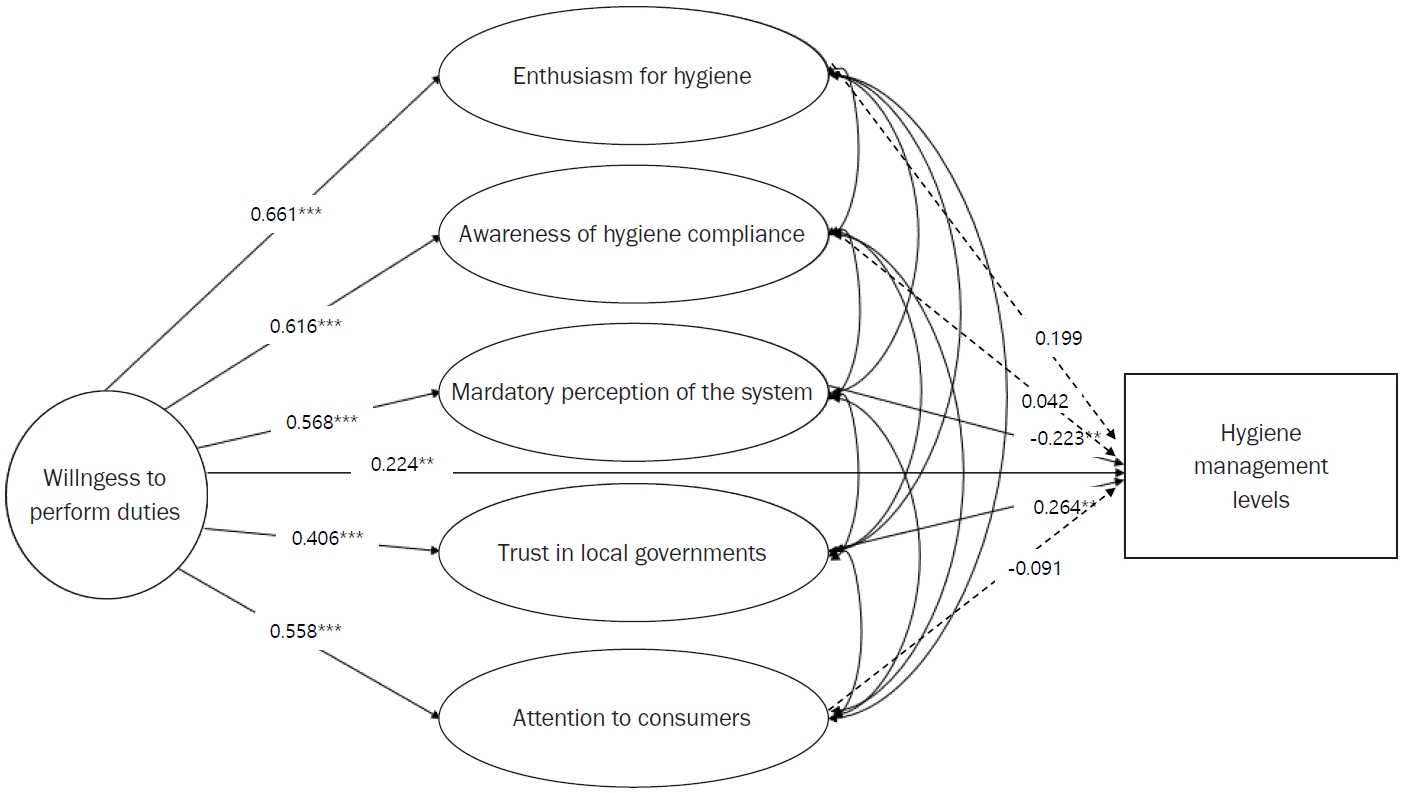
Managers’ willingness to perform duties had a positive influence on hygiene management level (0.224), enthusiasm for hygiene (0.661), awareness of hygiene compliance (0.616), mandatory perception of the system (0.568), trust in local governments (0.406), and attention to consumers (0.558). In the relationship between managers’ willingness to perform duties and hygiene management level, mandatory perception of the system had a negative mediating effect (–0.223), while trust in local governments had a positive mediating effect (0.264).
Conclusion
Structural equation modeling was used to identify the complex pathways by which foodservice establishment managers’ willingness to perform duties, mediated by their human factors, influences their hygiene management level. Accordingly, policy implications were presented, suggesting that the hygiene management level of foodservice establishments could be enhanced by increasing managers’ willingness to perform their duties, and that a shift from mandatory regulations by local governments to support-oriented systems that foster trust in local governments is necessary.
- 1,567 View
- 104 Download

- [Korean]
- Analysis of Awareness, Knowledge, and Behavior about Food Hygiene·Safety Among the elderly
- Mi Sook Lee, Sim-Yeol Lee
- Korean J Community Nutr 2021;26(3):200-210. Published online June 30, 2021
- DOI: https://doi.org/10.5720/kjcn.2021.26.3.200
-
Abstract
PDF
- Objectives
This study was conducted to investigate the awareness, knowledge, and behavior about food hygiene·safety among the elderly, and to provide basic data on this for their healthy dietary life.
Methods
The study was conducted through a survey using a self-administered questionnaire on 473 elderly people over 60 years old living in Seoul and Gyeonggido. The questionnaire was designed to examine general characteristics, meal preparation status, the relation between awareness, knowledge, food hygiene behavior, and safety.
Results
Among the particpants, 44.2% of the total people surveyed were elderly married couples, and 14.0% were single-person households. For men, most of the meals were prepared by the spouse (74.1%), and among women, 93.8% prepared their meals themselves (P < 0.001). 61.3% of the total subjects answered that they were very interested in food hygiene and safety. Men (32.4%) thought it was more difficult to collect food hygiene·safety information compared to women (14.0%, P < 0.001). The knowledge score about food hygiene·safety was 0.60 (P < 0.05) and the behavior score was 3.70 (P < 0.001). The correlation coefficient between knowledge and behavior according to food hygiene·safety was 0.371 (P < 0.001).
Conclusions
The food hygiene·safety behavior of the elderly was associated with knowledge (P < 0.001). Therefore, food hygiene·safety education is necessary to ensure information availability and promote the health of the elderly. -
Citations
Citations to this article as recorded by
- Nutritional vulnerability and its associated characteristics among the elderly in Seoul: analysis of data from the Seoul food survey 2024
Misung Lee, Youngmin Nam, Hye-Jong Yoo, Jihyun Yoon
Frontiers in Nutrition.2026;[Epub] CrossRef - Comparison of dietary behaviors and nutrient intake by gender and household type among older Koreans: a cross-sectional study using data from the 8th Korea National Health and Nutrition Examination Survey
Dana Park, Soo-Kyung Lee
Korean Journal of Community Nutrition.2026; 31(1): 87. CrossRef - Understanding the Impact of Food Safety Knowledge on Food Label Checking Behavior : The Mediating Role of Interest in Food Safety
DongYoung Kim, HeeSun Park, Sunny Ham
Journal of the East Asian Society of Dietary Life.2025; 35(3): 171. CrossRef
- Nutritional vulnerability and its associated characteristics among the elderly in Seoul: analysis of data from the Seoul food survey 2024
- 1,647 View
- 39 Download
- 3 Crossref
Original Articles
- [English]
- Study on Hygiene Knowledge and Recognition on Job Performance Levels for HACCP Application for Employees at Contract Foodservices
- Hye Kyung Moon, Jam Ok Hwang
- Korean J Community Nutr 2003;8(1):71-82. Published online February 28, 2003
-
Abstract
PDF
- In this study, hygiene knowledge and recognition on job performance levels of foodservice employees at different degrees of HACCP application had been compared. As for the comparison of hygiene knowledge for HACCP application, foodservice employees at "Appointed" showed significantly higher HACCP knowledge (p < 0.01). As for recognition on job performance levels, this status also assured the significant difference between the comparison groups (p < 0.01): "Appointed" showed the highest point of 4.24 while "Voluntary applying" and "Non-applying" showed 3.39 and 2.53 respectively. The "Appointed" group showed the well performance of most of the surveyed items. "Voluntary applying" group showed unsatisfactory performance in various log recordings and some part of surveyed items. As for "Non-applying", many items were performed under the average score as they do not apply HACCP.
- 517 View
- 0 Download
- [English]
- A Glance at the Health Status and Food Intake of North Koreans
- young sook Park, Kee Choon Rhee, Ki Young Lee, Eun Young Rhee, Soon Hyung Yi, Dea Nyun Kim, youn Shil Choi
- Korean J Community Nutr 1997;2(3):396-405. Published online August 31, 1997
-
Abstract
PDF
- We performed this study to understand the health status and food intake of North Koreans. Information was collected by individual closed in-depth interviews of 11 escapers from North Korea as well as books, newspapers and North Korean movies. Interviews were done from October, 1996 to May, 1997, covering their heights and weights, their appearance and disease, food system and intake of various main/side foods, concern about health and hygiene. North Korean's height and BMI were lower than those of South Koreans. Difference of BMIs between North and South Koreans was profound in middle aged women than in other age groups. Childrem showed many malnutrition appearances of moon face, large abdomem, arrow-like legs, flaky skin, decolored hair, etc.. Main foods in North Korea were rice-shaped corn, corn flour, wheat flour and wet noodle, and side foods were kimchi and/or soups and steamed soy paste. Food supply system there seemed not to work normally for many years, so foods, especially in cities, has been extremely short in government-operating shops, but some in private market. Many housewives were eager to make and sell simple snack food products, We noticed that North korea schools didn't check students' health even though their medical policy was based on preventive medicine. Their living environmental hygiene was shown to be oyt of control.
- 699 View
- 1 Download
 First
First Prev
Prev


