
 KSCN
KSCN
Search
- Page Path
- HOME > Search
Research Articles
- [Korean]
- Association between mukbang and cookbang watching and obesity in Korean adolescents: a cross-sectional study
- Ji-Hye Jung, Yeon-Oh Han
- Korean J Community Nutr 2026;31(4):339-347. Published online August 31, 2026
- DOI: https://doi.org/10.5720/kjcn.2026.00171
-
 Abstract
 PDF
PDF - Objectives
In this study, the association between the frequency of watching mukbang/ cookbang (online eating and cooking broadcasts) and obesity in Korean adolescents was investigated using data from the 21st (2025) Korea Youth Risk Behavior Web-based Survey.
Methods
The subjects were 52,624 middle- and high-school students, who were classified based on watching frequency as follows: non-watchers, monthly watchers, and weekly watchers (≥ 1 time/week). Changes in the dietary behavior of the watchers (n = 34,375) were assessed. Obesity was defined as a sex- and age-specific body mass index ≥ 95th percentile as per the 2017 Korean Children and Adolescents Growth Standard. Complex sample multiple logistic regression was used to calculate the adjusted odds ratios (aORs) and 95% confidence intervals (CIs), controlling for sociodemographic, health-related, and dietary covariates. Sex-stratified analyses and P for trend tests were also conducted.
Results
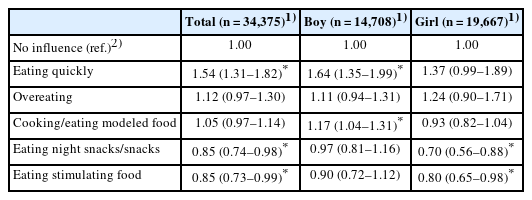
Overall, 65.3% of students watched mukbang/cookbang in the past year. The weekly watchers had significantly higher odds of obesity than the non-watchers (aOR = 1.09, 95% CI: 1.02–1.16; P for trend = 0.011). Sex-stratified analyses showed a positive association in boys (aOR = 1.20, 95% CI: 1.11–1.30), but an inverse association in girls (aOR = 0.86, 95% CI: 0.77–0.97). Among the watchers, the “eating quickly” group had the highest odds for obesity (aOR = 1.54, 95% CI: 1.31–1.82), whereas the “eating night snacks/ snacks” (aOR = 0.85, 95% CI: 0.74–0.98) and “eating spicy or highly flavored foods” (aOR = 0.85, 95% CI: 0.73–0.99) groups were associated with lower odds of obesity.
Conclusion
Regular mukbang/cookbang viewing was significantly associated with adolescent obesity. A media-induced “fast eating rate” was identified as a potential behavioral pathway linked to higher obesity risk, suggesting that adolescent obesity prevention programs should incorporate media literacy and behavioral interventions that promote slower eating.
- 168 View
- 8 Download

- [Korean]
- Health behaviors and eating habits in people’s 20s and 30s according to food content usage level on social media: a cross-sectional study
- Seo-Yeon Bang, Bok-Mi Jung
- Korean J Community Nutr 2023;28(5):392-403. Published online October 31, 2023
- DOI: https://doi.org/10.5720/kjcn.2023.28.5.392
-
Abstract
PDF
- Objectives
This study was intended to investigate adults’ health behaviors and eating habits according to their levels of social media use.
Methods
From May 27 to July 11, 2022, an online survey was conducted of 452 male and female social media users in their 20s and 30s, and their eating habits and health behaviors were compared and analyzed according to their degree of social media use. For each of the three levels of food content use, the frequency of social media content use, and the total score range of average social media viewing time per day were divided into three parts, and a group with a score of less than 2 points was classified as low-use; a group with a score of 2 or more and less than 3 points was classified as middle-use; and a group with a score of 3 points or more was classified as high-use.
Results
The use of food content was higher in women than in men (P < 0.001), and higher in those in their 20s than in those in their 30s (P < 0.001). The group with a high level of food content use showed a higher rate of post-use hunger than the group with a low level (P < 0.01). The experience of eating after using food content was also higher in the group with a high level of use than in the group with a low level of use (P < 0.001). The group with a normal or high level of food content use had more negative eating habits than the group with a low level.
Conclusions
The study highlighted the need to provide desirable food content to people in their 20s and 30s with negative eating habits and to promote them so that they can use the right healthy nutrition–related content. -
Citations
Citations to this article as recorded by
- Eating Habits and Health Behaviors According to Long-Form and Short-Form Mukbang Viewing of Adults in Their 20s and 30s
Seogyong Go, Bok-Mi Jung, Yun-Jung Bae, Mi-Kyeong Choi
Journal of the East Asian Society of Dietary Life.2025; 35(6): 597. CrossRef - The relationship between smartphone usage and eating behavior for elementary school students in Gangneung, South Korea: cross-sectional study
Minji Kim, Meera Jang
Korean Journal of Community Nutrition.2024; 29(4): 278. CrossRef
- Eating Habits and Health Behaviors According to Long-Form and Short-Form Mukbang Viewing of Adults in Their 20s and 30s
- 6,184 View
- 181 Download
- 2 Crossref
 First
First Prev
Prev


