
 KSCN
KSCN
Search
- Page Path
- HOME > Search
Reviews
- [English]
- Nutritional strategies to promote healthy life expectancy of Korean older adults based on their nutritional status and current nutrition programs: a narrative review
- SuJin Song
- Korean J Community Nutr 2026;31(4):297-308. Published online August 31, 2026
- DOI: https://doi.org/10.5720/kjcn.2026.00283
-
 Abstract
 PDF
PDF - Objectives
Korea has entered a super-aged society, resulting in a growing socioeconomic burden and rapidly increasing demand for home- and community-based nutrition services. This review aimed to examine the nutritional health status of Korean older adults and the existing nutrition programs, along with suggesting effective nutritional strategies to improve their healthy life expectancy.
Methods
This narrative review was conducted by collecting and synthesizing domestic and international literature, including journal articles, books, government documents, national health statistics, and reports on foreign nutrition programs. The literature was collected through scholarly databases and institutional websites searches using relevant keywords.
Results
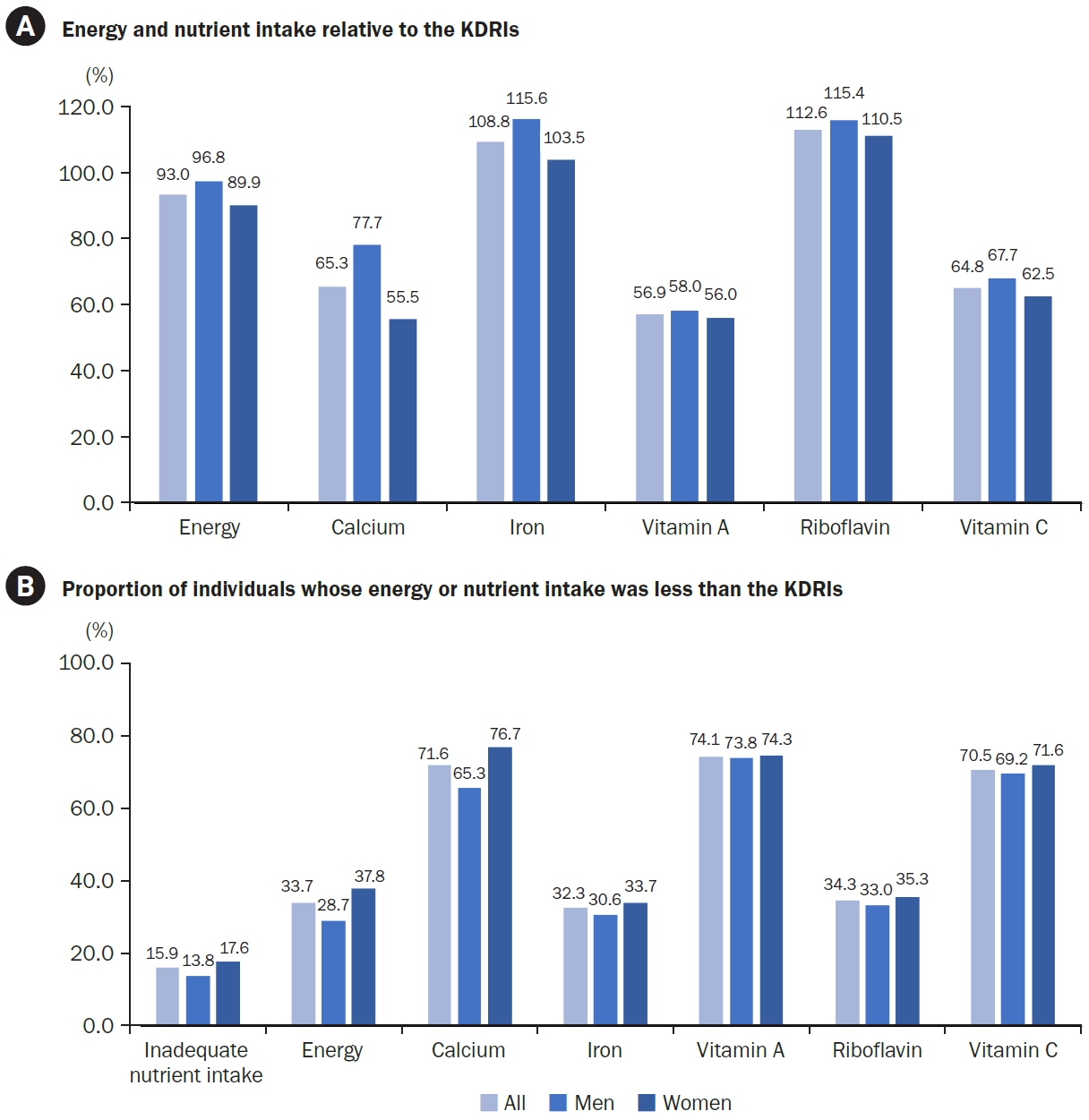
The synthesized results indicate that Korean older adults have insufficient intakes of essential nutrients, such as calcium, vitamin A, and vitamin C, alongside a high prevalence of multimorbidity and associated polypharmacy. Existing community-based nutrition programs provide meal services, home-delivered meals/side dishes, and nutrition education/counseling to vulnerable older populations. Additionally, the Center for Social Welfare Foodservice Management contributes to overseeing nutrition and hygiene management in small-scale elderly foodservice facilities. However, more effective nutritional strategies are required to achieve fully integrated community care. First, homebased nutrition care services for community-dwelling older adults should be introduced to enable tailored nutritional management. Second, expanding and strengthening the role of the Center for Social Welfare Foodservice Management may facilitate efficient management of meals across elderly foodservice facilities. Third, specialized education and training programs are required to enhance the professional competency of dietitians delivering these services. Furthermore, robust legal, institutional, and budgetary foundations, improved working conditions and job security for dietitians, and heightened public awareness of nutrition services are needed.
Conclusion
Implementing these strategies may prevent functional decline and disease aggravation, and ultimately reduce the socioeconomic costs associated with medical treatment, nursing, and long-term care of older adults.
- 183 View
- 7 Download

- [English]
- The transition of nutritional status in infants, young children, and school-aged children in Korea and future-oriented nutritional strategies: a narrative review
- Yoonna Lee
- Korean J Community Nutr 2026;31(2):115-126. Published online April 30, 2026
- DOI: https://doi.org/10.5720/kjcn.2026.00115
-
Abstract
PDF
- Objectives
This study examined the secular trends in anthropometric changes and the nutritional transition among Korean infants and school-aged children, while evaluating the efficacy and constraints of existing state-led nutritional policies. Ultimately, it proposes a “systems-centered” nutrition strategy, aligned with the United Nations Children’s Fund (UNICEF) Nutrition Strategy 2020–2030, to ensure health equity for future generations.
Methods
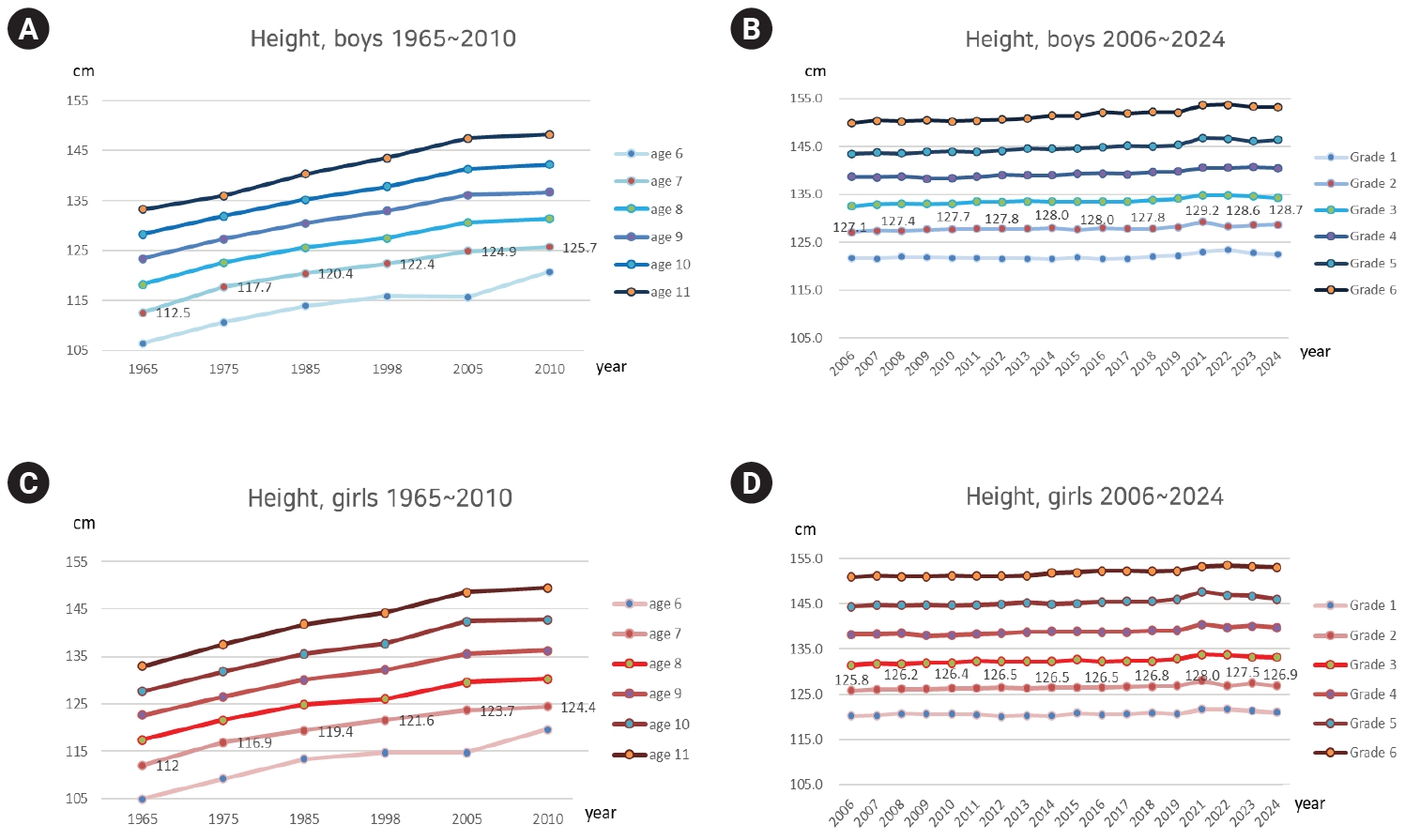
We reexamined comprehensive national health statistics, including school health examination data (1965–2024) and the Korea National Health and Nutrition Examination Survey (1998–2023). Additionally, Dietary Screening Test results from 126,768 young children (2021–2024) were reviewed. These quantitative findings were synthesized through a narrative review of South Korean pediatric nutrition policies and UNICEF’s global strategic frameworks.
Results
While Korean children have historically experienced rapid secular growth, this has decelerated in the 2000s. Conversely, the prevalence of obesity has surged along with stagnant underweight rates. Dietary problems such as insufficient vegetable intake and frequent consumption of sweet snacks were also found, accelerating the “triple burden” of malnutrition. Policies such as school lunches, NutriPlus program, and Center for Children’s Foodservice Management have demonstrated great success in reducing nutritional risks and improving dietary habits. However, existing fragmented programs face limitations in comprehensively addressing regional disparities or blind spots and in providing tailored nutritional management.
Conclusion
A paradigm shift is imperative to fundamentally resolve these multidimensional nutritional crises. Moving beyond fragmented programs, we need to adopt a “systems- centered” approach integrating health, education, and welfare ecosystems. Key policy recommendations include establishing a continuous life-cycle health database, introducing artificial intelligence and FoodTech-driven precision nutrition coaching, and fostering a healthy food environment through public-private partnerships within a community integrated care network.
- 927 View
- 36 Download
Research Articles
- [Korean]
- Food purchase patterns, food policy recognition, and food environment satisfaction among adults in Jeju, Korea, according to food security: a cross-sectional study
- Sumin Kim, Youjeong Jang, Hyunji Ham, Hanbin Ko, Insuk Chai, Kyungho Ha
- Korean J Community Nutr 2024;29(5):406-417. Published online October 31, 2024
- DOI: https://doi.org/10.5720/kjcn.2024.00012
-
Abstract
PDF
 Supplementary Material
 - Objectives
Recently, food insecurity has been a major public health issue along with the food crisis caused by COVID-19, climate change, and the polarization of food supply due to socioeconomic disparities. Food insecurity is known to be related to the food choices and environment of the consumer. Therefore, this study aimed to evaluate the food security statuses of adults in Jeju and investigate their food purchase patterns, food policy recognition, and food environment satisfaction.
Methods
Based on data from the 2022 Jeju Food Survey, 346 adults aged ≥19 years in Jeju were classified into food security and insecurity groups (quantitatively and qualitatively) using the questionnaire. Food purchase patterns, including purchasing frequency, items, and reasons, were surveyed for local and eco-friendly foods. The recognition and necessity of several food policies and satisfaction with diet and food environment (availability, accessibility, affordability, accommodation, and acceptability) were measured using the Likert scale.
Results
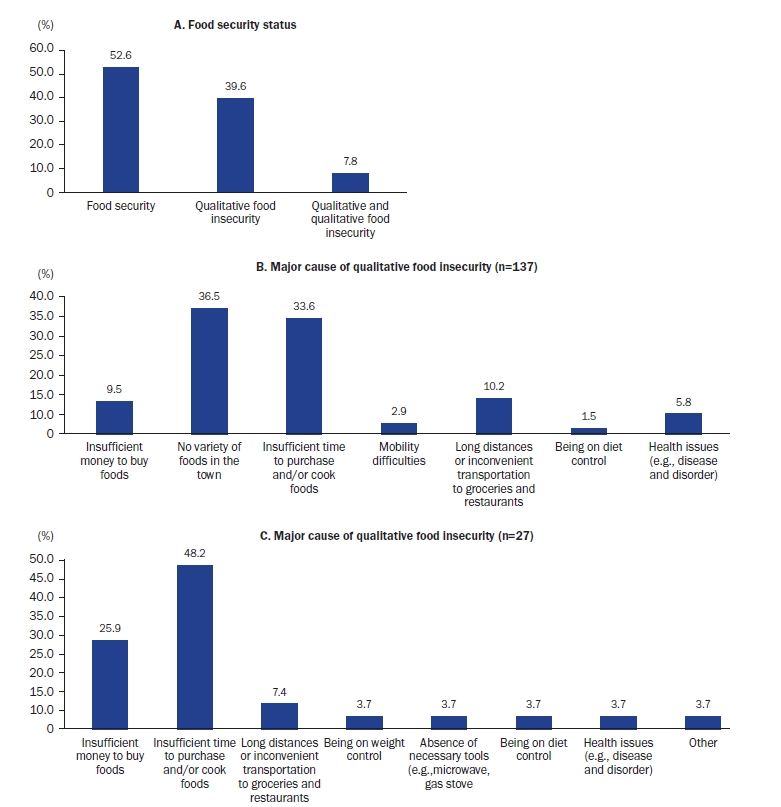
Among the total participants, 47.4% were in the food insecurity group. The frequency of purchasing local and eco-friendly foods did not significantly differ by food security status. The insecurity group exhibited a higher recognition rate of basic rights to food (36.0%) than the security group (24.7%, P = 0.023). The recognition and necessity of specific food policies did not significantly differ by food security status, except for the policy of promoting food communities, for which the food security group exhibited higher recognition than the food insecurity group did (P = 0.004). The food insecurity group exhibited significantly lower scores regarding satisfaction toward diet and food environment factors (P < 0.05 for all).
Conclusions
Overall, the food security group reported higher satisfaction with their diet and food environment than the food insecurity group. Further in-depth studies to investigate the determinants of food insecurity and effective promotional strategies for food policies are needed.
- 3,202 View
- 63 Download
- [Korean]
- The needs and prioritization of nutrition and dietary support for individuals with disabilities: an exploratory study
- Jong Eun Park, Yu Jin Kim, So Young Kim, Jong Hyock Park
- Korean J Community Nutr 2024;29(5):431-443. Published online October 31, 2024
- DOI: https://doi.org/10.5720/kjcn.2024.00009
-
Abstract
PDF
- Objectives
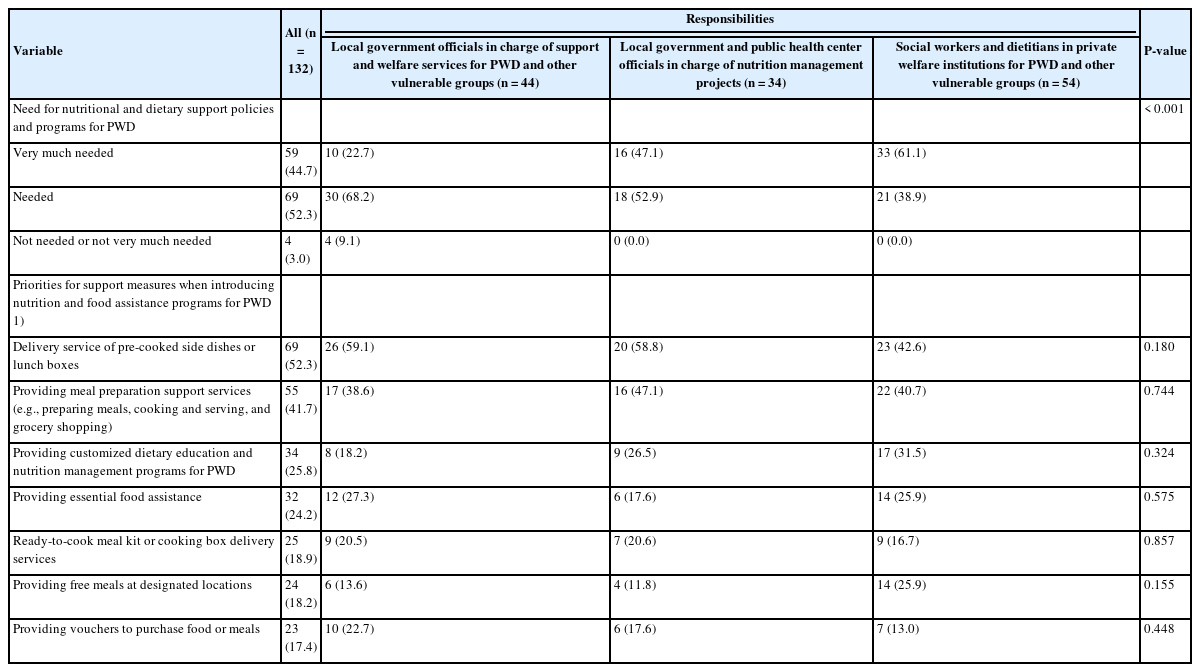
Based on a survey of officers, social workers, and dietitians involved in managing nutrition and welfare policies or projects for vulnerable groups in local governments or private welfare institutions, this study aimed to assess the need for nutritional and dietary support policies and programs for persons with disabilities (PWD), as well as to identify appropriate support measures. Methods: An online survey was conducted from March 2 to 15, 2021. The survey included 20 questions exploring perspectives on the nutritional status of PWD, their need for nutritional and dietary support policies and programs, and the prioritization of appropriate support measures. A total of 132 responses were analyzed. Results: Approximately 68.9% of the respondents rated the nutritional status of PWD as “bad” or “very bad.” A substantial number identified “difficulty in purchasing ingredients, cooking, and preparing meals independently due to disability,” and “limited knowledge about nutrition and recipes necessary for maintaining a healthy and balanced diet” as the primary challenges in the dietary and nutritional management of this population. Additionally, 97.0% of the respondents deemed that the introduction of nutritional and dietary support policies and programs for PWD was “needed” or “very much needed.” Priority strategies to implement and strengthen these policies and systems included the “development of customized programs and services tailored to the needs and demands of the target population” and the “establishment of a dedicated department with specialized personnel.” Conclusion: Comprehensive nutritional and dietary support policies and programs should be actively implemented to ensure a healthy and stable diet for PWD, tailored to meet their actual needs and demands. -
Citations
Citations to this article as recorded by
- Research trends in dietary behaviors and nutrition education among individuals with developmental disabilities in Korea: a scoping review (2015–2025)
Nakyung Kwak, Wonyeong Park, Yu-Ri Kim, Jieun Oh
Korean Journal of Community Nutrition.2026; 31(1): 1. CrossRef - Development of a standard nutrition management model algorithm for personalized care in social welfare facilities for the disabled
Su-Jin Lee, Ji-Won Kang, Sil Ah Kim, Kirang Kim, Sohyun Park, Jieun Oh, Hyunjoo Ryou, Ji-Yun Hwang
Journal of Nutrition and Health.2025; 58(5): 498. CrossRef - Factors associated with nutritional risk among disabled persons in the Republic of Korea: a cross-sectional study using 2020 Disability and Life Dynamics Panel
Seong-Ah Kim, Seul Ki Choi
Korean Journal of Community Nutrition.2025; 30(5): 364. CrossRef
- Research trends in dietary behaviors and nutrition education among individuals with developmental disabilities in Korea: a scoping review (2015–2025)
- 4,105 View
- 152 Download
- 3 Crossref
 First
First Prev
Prev


