
 KSCN
KSCN
Search
- Page Path
- HOME > Search
Research Articles
- [Korean]
- Differences in lunch nutrient intake and nutritional adequacy among Korean older adults by meal site: a cross-sectional analysis of the 2018–2021 Korea National Health and Nutrition Examination Survey data
- Daeun Choi, Sunhee Seo
- Korean J Community Nutr 2026;31(2):205-213. Published online April 30, 2026
- DOI: https://doi.org/10.5720/kjcn.2026.00045
-
 Abstract
 PDF
PDF - Objectives
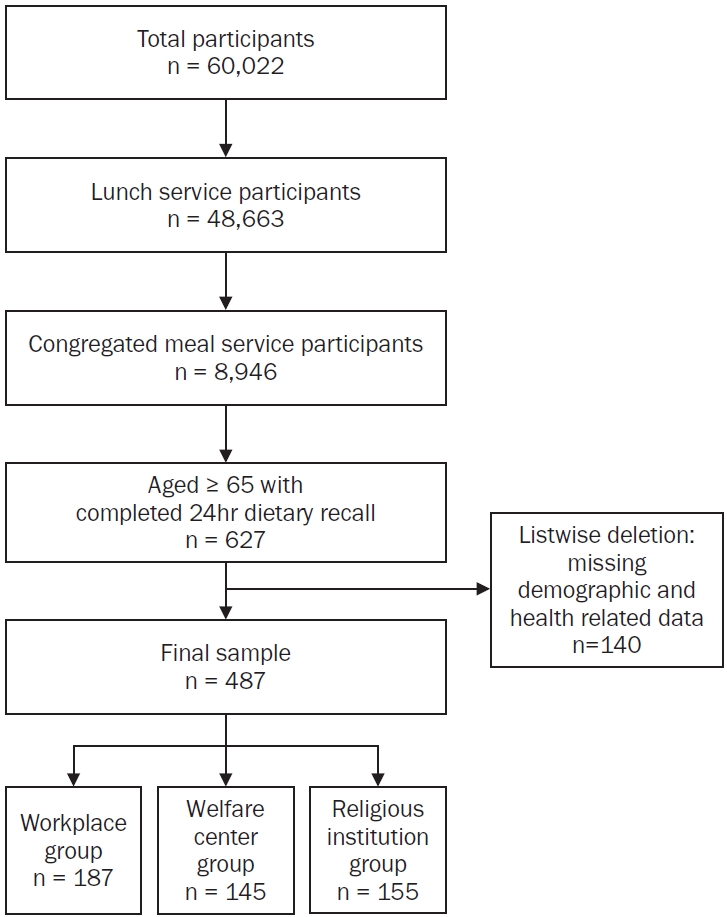
This study aimed to examine whether the dietary quality of congregate lunches differs according to meal location among older adults and to identify meal settings that may represent gaps in nutritional oversight. Specifically, this study compared lunchtime nutrient intake and adequacy among older adults eating at workplaces, welfare centers, and religious institutions.
Methods
Data were obtained from the 2018–2021 Korea National Health and Nutrition Examination Survey. The participants included 487 adults aged ≥ 65 years who reported consuming lunch at institutional meal sites, including workplaces (n = 187), welfare centers (n = 145), and religious institutions (n = 155). Nutrient intakes, nutrient adequacy ratio (NARs), and the mean adequacy ratio were compared using complex-sample general linear models with Bonferroni post-hoc tests, adjusting for sex, age, and total energy intake.
Results
Socioeconomic characteristics were broadly comparable across groups, but nutrient intake and dietary quality differed according to meal location. In food-group analyses, meat intake was lowest among participants eating at religious institutions, and dairy intake also differed significantly across settings. In nutrient adequacy analyses, NAR for carbohydrate, thiamin, and niacin differed significantly by meal location. However, except for carbohydrate, most nutrient-specific NAR remained below 1.0 across all groups, indicating insufficient adequacy relative to one-third of the recommended intake from lunch alone.
Conclusion
The dietary quality of congregate lunches among older adults differed according to meal location. Although nutrient inadequacy was common across settings, older adults eating at religious institutions showed relatively lower adequacy for some nutrients, particularly thiamin and niacin. These findings suggest that nutritional support should be strengthened across congregate meal services, with particular attention to less structured community-based settings such as religious institutions.
- 647 View
- 25 Download

- [Korean]
- A comparative study on nutritional status and diet-related subjective perceptions according to free meal service utilization among older adults living alone in Korea: a cross-sectional study
- Minju Jeong, Dayeon Shin
- Korean J Community Nutr 2026;31(2):165-177. Published online April 30, 2026
- DOI: https://doi.org/10.5720/kjcn.2025.00339
-
Abstract
PDF
- Objectives
To assess whether the use of free meal services is associated with diet quality among older adults living alone in Incheon, Korea, by comparing the Nutrition Quotient for the Elderly (NQ-E), index of nutritional quality (INQ), and mean adequacy ratio (MAR).
Methods
A cross-sectional survey was conducted from March 5 to April 24, 2025 using one-to-one interviews and partially self-administered questionnaires. After excluding cases with missing responses or energy intake of < 500 kcal/day, 119 participants were analyzed (56 men and 63 women). A single 24-hour recall was used to calculate INQ and MAR. NQ-E was evaluated using total and subdomain scores. Group comparisons and sex-stratified multiple linear regression analyses were performed.
Results
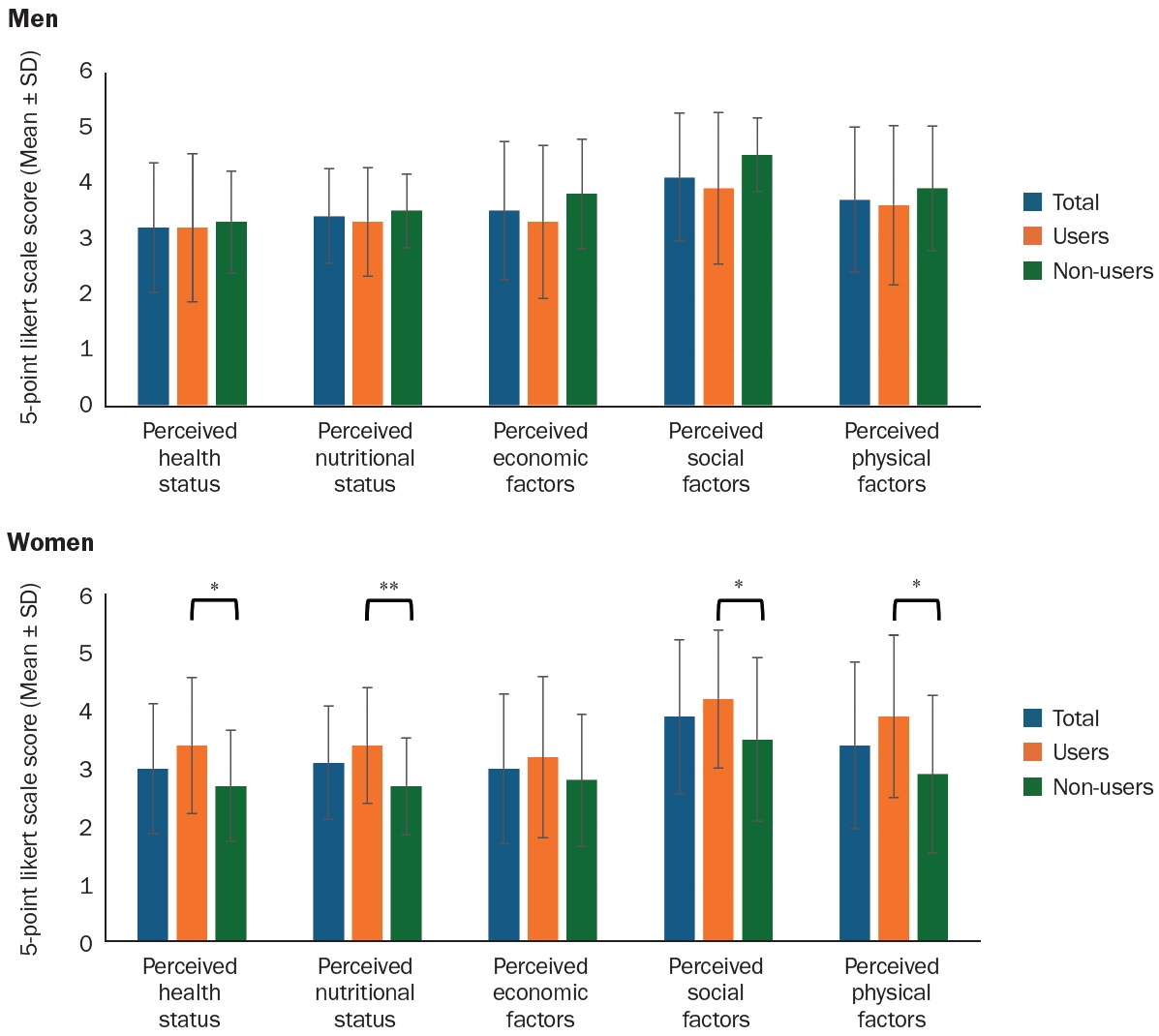
Diet-quality indicators were higher among service users than among non-users. INQ for thiamin and riboflavin was significantly higher in men than in women. Meanwhile, INQ for zinc, vitamin A, riboflavin, and folate was higher in women than in men. In both sexes, MAR was higher among users than among non-users (men: 0.8 ± 0.2 vs. 0.6 ± 0.2; women: 0.7 ± 0.2 vs. 0.5 ± 0.2; P < 0.001 for all). Differences in NQ-E total scores were small. Among women, the practice subdomain score was higher in users than in non-users (66.0 ± 16.4 vs. 55.2 ± 15.5; P = 0.016), and the proportion in upper grades was greater (P = 0.030). Regression analysis showed that service use was negatively associated with NQ-E in men (P = 0.007) and positively associated with MAR in women (P = 0.010).
Conclusion
Use of free meal services was associated with improved diet quality, as reflected by MAR and INQ for specific nutrients, and with higher NQ-E practice scores observed in women than in men. Policies should prioritize food-insecure groups and support sustained participation.
- 953 View
- 46 Download
- [Korean]
- Association between Sarcopenia and Energy and Protein Intakes in Community-dwelling Elderly
- Woori Na, Dayoung Oh, Seohyeon Hwang, Bonghee Chung, Cheongmin Sohn
- Korean J Community Nutr 2022;27(4):286-295. Published online August 31, 2022
- DOI: https://doi.org/10.5720/kjcn.2022.27.4.286
-
Abstract
PDF
- Objectives
Sarcopenia is one of the most representative factors of senescence, and nutritional status is known to affect sarcopenia. This study was performed to analyze the relationships between energy and protein intake and sarcopenia.
Methods
The study subjects were 3,236 individuals aged ≥ 65 that participated in the Korea National Health and Nutrition Examination Survey (KNHANES) 2008 ~ 2011. General characteristics and anthropometric and 24-hour dietary recall data were analyzed. Sarcopenia was diagnosed using a formula based on appendicular skeletal muscle mass (ASM) and body weight. Logistic regression was performed to determine relationships between sarcopenia risk and energy and protein intakes.
Results
For energy intake, the odds ratio (OR) of sarcopenia in women was significantly higher those with the lowest intake [OR = 1.680, 95% confidence interval (CI) = 1.213-2.326] than those with the highest intake (P for trend = 0.001). Regarding protein intake per kg of body weight, the odds ratio of sarcopenia was significantly higher for those that consumed < 0.8 g/kg of protein daily than those that consumed > 1.2g/kg for men (OR = 2.459, 95% CI = 1.481-4.085) and women (OR = 2.178, 95% CI = 1.423-3.334).
Conclusions
This study shows a link between sarcopenia and energy and protein intake levels and suggests that energy and protein consumption be promoted among older adults to prevent sarcopenia. -
Citations
Citations to this article as recorded by
- Relationship Between Electronic Device Usage and Frailty Among Older Adults Living Alone in South Korea: Analysis of the Mediating Effect of Nutrition Management
Kawoun Seo
Healthcare.2026; 14(6): 816. CrossRef - Association between nutrient intake and frailty status in Korean older adults: a cross-sectional study using the 9th (2022–2023) Korea National Health and Nutrition Examination Survey
Hyejin Yu, Sang-Jin Chung
Korean Journal of Community Nutrition.2026; 31(2): 153. CrossRef - Association Between Vitamin D Intake and Sarcopenia in Older Adults in South Korea: The Moderating Role of the Area Deprivation Index
Jong Suk Lee, Seok Hwan Kim
Asia Pacific Journal of Public Health.2026; 38(4): 274. CrossRef - Comparison of energy and protein intake adequacy, dietary habits, and social characteristics associated with sarcopenia in young-old and old-old Korean adults: based on the 2022–2023 Korea National Health and Nutrition Examination Survey
Saetbyeol Chae, Sarang Jeong, Suji Im, Yoon Jung Yang
Journal of Nutrition and Health.2026; 59(3): 260. CrossRef - Association Between Protein Intake and Sarcopenia-Related Indicators Among Korean Older Adults: A Scoping Review
Minjee Han, Kyung-sook Woo, Kirang Kim
Clinical Nutrition Research.2025; 14(3): 216. CrossRef - Nutritional Approaches in Sarcopenia Management
Min-Yu Chung
Journal of the Korean Society of Food Science and Nutrition.2025; 54(7): 565. CrossRef - The Present and Future of Sarcopenia Diagnosis and Exercise Interventions: A Narrative Review
Hongje Jang, Jeonghyeok Song, Jeonghun Kim, Hyeongmin Lee, Hyemin Lee, Hye-yeon Park, Huijin Shin, Yeah-eun Kwon, Yeji Kim, JongEun Yim
Applied Sciences.2025; 15(23): 12760. CrossRef - Design of contents for developing an intervention app for sarcopenia in older adults: A research study using the Delphi technique
Hee Jung Kim, Ju Young Ha
Journal of Korean Gerontological Nursing.2024; 26(4): 370. CrossRef - Association of Protein Intake with Sarcopenia and Related Indicators Among Korean Older Adults: A Systematic Review and Meta-Analysis
Minjee Han, Kyungsook Woo, Kirang Kim
Nutrients.2024; 16(24): 4350. CrossRef - Muscle Mass Changes After Daily Consumption of Protein Mix Supplemented With Vitamin D in Adults Over 50 Years of Age: Subgroup Analysis According to the Serum 25(OH)D Levels of a Randomized Controlled Trial
Yeji Kang, Namhee Kim, Yunhwan Lee, Xiangxue An, Yoon-Sok Chung, Yoo Kyoung Park
Clinical Nutrition Research.2023; 12(3): 184. CrossRef
- Relationship Between Electronic Device Usage and Frailty Among Older Adults Living Alone in South Korea: Analysis of the Mediating Effect of Nutrition Management
- 5,011 View
- 91 Download
- 10 Crossref
- [Korean]
- Nutritional Status according to the Frailty Status of the Elderly at Home in Seo-gu, Gwangju, Korea
- Ye Eun Kim, Young-Ran Heo
- Korean J Community Nutr 2021;26(5):382-395. Published online October 31, 2021
- DOI: https://doi.org/10.5720/kjcn.2021.26.5.382
-
Abstract
PDF
- Objectives
This study examined the nutritional status according to frailty status in the elderly at home. Methods: The participants were a total of 76 elderly at home living in Seo-gu, Gwangju, Korea. The nutritional status and frailty status were analyzed using the Nutrition Quotient for Elderly (NQ-E) and the Korean version of the Fatigue, Resistance, Ambulation, Illnesses and Loss of weight Scale (K-FRAIL), respectively. Results: The distribution of frailty status was robust (17.1%), pre-frailty (38.2%) and frailty (44.7%), and its distribution was significantly different in genders, age groups and the number of medications. The mean NQ-E score was 47.0 for total subjects, indicating a low grade. The scores of balance, diversity and dietary behavior factors were within the low grade, while the score of the moderation factor was within the medium-high grade. According to the frailty status, pre-frailty and frailty showed significantly higher scores for sugar-added beverages intake in the moderation constructs than robust. Robust showed significantly higher scores for the exercise hours and perception level for one’s health than pre-frailty and frailty. Conclusions: These results suggest that nutrition status is associated with frailty status. Regular nutrition education and visiting nutrition service should be established to improve the balance and diversity of food intake and improve the dietary behavior of the elderly at home. -
Citations
Citations to this article as recorded by- The Dietary Status among Mild Dementia Elderly Using the Nutrition Quotient for Elderly (NQ-E) in Daegu
Hyun-Kyoung Bang, Mi-Ok Kim
Journal of the East Asian Society of Dietary Life.2023; 33(4): 343. CrossRef - Evaluation of dietary quality using elderly nutrition quotient depending on the consumption of healthy functional foods
Jieun Lee, Hyo-Jeong Hwang, Hye-Young Kim, Jung-Sug Lee
Journal of Nutrition and Health.2023; 56(5): 483. CrossRef
- The Dietary Status among Mild Dementia Elderly Using the Nutrition Quotient for Elderly (NQ-E) in Daegu
- 2,001 View
- 24 Download
- 2 Crossref
Original Articles
- [English]
- Nutritional Assessment and Management in Long-term Care Insurance's Home Visit Care Service
- Mi Ock Yoon, Hyun Kyung Moon, Seo Yeon Kim, Bok Hee Kim
- Korean J Community Nutr 2013;18(2):142-153. Published online April 30, 2013
- DOI: https://doi.org/10.5720/kjcn.2013.18.2.142
-
Abstract
PDF
- The purpose of the study was to examine nutritional management and nutritional care demands of home-visit care service and the nutritional status of serviced elderly. The survey was carried out from 5th to 21st of January, 2011 among 37 In-Home Service institutions. The number of elderly surveyed by 143 care helpers was 281. Analysis was performed for 203 subjects (male: 44, female: 159). The age distribution was from 50 to 99 years. The grading by long-term care insuranceshowed 18,2% on level 1 and 2, and 81.8% on level 3. For the disease treatment, the proportion of implementing diet treatment turned out to be very low. The proportion of subjects living with their children was 45.3%, and living alone was 29.1%. The proportion of home-visit care among types of In-Home Service was 70%. Subjects who needed additional necessary diet management service turned out to be 40.9%. Diet management was the most necessary services from all levels. MNA (specifiy MNA) scores were significantly (p < 0.001) associated with BMI, mid-arm circumference (MAC), calf circumference (CC), intake problems, and weight loss during the last 3 months. For studied elderly, 45.3% were malnourished, and 46.8% were at the risk of malnutrition by MNA score. Based on the result of this survey, the nutritional care was not systematic on the In-Home Service. Prevention and management of the disease was much better than the treatment to improve the quality of life. We conclude that nutrition management is necessary for the elderly. To improve nutritional status of elderly in home care services, systematic nutrition management should be implemented.
-
Citations
Citations to this article as recorded by- Factors associated with malnutrition in demented and non-demented elderly residing in the community of Korea: a cross-sectional descriptive and analytical study
Jinhee Kwon, Jung Hee Kim, Hyeonjin Jeong, Jung Suk Lee
Korean Journal of Community Nutrition.2024; 29(5): 359. CrossRef - The Factors Affecting Frailty among the Elderly in Korea: A Study Using the Frailty Cohort
DaSol Park, Hee-Sun Kim
International Journal of Environmental Research and Public Health.2022; 20(1): 670. CrossRef - Current Status of Sanitary and Nutritional Food Service in Elderly Day Care Center
Jeonghyeon Woo, Yoo Kyoung Park, Mi-Hyun Kim, Soo-Kyung Lee, Kyunghee Song, Hye-Kyeong Kim
Korean Journal of Community Nutrition.2020; 25(5): 374. CrossRef - Feasibility Study on the Dietary Improvement Program Development for Senior Citizens
Sung-Hee Kim, Boram Kim, Nami Joo
Korean Journal of Community Nutrition.2017; 22(3): 218. CrossRef - Job importance, job performance, and job satisfaction in dietitians at geriatric hospitals or elderly healthcare facilities in Jeju
Hye-Sook Kang, Yunkyoung Lee, In-Sook Chae
Journal of Nutrition and Health.2016; 49(3): 189. CrossRef - Comparison of Health Status and Mini Nutritional Assessment according to Self-esteem of Elderly in Care Hospital
Eun-mi Kim, Jin Kwon
Journal of the East Asian Society of Dietary Life.2015; 25(4): 631. CrossRef - Relationship between Sense of Belonging, Powerlessness and Nutritional status of Elderly People
Mi-Hye Kim, Hae-Kyung Chung
Journal of The Korean Society of Food Culture.2015; 30(1): 118. CrossRef - Nutrition Status of Elderly Female Patients in Long-term Care Hospital according to Meal Types and Eating Ability
Hyejin Ahn, Juhee Kang, Hongmie Lee
Korean Journal of Community Nutrition.2014; 19(2): 187. CrossRef
- Factors associated with malnutrition in demented and non-demented elderly residing in the community of Korea: a cross-sectional descriptive and analytical study
- 2,141 View
- 5 Download
- 8 Crossref
- [English]
- Nutritional Status of Hospitalized Geriatric Patients Using by the Mini Nutritional Assessment
- Su Hyun Chung, Cheong Min Sohn
- Korean J Community Nutr 2005;10(5):645-653. Published online October 31, 2005
-
Abstract
PDF
- The prevalence of undernutrition in hospital populations is known to be high. The presence of malnutrition is associated with depression, infections, sarcopaenia, falls, fractures, reduced autonomy and increased mortality. This study specifically examined the prevalence of malnutrition in patients aged 65 or older at the time of admission as determined by the Mini Nutritional Assessment (MNA) which has been a frequently used nutritional risk screening tools in detecting undernutrition in old people. This study was done for one hundred eight hospitalized geriatric patients in Seoul National University Bundang Hospital, Seoul, Korea. On admission baseline history, anthropometrics measurements, laboratory data and nutritional status by MNA were assessed. Length of hospital stay was obtained by reviewing medical charts. We used one-way analysis of variance to compare the differences in variables. Spearman's rank correlation coefficients were calculated for associations between MNA and variables. On admission, 22.3% of patients were malnourished and 40.7% were at risk of malnutrition according to the MNA. Percent of ideal body weight, anthropometrics data, albumin, and hemoglobin were lower in the malnourished patients (p < 0.05). The malnourished patients stayed in the hospital 7.3 days longer, as compared with well nourished patients (p < 0.05). Percent of ideal body weight, albumin, hemoglobin and total cholesterol were correlated inversely with nutritional status according to MNA (p < 0.05). MNA can be used for nutritional assessment in Korean old people, because MNA significantly correlated with other nutritional assessment parameters, such as, anthropometric and laboratory data in hospitalized geriatric patients. The high prevalence of malnutrition in the elderly was observed and the presence of malnutrition on admission predicted a significant increase in the length of hospital stay in this study. Therefore further studies are needed to determine whether nutritional interventions in old people with low MNA scores can improve clinical outcomes during the hospital course.
- 531 View
- 2 Download
 First
First Prev
Prev


