
 KSCN
KSCN
Search
- Page Path
- HOME > Search
Research Articles
- [English]
- Impact of a foodservice establishment manager’s willingness to perform duties on hygiene management levels and the mediating effects of extrinsic motivations: a cross-sectional study
- Tae Yang Kim, Mi Young Lee, Young Eun Lee
- Korean J Community Nutr 2026;31(1):36-49. Published online February 28, 2026
- DOI: https://doi.org/10.5720/kjcn.2025.00332
-
 Abstract
 PDF
PDF - Objectives
Consumer demand is growing for more rigorous hygiene management within foodservice establishments. The aim of this study was to provide customized data specific to each foodservice establishment, thereby informing policy formulation to improve hygiene management levels.
Methods
We surveyed 310 managers of directly managed foodservice establishments (excluding franchises) that were subject to hygiene inspections by the Chungbuk Provincial Office in Korea between September 1 and 27, 2023. Additionally, 30 investigators trained in methods for evaluating the hygiene management levels of foodservice establishments objectively assessed 310 establishments using evaluation sheets. All 310 managers provided consent and personally completed the questionnaires. Data from 277 managers were included in the analysis. General characteristics were analyzed with descriptive statistics in IBM SPSS Statistics 28 (IBM Corp.). Univariate normality verification, measurement model verification, structural model verification, and mediation effect significance analysis were conducted using R’s lavaan package (version 4.3.2.).
Results
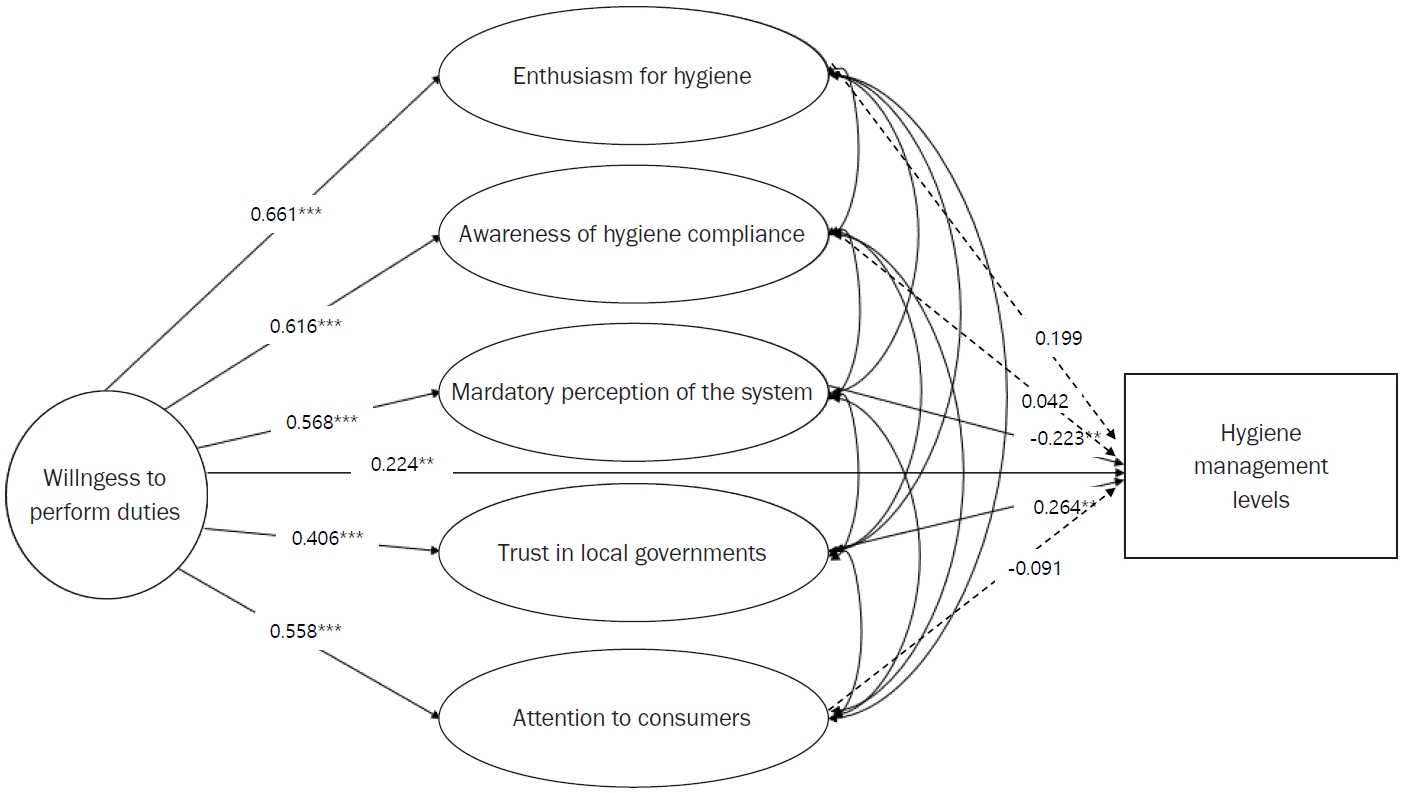
Managers’ willingness to perform duties had a positive influence on hygiene management level (0.224), enthusiasm for hygiene (0.661), awareness of hygiene compliance (0.616), mandatory perception of the system (0.568), trust in local governments (0.406), and attention to consumers (0.558). In the relationship between managers’ willingness to perform duties and hygiene management level, mandatory perception of the system had a negative mediating effect (–0.223), while trust in local governments had a positive mediating effect (0.264).
Conclusion
Structural equation modeling was used to identify the complex pathways by which foodservice establishment managers’ willingness to perform duties, mediated by their human factors, influences their hygiene management level. Accordingly, policy implications were presented, suggesting that the hygiene management level of foodservice establishments could be enhanced by increasing managers’ willingness to perform their duties, and that a shift from mandatory regulations by local governments to support-oriented systems that foster trust in local governments is necessary.
- 1,567 View
- 104 Download

- [Korean]
- Association between health financial capacity of local governments and health behaviors of local residents: a cross-sectional study
- Miyong Yon
- Korean J Community Nutr 2023;28(2):95-103. Published online April 30, 2023
- DOI: https://doi.org/10.5720/kjcn.2023.28.2.95
-
Abstract
PDF
- Objectives
The budget gap in the health sector of local governments affects the supply of health services, which can cause the health gap. This study classified local governments according to their financial characteristics, such as local financial independence and health budget level. It analyzed the health behaviors and disease prevalence of local residents to examine the effect of local government financial investment on the health of local residents.
Methods
To classify types according to the financial characteristics of local governments, financial independence and the health budget data for 17 local governments were collected from the local fiscal yearbook of the Ministry of Public Administration and Security. The prevalence of chronic diseases and healthy behavior was compared using the 16,333 data of adults between the ages of 30 and 65 years among the original data of the National Health and Nutrition Examination Survey (2016–2020).
Results
Cluster analysis was used to classify local governments into five clusters according to the health financial capacity type. A comparison of the prevalence of local residents by cluster revealed a similar prevalence of hypertension, diabetes, and hypercholesterolemia. On the other hand, the obesity rate (P < 0.01), high-risk drinking rate (P < 0.01), aerobic physical activity rate (P < 0.001), and healthy eating practice rate (P < 0.001) were significantly different. In addition, an analysis of the odds ratio based on the Seoul area revealed a higher risk of health behavior of non-Seoul residents.
Conclusions
It is necessary to review the universal health promotion project budget considering the degree of regional financial vulnerability from the viewpoint of health equity to narrow the health gap among regions. -
Citations
Citations to this article as recorded by
- Regional differences in health status and its associations with health behaviors and healthcare utilization among older adults in the context of the COVID-19 pandemic: A cross-sectional study using the 2019~2020 Korean Community Health Survey
Jieun Lee
Journal of Korean Gerontological Nursing.2026; 28(3): 264. CrossRef - Influence of health equity-based Healthy City infrastructure on walking practice
Hyeyun Son, Changwoo Shon
Korean Journal of Health Education and Promotion.2025; 42(5): 99. CrossRef
- Regional differences in health status and its associations with health behaviors and healthcare utilization among older adults in the context of the COVID-19 pandemic: A cross-sectional study using the 2019~2020 Korean Community Health Survey
- 2,098 View
- 30 Download
- 2 Crossref
 First
First Prev
Prev


