
 KSCN
KSCN
Search
- Page Path
- HOME > Search
Research Articles
- [Korean]
- Foodservice management and nutrition education status and needs for individuals with developmental disabilities in welfare facilities in Seoul and Gyeonggi, Korea: a cross-sectional study
- Mi-ra Lee, Youngmi Lee, Yun Hee Chang, Yujin Lee
- Korean J Community Nutr 2026;31(2):192-204. Published online April 30, 2026
- DOI: https://doi.org/10.5720/kjcn.2026.00087
-
 Abstract
 PDF
PDF - Objectives
This study aimed to examine the current status of foodservice management and nutrition education practices, and the needs for individuals with developmental disabilities in welfare centers in Seoul and Gyeonggi, South Korea, and to compare the differences according to dietitians’ level of understanding of developmental disabilities.
Methods
A cross-sectional survey was conducted among dietitians working at 65 welfare centers, and data from 45 centers were analyzed. The questionnaire assessed general characteristics, foodservice operations, nutrition education practices, perceived needs, and the understanding of developmental disabilities. Participants were classified into high- (n = 17) and low-understanding (n = 28) groups based on their self-rated understanding of developmental disabilities. Data were analyzed using IBM SPSS Statistics 29.0 (IBM Corp.).
Results
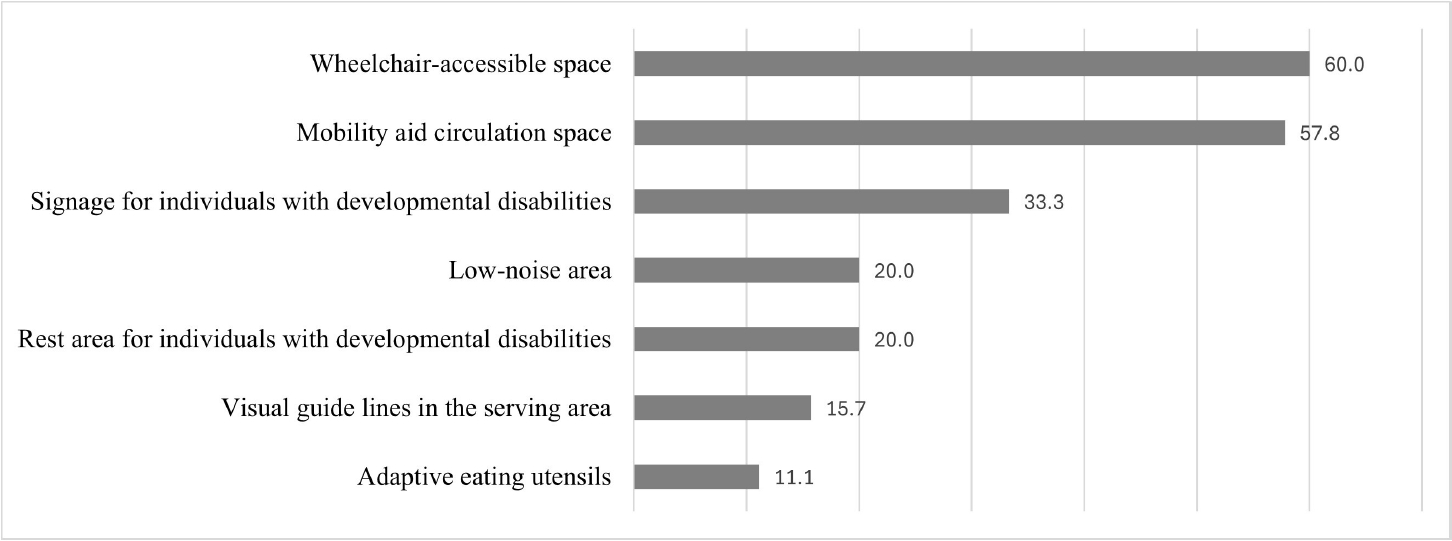
All centers provided one daily meal (lunch), with one cook serving an average of 116 individuals. Only 11.1% of centers implemented nutrition education, primarily limited due to insufficient time and low expectations regarding the effectiveness of nutrition education. Overall, no significant differences were observed between the two groups in most aspects of foodservice management and nutrition education practices, although some specific items showed significant differences. The high-understanding group reported a significantly greater perceived need for nutrition education and placed higher importance on rapport-building and situational response skills. These findings suggest that structural constraints, including staffing, budget, and limited resources, may play a greater role than individual- level understanding in shaping foodservice and nutrition education practices.
Conclusion
Welfare centers showed limited capacity to provide tailored foodservice and systematic nutrition education for adults with developmental disabilities. Strengthening staffing standards, improving foodservice environments, and developing standardized educational materials that consider communication levels are necessary. Moreover, expanding professional training opportunities for dietitians and establishing institutional support systems are essential to enhance sustainable nutrition education practices.
- 604 View
- 25 Download

- [English]
- Changes in the importance and performance of low-sodium management among childcare center cooks in Yongin, South Korea, after salinometer support programs: a descriptive study
- Jiwoo Min, Youngmi Lee, Yunhee Chang, Yujin Lee
- Korean J Community Nutr 2024;29(4):304-317. Published online August 31, 2024
- DOI: https://doi.org/10.5720/kjcn.2024.00004

-
Abstract
PDF
- Objectives
This study aimed to evaluate the importance and performance of sodium reduction practices among childcare center cooks in the Yongin area before and after a 3-month salinometer support program.
Methods
In total, 313 cooks employed in childcare centers in Yongin were surveyed before and after participating in a salinometer support program. The survey included questions on general information, sodium-related dietary habits, and perceived importance and performance levels of sodium reduction approaches in the purchasing, cooking, and serving areas. The centers were divided into childcare centers registered as group-feeding facilities (FS group, n = 68) and those not registered as such (non-FS group, n = 245). The differences between the two groups were analyzed.
Results
The overall importance levels increased significantly after the program in both the FS-group (P < 0.001) and non-FS group (P = 0.005). The overall performance levels also increased significantly in both groups (P < 0.001 for all). Consequently, the significant difference between the importance and performance levels disappeared in both groups after the program. However, unlike the FS group, which showed no significant differences between the importance and performance levels after the program in all three areas, the non-FS group still demonstrated lower performance levels than importance levels in the purchasing (P = 0.011) and serving (P = 0.034) areas after the program.
Conclusions
The use of salinometers significantly enhanced the performance and importance of low-sodium management practices among cooks in childcare centers, especially in the FS group. The continuous monitoring of salinity measurements and tailored education specialized for the FS and non-FS groups are recommended.
- 2,547 View
- 30 Download
 First
First Prev
Prev


