
 KSCN
KSCN
Search
- Page Path
- HOME > Search
Research Article
- [English]
- Impact of a foodservice establishment manager’s willingness to perform duties on hygiene management levels and the mediating effects of extrinsic motivations: a cross-sectional study
- Tae Yang Kim, Mi Young Lee, Young Eun Lee
- Korean J Community Nutr 2026;31(1):36-49. Published online February 28, 2026
- DOI: https://doi.org/10.5720/kjcn.2025.00332
-
 Abstract
 PDF
PDF - Objectives
Consumer demand is growing for more rigorous hygiene management within foodservice establishments. The aim of this study was to provide customized data specific to each foodservice establishment, thereby informing policy formulation to improve hygiene management levels.
Methods
We surveyed 310 managers of directly managed foodservice establishments (excluding franchises) that were subject to hygiene inspections by the Chungbuk Provincial Office in Korea between September 1 and 27, 2023. Additionally, 30 investigators trained in methods for evaluating the hygiene management levels of foodservice establishments objectively assessed 310 establishments using evaluation sheets. All 310 managers provided consent and personally completed the questionnaires. Data from 277 managers were included in the analysis. General characteristics were analyzed with descriptive statistics in IBM SPSS Statistics 28 (IBM Corp.). Univariate normality verification, measurement model verification, structural model verification, and mediation effect significance analysis were conducted using R’s lavaan package (version 4.3.2.).
Results
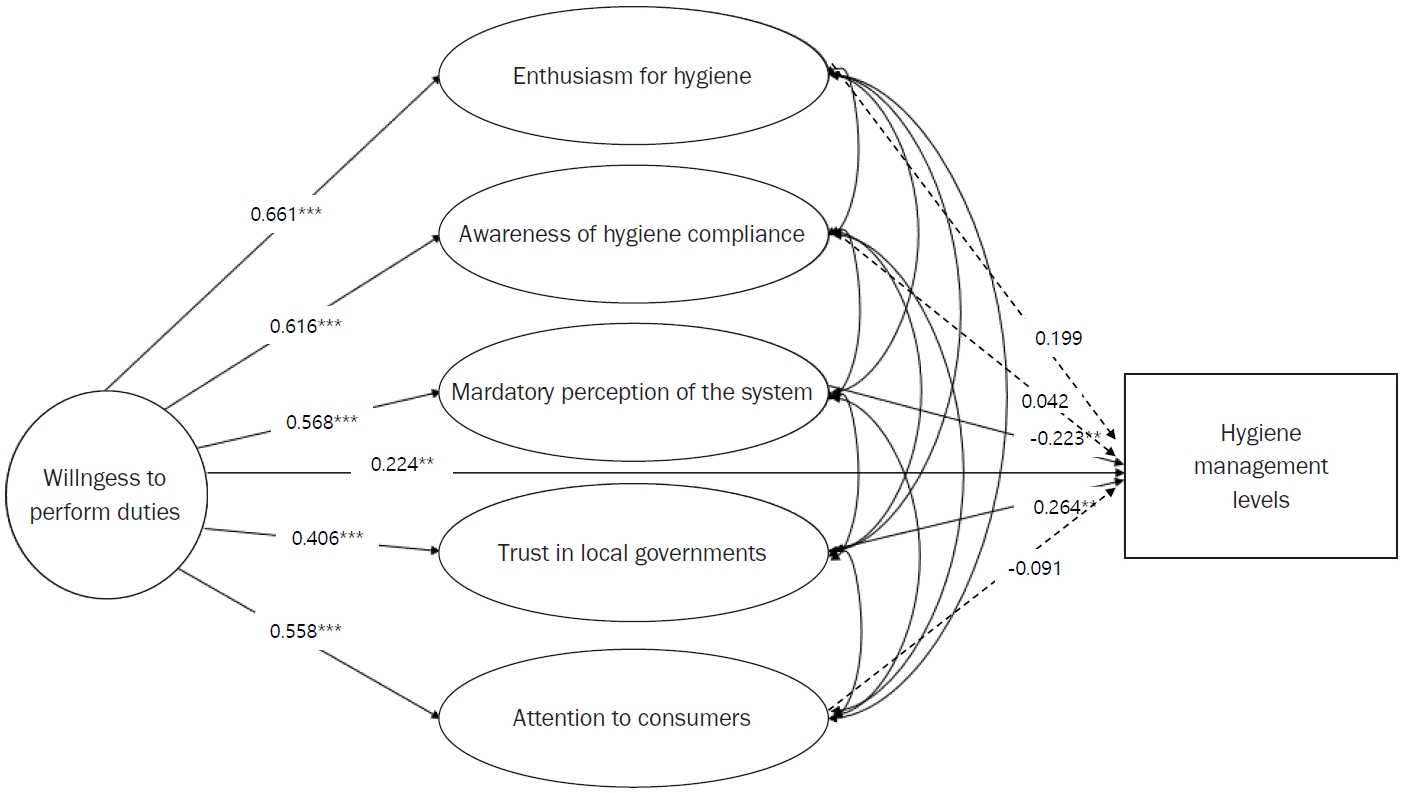
Managers’ willingness to perform duties had a positive influence on hygiene management level (0.224), enthusiasm for hygiene (0.661), awareness of hygiene compliance (0.616), mandatory perception of the system (0.568), trust in local governments (0.406), and attention to consumers (0.558). In the relationship between managers’ willingness to perform duties and hygiene management level, mandatory perception of the system had a negative mediating effect (–0.223), while trust in local governments had a positive mediating effect (0.264).
Conclusion
Structural equation modeling was used to identify the complex pathways by which foodservice establishment managers’ willingness to perform duties, mediated by their human factors, influences their hygiene management level. Accordingly, policy implications were presented, suggesting that the hygiene management level of foodservice establishments could be enhanced by increasing managers’ willingness to perform their duties, and that a shift from mandatory regulations by local governments to support-oriented systems that foster trust in local governments is necessary.
- 1,567 View
- 104 Download

Original Article
- [English]
- Awareness and Consumption of Energy Drinks and Associated Factors among College Students in Cheongju
- Tae Yang Kim, Soo Min Kim, Ji Yeon Kim, Jeong Yeon Im, Hui Yu, Young Hee Han, Taisun Hyun
- Korean J Community Nutr 2018;23(1):60-72. Published online February 28, 2018
- DOI: https://doi.org/10.5720/kjcn.2018.23.1.60
-
Abstract
PDF
- OBJECTIVES
This study was conducted to investigate the awareness of energy drinks, energy drink consumption behaviors, and associated factors among college students.
METHODS
A total of 536 students from three universities in Cheongju completed a self-administered questionnaire regarding awareness and consumption of energy drinks as well as general characteristics, health-related characteristics, and eating habits.
RESULTS
Approximately half of the respondents reported they knew what energy drinks were, while 45.7% had heard of energy drinks but did not know what they were. However, 76.9% had experience in using energy drinks. The main reason for using energy drinks was to stay awake, and the main place that they were used was on campus or at the library. More than 70% of energy drink users did not read the caffeine contents of energy drinks. After consuming energy drinks, 31.3% experienced adverse effects, the most serious being sleep disturbance. Approximately 33% of students consumed energy drinks once a month or more frequently, and men consumed energy drinks more frequently than females. Energy drink users who consumed at least one drink each month were more likely to be natural science major or drink more milk for male students, and to have more allowances or consume less meat for female students, compared with non-users.
CONCLUSIONS
Our study showed that 33% of students consumed at least one energy drink each month, and there were a small number of students consumed energy drinks almost every day or energy drinks mixed with alcohol. Accordingly, college students should be taught potential health hazards of energy drinks mixed with alcohol as well as energy drinks alone. In addition, reading labels about caffeine and sugar contents in energy drinks is encouraged. -
Citations
Citations to this article as recorded by
- Gender differences in beverage consumption patterns, dietary behaviors, and beverage-derived nutrient intake among South Korean university students: a cross-sectional study
So-Yun Kim, Mi-Hyun Kim, Mi-Kyeong Choi
Clinical Nutrition Research.2026; 15(3): 161. CrossRef - The Impact of Promotional Activities on the Purchase and Repurchase Intention of Energy Drinks in Yemen Under Different Levels of Awareness of the Potential Adverse Effects
Majid Mapkhot Goaill, Mohammed A. Al-Hakimi, Hamood Mohammed Al-Hattami, Mohsen Ali Murshid, Amal Al-Mogahed, Sharf Obad
Sage Open.2023;[Epub] CrossRef - Analysis of Usage, Preference, and Satisfaction for Convenience
Store Dessert among University Students in Chungbuk Area
Go Eun Lee, Hye-In Yang, Yun-Jung Bae
Journal of Biotechnology and Bioindustry.2021; 9: 63. CrossRef - Energy drinks
Towhid Hasan, Marjia Sultana, Md. Tareq Hossain, Lima Khatun, Md. Alauddin
Journal of Health Research.2020; 34(3): 221. CrossRef - Energy Drink Consumption and Dietary-, Lifestyle-, and Mental Health-Related Behaviors in Korean Adolescents: Based on the 10th–13th Korea Youth Risk Behavior Web-Based Survey
Jiwon Oh, Jayong Chung
Korean Journal of Health Promotion.2019; 19(3): 145. CrossRef - Sleep Quality and Its Association with the Dietary Behavior and Lifestyle of University Students in Cheongju
Sewhan Jin, Munkyong Pae
Korean Journal of Community Nutrition.2019; 24(5): 395. CrossRef - Consumption of energy drink and associated factors
Towhid Hasan, Marjia Sultana, Lincon Chandra Shill, Sara Sultana
Nutrition & Food Science .2019; 50(1): 131. CrossRef - Consumption Behaviors of Energy Drinks and Comparison of Associated Factors Among College Students in Gwangju
DaWun Seo, Bok Hee Kim
Korean Journal of Community Nutrition.2018; 23(4): 289. CrossRef
- Gender differences in beverage consumption patterns, dietary behaviors, and beverage-derived nutrient intake among South Korean university students: a cross-sectional study
- 2,939 View
- 24 Download
- 8 Crossref
 First
First Prev
Prev


