
 KSCN
KSCN
Search
- Page Path
- HOME > Search
Research Articles
- [Korean]
- A needs assessment for the development of a digital-based self-nutrition management education program for older adults in Korea: a cross-sectional study
- Hae-Song Yoo, Jin-Myung Lee, Min-Sun Jeon
- Korean J Community Nutr 2026;31(2):178-191. Published online April 30, 2026
- DOI: https://doi.org/10.5720/kjcn.2026.00010
-
 Abstract
 PDF
PDF - Objectives
This study aimed to investigate the current status of nutrition management and digital utilization, the demand for e-learning nutrition education, and the factors influencing e-learning nutrition education among older adults.
Methods
A total of 500 older adults aged 65–84 years, registered as panelists with a professional survey agency, participated in an online survey. Chi-square and independent samples t-tests were used to examine gender differences. Correlations between participants’ general characteristics and the major variables were analyzed. Based on the results, a moderated regression analysis was conducted to identify how the general characteristics significantly associated with the intention to use e-learning nutrition education functioned as moderators.
Results
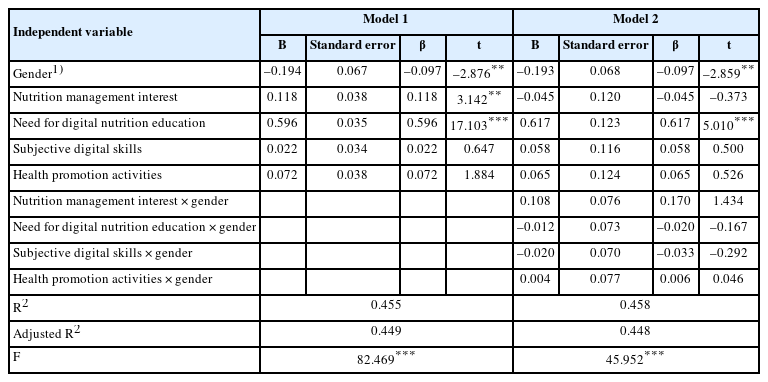
Significant gender differences were observed in nutrition education experience, interest and practice of nutrition management, barriers, and digital device utilization (all P < 0.05). Exploratory factor analysis identified four sub-factors for education needs: ‘Self-directed well-being practice education’, ‘Dietary therapy for major chronic diseases’, ‘Nutrition strategy for longevity and anti-aging’, and ‘Enhancing nutrition literacy education’. In Model 1, the need for digital education, interest in nutrition management, and gender were significantly associated with usage intention (all P < 0.05), whereas health-promoting behavior showed marginal significance (P = 0.06). Although the Model 2 interaction was significant, the change in explanatory power was negligible (Delta R2 = 0.003), and all interaction terms were non-significant (P > 0.05), indicating that the relationships are not moderated by gender.
Conclusion
Although older adults exhibited high interest in nutrition management, their experience with nutrition education was limited. Significant gender differences in educational needs and health-promoting behaviors highlight the importance of tailored strategies. Enhancing digital accessibility and providing gender-specific, competency-based content are essential to effectively translate interest into behavioral change. This study underscores the importance of integrating gender-specific approaches, individual digital competencies, and inducement of health-promoting behaviors when developing e-learning nutrition education programs for older adults.
- 830 View
- 29 Download

- [Korean]
- Toward the development of a digital self-nutrition management education program for elderly: findings from focus groups study
- Hae-song Yoo, Jin-myong Lee, Min-sun Jeon
- Korean J Community Nutr 2025;30(6):431-440. Published online December 31, 2025
- DOI: https://doi.org/10.5720/kjcn.2025.00234

-
Abstract
PDF
- Objectives
The aim of this qualitative study was to explore and understand the behaviors and challenges of self-nutrition management from the perspective of elderly.
Methods
In May 2025, ten elderly aged 65–83 years with prior experience using digital devices were recruited through purposeful sampling. Data were collected via focus group interviews using a semi-structured questionnaire until saturation was reached, and all interviews were recorded, transcribed, and analyzed using traditional content analysis methods. The collected interview data were extracted focusing on phrases or sentences relevant to the research purpose, and various concepts derived through memo writing and the constant comparison were categorized based on common meanings. Subsequently, the categorized statements were deeply interpreted and reclassified into subcategories for final analysis.
Results
Under the overarching theme of development directions for a digital self-nutrition management education program for elderly, three main categories and 13 subcategories were derived. The three main categories include: (1) processes of acceptance and utilization of digital technologies; (2) potential for applying digital self-nutrition management; and (3) strategies for implementing digital-based nutrition education.
Conclusion
Our findings indicate that elderly face barriers to utilizing digital tools for self-nutrition management not only due to physical or technical limitations, but also because of the confusion arising from limited nutrition knowledge and information overload. To overcome the barriers that may arise during the digital-based education process for elderly, strategies (educational topics, delivery strategies, and operational strategies) were derived to vitalize a digital self-nutrition management education program. These results highlight the necessity of developing tailored digital nutrition education programs that reflect the characteristics of elderly, which may enhance their practical applicability and provide foundational evidence for establishing a digital–nutrition integrated care model within the senior customized care service. -
Citations
Citations to this article as recorded by
- A needs assessment for the development of a digital-based self-nutrition management education program for older adults in Korea: a cross-sectional study
Hae-Song Yoo, Jin-Myung Lee, Min-Sun Jeon
Korean Journal of Community Nutrition.2026; 31(2): 178. CrossRef
- A needs assessment for the development of a digital-based self-nutrition management education program for older adults in Korea: a cross-sectional study
- 1,735 View
- 78 Download
- 1 Crossref
 First
First Prev
Prev


