
 KSCN
KSCN
Search
- Page Path
- HOME > Search
Research Article
- [English]
- Development of a simplified NOVA-based scoring tool for assessing ultra-processed food consumption among Korean young adults: a cross-sectional study
- Jinhyun Kim, Eunjin Jang, Sarang Jeong, Sukyoung Jung, Jee Young Kim, Jung Eun Lee, Dahye Han, Eunseo Lee, Junhyeok Jang, Sohyun Park
- Korean J Community Nutr 2026;31(2):140-152. Published online April 30, 2026
- DOI: https://doi.org/10.5720/kjcn.2026.00059
-
 Abstract
 PDF
PDF Supplementary Material
 - Objectives
This study aimed to develop a NOVA-based scoring approach for evaluating ultra- processed food (UPF) intake among Korean adults and to examine its performance. Previous studies have reported that young adults have the highest levels of UPF consumption. Accordingly, this study focused on adults aged 19–40 years and developed scoring components reflecting dietary patterns specific to Korean eating habits.
Methods
Using 24-hour dietary recall data from adults aged 19–40 years in the Korea National Health and Nutrition Examination Survey (2021–2023), foods were classified according to the Korean-adapted NOVA system. The top 10 food groups accounting for ≥ 80% of cumulative UPF-derived energy were selected to construct the scoring components. The tool was operationalized using food frequency questionnaire (FFQ) data from the Gangwon cohort study (2022–2024). Intake frequencies were converted into scores ranging from 0 (“rarely or never”) to 5 (“≥ 1 time/day”), and summed to generate the NOVA–UPF score (range: 0–50).
Results
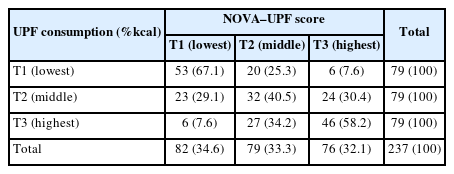
Among 237 young adults (aged 20–49 years), the mean NOVA–UPF score was 22.9 ± 8.3. A positive association was observed between the NOVA–UPF score and FFQbased UPF energy intake (Spearman’s ρ = 0.629, P < 0.001). Cross-classification showed that 51.9% were classified into the same tertile and 94.9% into the same or adjacent tertiles, with a weighted kappa coefficient of 0.279.
Conclusion
This NOVA-based scoring approach may serve as a preliminary tool for assessing UPF intake in Korean young adults. Further refinement and rigorous validation using quantitative dietary assessment methods and more diverse populations are required before broader application.
- 1,207 View
- 53 Download

Research Note
- [English]
- A pilot investigation of a combined food literacy and exercise program for college students: a one-group pre-post intervention study
- Minjeong Jeong, Jinhyun Kim, Dahye Han, Eunjin Jang, Kyoungho Choi, Sohyun Park
- Korean J Community Nutr 2024;29(6):455-466. Published online December 31, 2024
- DOI: https://doi.org/10.5720/kjcn.2024.00248
-
Abstract
PDF
- Objectives
A campus-based intervention to enhance food literacy (FL) and establish exercise habits among college students was developed and the program’s effectiveness was evaluated.
Methods
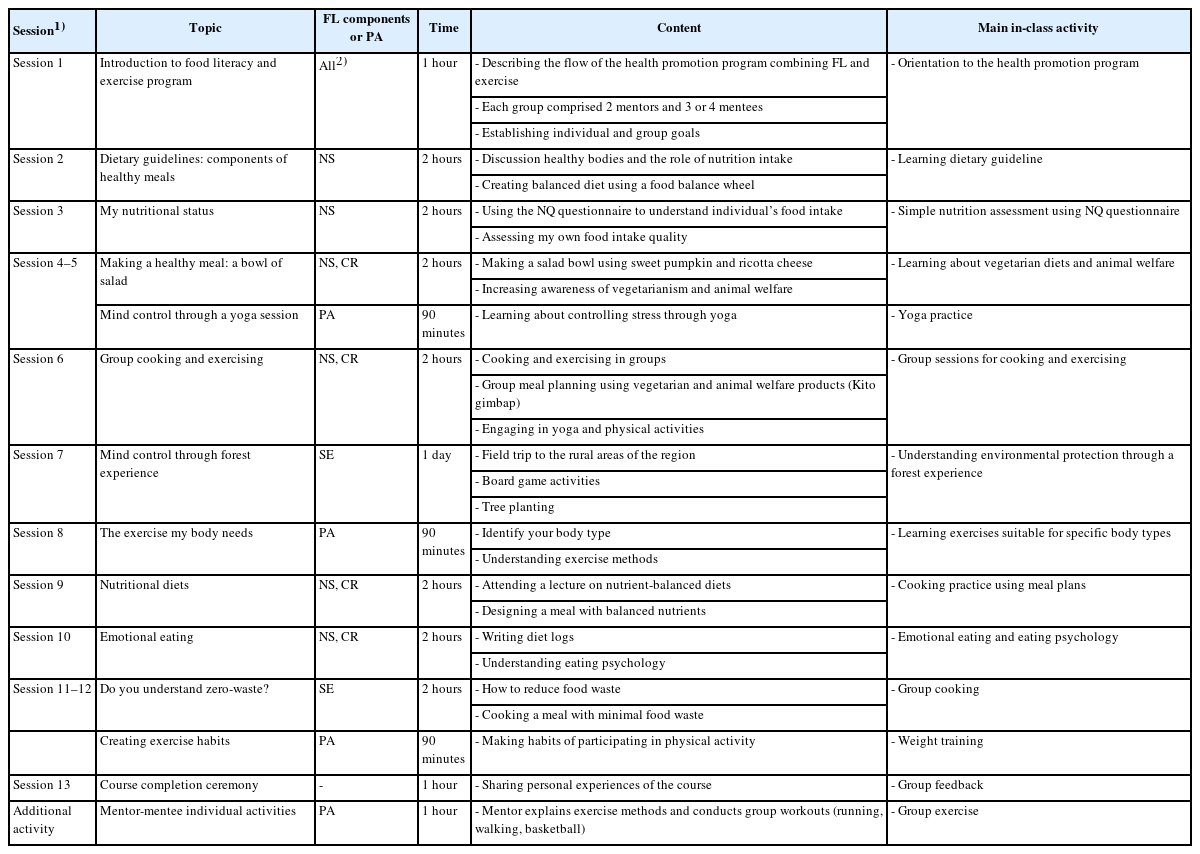
The 13-session program was developed based on the transtheoretical model and social cognitive theory. Junior and senior students majoring in food and nutrition and physical education were asked to participate as mentors, with freshmen and sophomores from varied majors as mentees. The program encompassed food, nutrition, and exercise lessons including cooking sessions. Data were collected via pre- and post-program surveys using a questionnaire consisting of items on FL and nutrition behaviors and physical fitness measurements.
Results
Among 39 participants (35.9% male, 64.1% female), the overall FL score increased significantly from 64.1 to 70.6 post-program (P = 0.001). Significant increases were observed in the nutrition and safety (P < 0.001), cultural and relational (P = 0.023), and socio-ecological (P = 0.001) domains, as well as knowledge (P = 0.001), self-efficacy (P = 0.013), attitude (P < 0.001), and behavior (P = 0.005) items in three domains of FL. Additionally, meal duration increased significantly (P = 0.007) and sit-up performance among female showed a meaningful change (P = 0.046). Changes in dietary behaviors significantly progressed (P = 0.015) while that in exercise habits approached a marginal significance (P = 0.053) after the intervention.
Conclusion
The results reveal positive changes in FL and some modifications in eating habits, although the program had limited effects on physical activity and fitness measurements. These findings suggest that strategic approaches to foster exercise behavior changes in college students are required. This pilot program can serve as foundational data for improving and expanding multicomponent health promotion programs for this population. -
Citations
Citations to this article as recorded by
- Food literacy as a moderator in the relationship between food security and dietary diversity among adults in Seoul: based on the 2021–2023 Seoul Food Survey
Minjeong Jeong, Jinhyun Kim, Dahye Han, Eunseo Lee, Eunjin Jang, Sarang Jeong, Sohyun Park
Nutrition Research and Practice.2026; 20(3): 490. CrossRef - The Dragon Fruit Advantage: Exploring University Students’ Experiences and Perceptions of a Targeted Nutrition Education Module
Adelfa Silor, Faith Stephanny C. Silor
Seminars in Medical Writing and Education.2025; 4: 924. CrossRef
- Food literacy as a moderator in the relationship between food security and dietary diversity among adults in Seoul: based on the 2021–2023 Seoul Food Survey
- 3,687 View
- 69 Download
- 2 Crossref
 First
First Prev
Prev


