
Skip Navigation
Skip to contents

Korean J Community Nutr : Korean Journal of Community Nutrition

OPEN ACCESS

Articles

Page Path
HOME > Korean J Community Nutr > Volume 31(2); 2026 > Article
Research Article
Development of a simplified NOVA-based scoring tool for assessing ultra-processed food consumption among Korean young adults: a cross-sectional study
Jinhyun Kim1),2)orcid, Eunjin Jang3)orcid, Sarang Jeong4),5)orcid, Sukyoung Jung6)orcid, Jee Young Kim7)orcid, Jung Eun Lee8),9)orcid, Dahye Han1),2)orcid, Eunseo Lee1),2)orcid, Junhyeok Jang1),2)orcid, Sohyun Park10),11),†orcid
Korean Journal of Community Nutrition 2026;31(2):140-152.
DOI: https://doi.org/10.5720/kjcn.2026.00059
Published online: April 30, 2026

1)Master Student, Department of Food Science and Nutrition, Hallym University, Chuncheon, Korea

2)Master Student, The Korean Institute of Nutrition, Hallym University, Chuncheon, Korea

3)Researcher, The Korean Institute of Nutrition, Hallym University, Chuncheon, Korea

4)Research Professor, Industry-Academy Collaboration Foundation, Dongduk Women’s University, Seoul, Korea

5)Research Fellow, The Korean Institute of Nutrition, Hallym University, Chuncheon, Korea

6)Associate Research Fellow, Department of Healthcare Policy Research, Korea Institute for Health and Social Affairs, Sejong, Korea

7)Ph. D., Jeju Jinsan Co., Seogwipo, Korea

8)Professor, Department of Food and Nutrition, College of Human Ecology, Seoul National University, Seoul, Korea

9)Professor, Research Institute of Human Ecology, College of Human Ecology, Seoul National University, Seoul, Korea

10)Professor, Department of Food Science and Nutrition, Hallym University, Chuncheon, Korea

11)Professor, The Korean Institute of Nutrition, Hallym University, Chuncheon, Korea

†Corresponding author: Sohyun Park Department of Food Science and Nutrition, Hallym University, 1 Hallymdaehak-gil, Chuncheon 24252, Korea Tel: +82-33-248-2134 Fax: +82-33-256-3420 Email: sopark@hallym.ac.kr
• Received: February 2, 2026   • Revised: March 5, 2026   • Accepted: March 11, 2026

© 2026 The Korean Society of Community Nutrition

This is an Open-Access article distributed under the terms of the Creative Commons Attribution Non-Commercial License (https://creativecommons.org/licenses/by-nc/4.0) which permits unrestricted non-commercial use, distribution, and reproduction in any medium, provided the original work is properly cited.

  • 120 Views
  • 12 Download
prev next
  • Objectives
    This study aimed to develop a NOVA-based scoring approach for evaluating ultra-processed food (UPF) intake among Korean adults and to examine its performance. Previous studies have reported that young adults have the highest levels of UPF consumption. Accordingly, this study focused on adults aged 19–40 years and developed scoring components reflecting dietary patterns specific to Korean eating habits.
  • Methods
    Using 24-hour dietary recall data from adults aged 19–40 years in the Korea National Health and Nutrition Examination Survey (2021–2023), foods were classified according to the Korean-adapted NOVA system. The top 10 food groups accounting for ≥ 80% of cumulative UPF-derived energy were selected to construct the scoring components. The tool was operationalized using food frequency questionnaire (FFQ) data from the Gangwon cohort study (2022–2024). Intake frequencies were converted into scores ranging from 0 (“rarely or never”) to 5 (“≥ 1 time/day”), and summed to generate the NOVA–UPF score (range: 0–50).
  • Results
    Among 237 young adults (aged 20–49 years), the mean NOVA–UPF score was 22.9 ± 8.3. A positive association was observed between the NOVA–UPF score and FFQ-based UPF energy intake (Spearman’s ρ = 0.629, P < 0.001). Cross-classification showed that 51.9% were classified into the same tertile and 94.9% into the same or adjacent tertiles, with a weighted kappa coefficient of 0.279.
  • Conclusion
    This NOVA-based scoring approach may serve as a preliminary tool for assessing UPF intake in Korean young adults. Further refinement and rigorous validation using quantitative dietary assessment methods and more diverse populations are required before broader application.
Recent domestic and international studies describe ultra-processed foods (UPFs) as products manufactured using industrially processed food (PF) ingredients and a wide range of additives [1]. These foods are characterized by high energy density and increased added sugar, sodium, and saturated fat contents, while being low in dietary fiber and micronutrients [1]. Several epidemiological studies have reported that excessive UPF consumption increases the risk of major chronic diseases, including obesity [2], dyslipidemia [3], metabolic syndrome [4, 5], and coronary and cerebrovascular disorders [6]. Further, diets high in UPFs increase sugar, fat, and sodium intake, thereby lowering overall diet quality and emerging as an important public health concern [1, 7, 8].
The NOVA classification system is a representative framework for classifying foods according to their level of processing [9]. It categorizes foods and beverages into four groups based on the purpose and extent of industrial processing: (1) minimally PF, (2) processed culinary ingredients, (3) PF, and (4) UPF [1]. In Korea, UPF consumption has steadily increased due to dietary westernization and the widespread availability of convenience foods, with particularly high intake observed among young adults [10-12]. This age group has irregular eating schedules due to academic or work demands and prefers convenient, palatable foods, making them more likely to consume PFs [11, 13]. Such trends reflect changing food consumption patterns among young adults and emphasize the need for early identification and monitoring of the health impacts of UPF intake.
Globally, several countries have developed and validated UPF intake assessment tools tailored to their dietary environments, and practical instruments for rapidly assessing UPF consumption are currently employed in Brazil, Senegal, Colombia, and other countries [14-17]. However, in Korea, a standardized and simplified assessment tool remains unavailable to evaluate UPF intake. Most studies rely on complex dietary assessment methods, including 24-hour recalls or food frequency questionnaires (FFQs), which require substantial time, cost, and analytical effort [15, 16]. Further, the rapidly evolving food environment has created a gap in up-to-date data that can capture new dietary patterns and the changing trends in UPF consumption [14, 17]. Therefore, the development of a standardized tool that enables quick and simple assessment of UPF intake at the population level is warranted.
The need for a simplified UPF assessment approach reflecting Korean dietary habits has been recognized; however, existing international UPF tools are largely based on Western dietary patterns and may not adequately capture the characteristics of Korean food consumption [18]. For example, traditional fermented condiments, such as Doenjang and Gochujang, are widely used as household cooking ingredients, but their commercial production may involve added sugars and seasonings, thereby making their level of processing nontrivial [19]. These considerations emphasize the need for developing a Korea-specific scoring approach that accounts for the unique characteristics of Korean dietary culture.
In this context, the present study serves as an initial step toward constructing a UPF intake scoring tool suitable for Korea. The NOVA–UPF scoring tool was developed as an FFQ-derived scoring approach based on selected food items relevant to UPF consumption, rather than as a standalone questionnaire. Major UPF food groups commonly consumed by young adults—who exhibit relatively high UPF intake—were first identified using 24-hour recall data from the Korea National Health and Nutrition Examination Survey (KNHANES, 2021–2023) and applying the Korean-adapted NOVA classification. The association between the constructed score and the proportion of energy from UPFs was examined using FFQ data from the Gangwon Obesity and Metabolic Syndrome (GOMS) cohort study (2022–2024) to provide preliminary evidence on its performance in the Korean population.
Ethics statement
The written informed consent was obtained from all participants. This study was conducted with the approval of the Research Ethics Committee of Hallym University Institutional Review Board (HIRB-2021-077-2-RR-CR-R-CR-R).
1. Study design
This study was conducted as a cross-sectional study and reported in accordance with the Strengthening the Reporting of Observational Studies in Epidemiology (STROBE) statement, available at https://www.strobe-statement.org/.
2. Data collection
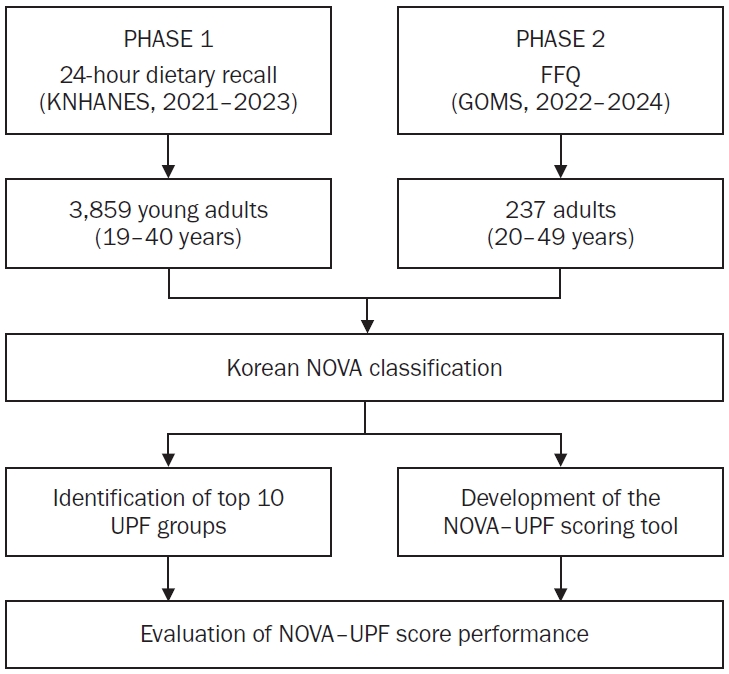
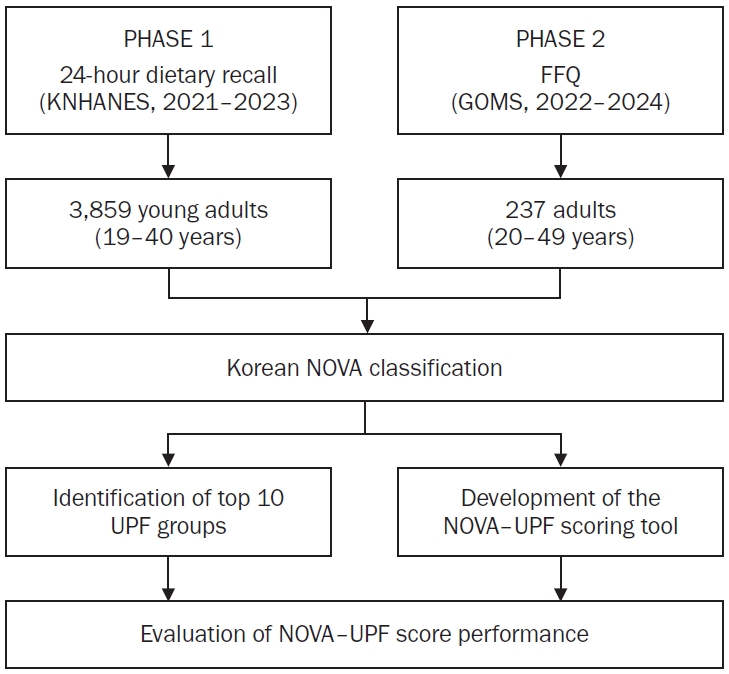
This cross-sectional study developed a simplified NOVA-based scoring tool for assessing UPF intake among young Korean adults and evaluated its performance. The study comprised two phases (Fig. 1).
Phase 1 used 24-hour dietary recall data from the KNHANES (2021–2023), a nationwide survey that annually assesses the health and nutritional status of a randomly selected representative sample of the Korean population through health examinations and nutrition surveys. This phase aimed to identify UPF items consumed by young adults. Food items were classified according to the NOVA food classification system [18, 19]. Food groups with high contributions to total energy intake were extracted among the identified UPFs, and the foundational components of the scoring tool included the top 10 food groups that collectively accounted for ≥ 80% of cumulative energy contribution. A total of 4,285 adults aged 19–40 years were initially included, whereas individuals with missing data or implausible daily energy intake (< 500 kcal or > 5,000 kcal; n = 426) were excluded, leading to a final analytic sample of 3,859 participants.
Phase 2 used FFQ data from the GOMS cohort collected between 2022 and 2024. The GOMS study is an ongoing observational cohort designed to investigate dietary and lifestyle determinants of obesity and metabolic health among Korean adults in Gangwon province [20].
The GOMS study employed a dish-based semiquantitative FFQ developed in 2009 to assess usual dietary intake over the preceding year, covering 112 food and dish items [21]. Participants reported the frequency of consumption across nine categories, ranging from “never or less than once per month” to “three times per day,” along with standard portion sizes. The FFQ has been previously validated and demonstrated acceptable reproducibility and validity [21]. In the present study, alcoholic beverages were excluded from the NOVA classification, resulting in 109 items included in the analysis.
In the FFQ, food items were categorized based on processing level using the NOVA system to assess UPF intake [19]. Scores for the NOVA–UPF tool were calculated using the UPF list identified in the 24-hour recall analysis, whereas the FFQ-based UPF energy proportion was used as a reference indicator for assessing tool performance. This study analyzed 237 adults aged 20–49 years (65 men and 172 women). Individuals with insufficient literacy, moderate or severe cognitive impairment, or participation in other clinical or observational studies were excluded [20].
3. Assessment of UPF intake and performance evaluation

1) Identification of UPF food groups using 24-hour recall data

To reflect contemporary dietary patterns, the present study used 24-hour dietary recall data from the KNHANES (2021–2023) to identify UPF food groups consumed by Korean adults aged 19–40 years. The 24-hour dietary recall method requires respondents to report all foods and beverages consumed over the previous day [22].
All reported food items were classified into the four NOVA processing levels (Groups 1–4) following the framework proposed by Monteiro et al. [23]. Given that the original NOVA criteria may not fully capture domestic food manufacturing processes or consumption contexts in Korea, a secondary classification was conducted using the Korean-adapted NOVA guidelines, which consider commonly consumed traditional foods such as kimchi, fermented soybean pastes, and side dishes [18].
Foods were re-examined using updated information on cooking methods, product names, brand information, food types, nutrient composition (particularly sugar and sodium content), and ingredient lists to better reflect recent changes in the industrial food supply [18, 19]. The classification process was conducted through expert panel discussions involving specialists in nutritional epidemiology, and discrepancies were resolved through iterative deliberation until consensus was reached. Among the classified foods, only those categorized as ultra-processed (Group 4) were retained as candidate UPF items. A total of 2,081 food items were initially evaluated, of which 949 were classified as UPFs.
Among the identified UPF items, food groups with high contributions to total daily energy intake were selected. The contribution of each UPF food group to total UPF-derived energy intake was calculated and ranked. Cumulative energy contribution was identified by sequentially summing energy contributions in descending order, and food groups accounting for approximately 80% or more of cumulative UPF-derived energy were selected as the final candidates for inclusion in the scoring tool [24].

2) Scoring of the tool using the FFQ

The NOVA–UPF scoring tool was developed based on 24-hour dietary recall data from the 2021–2023 KNHANES, using the top 10 food groups that accounted for ≥ 80% of cumulative UPF-derived energy as scoring components. FFQ food items were grouped by matching them to these 10 UPF food groups identified from the contribution analysis and the list of foods classified as NOVA Group 4 [19]. Details of how FFQ items correspond to each scoring component are provided in Supplementary Table 1.
The consumption frequency of each grouped FFQ item was scored using the frequency categories of the FFQ administered in the GOMS cohort (2022–2024). Frequency responses were converted into scores ranging from 0 (“rarely or never”) to 5 (“≥ 1 time/day”) based on a six-point scale. The scores of all items were summed to generate an individual’s NOVA–UPF total score, with higher scores indicating higher UPF consumption levels.

3) Assessment of tool performance

The performance of the NOVA–UPF scoring tool was assessed by evaluating its association with the proportion of energy intake from UPFs (%kcal), derived from FFQ data. Each FFQ item was classified according to the NOVA processing level following established criteria [19], and the percentage of total energy intake attributable to UPFs was calculated for each participant. This FFQ-based UPF energy proportion (%kcal) was utilized as the reference indicator.
To examine the extent to which the tool captured relative UPF intake, Spearman’s rank correlation coefficients were calculated between NOVA–UPF scores and the FFQ-based UPF energy proportion. In addition, both measures were categorized into tertiles to evaluate agreement in classification, and cross-classification analyses along with the weighted kappa coefficient were used to assess concordance between the two indicators.
4. Assessment of sociodemographic and lifestyle characteristics
Education level was classified into “middle school or below,” “high school graduate,” and “college or above.” Household income was categorized into “< 2 million KRW per month,” “2–4 million KRW,” and “≥ 4 million KRW.” Household composition was classified as single-person or multi-person households. Alcohol consumption was categorized as current drinking (yes/no), whereas smoking status was classified as never smoker (lifetime consumption < 100 cigarettes), former smoker, or current smoker. Physical activity was assessed following the World Health Organization guidelines, which recommend at least 150 minutes of moderate-intensity physical activity or 75 minutes of vigorous-intensity activity per week. Vigorous-intensity activity time was multiplied by two and combined with moderate-intensity time to identify total activity, after which participants were categorized into “none,” “insufficient,” and “sufficient” activity levels [25, 26].
5. Statistical analysis
KNHANES is based on a stratified, clustered, and systematic sampling design, and all statistical analyses were conducted by accounting for sampling weights, stratification variables, and clustering variables. The proportion of energy intake from UPFs (%kcal) was calculated and categorized into tertiles using the 24-hour dietary recall data from KNHANES (2021–2023). Sociodemographic characteristics and major variables of participants were summarized using descriptive statistics based on the GOMS cohort (2022–2024). Consumption frequencies for the FFQ data for each food group were converted to scores of 0 to 5, and these were summed to obtain the NOVA–UPF total score. Total scores were expressed as means and standard deviations, and differences across sociodemographic and lifestyle factors were assessed using independent t-tests and one-way analysis of variance.
Spearman’s rank correlation coefficient was used to examine the correlation between the NOVA–UPF score and the FFQ-based proportion of energy intake from UPFs. Further, both the NOVA–UPF score and the FFQ-based UPF energy proportion were categorized into tertiles, and cross-classification analysis was conducted to assess the degree of agreement between the two indicators. The proportions of participants classified into the same tertile, adjacent tertiles, and opposite tertiles were calculated. Agreement between the two classifications was further evaluated using the weighted kappa coefficient. Stata MP version 17.0 (StataCorp LLC.) was used for all statistical analyses.
1. Comparison of energy intake (%) from subgroups of UPF in terms of gender among adults aged 19–40 years: KNHANES in 2021–2023
Table 1 presents the adjusted mean percentage of energy intake from UPF subgroups among adults aged 19–40 years according to gender. Overall, noodles and pasta dishes contributed the largest proportion of UPF-derived energy intake (16.0%), followed by soda and beverages (15.0%), breads and bakery products (13.4%), seasonings and condiments (10.2%), and traditional sauces (9.0%). Significant gender differences were observed in several subgroups. Men had higher energy contributions from noodles and pasta dishes (17.1% in men and 14.1% in women, P < 0.001), traditional sauces (9.8% and 8.1%, P = 0.013), processed meat and packaged meat products (10.1% and 7.1%, P < 0.001), and convenience or ready-to-eat foods (5.5% and 4.2%, P = 0.011). Women had higher contributions from breads and bakery products (15.7% in women and 11.3% in men, P < 0.001), snack foods (8.0% and 4.7%, P < 0.001), frozen desserts or ice cream (3.1% and 2.0%, P = 0.001), and dairy products (5.4% and 3.0%, P < 0.001). No significant gender differences were observed for the remaining UPF subgroups. Detailed characteristics of participants according to tertiles of ultra-processed foods energy intake are provided in Supplementary Table 2.
2. Cumulative contribution of UPF subgroups based on 24-hour dietary recall data from adults aged 19–40 years: KNHANES in 2021–2023
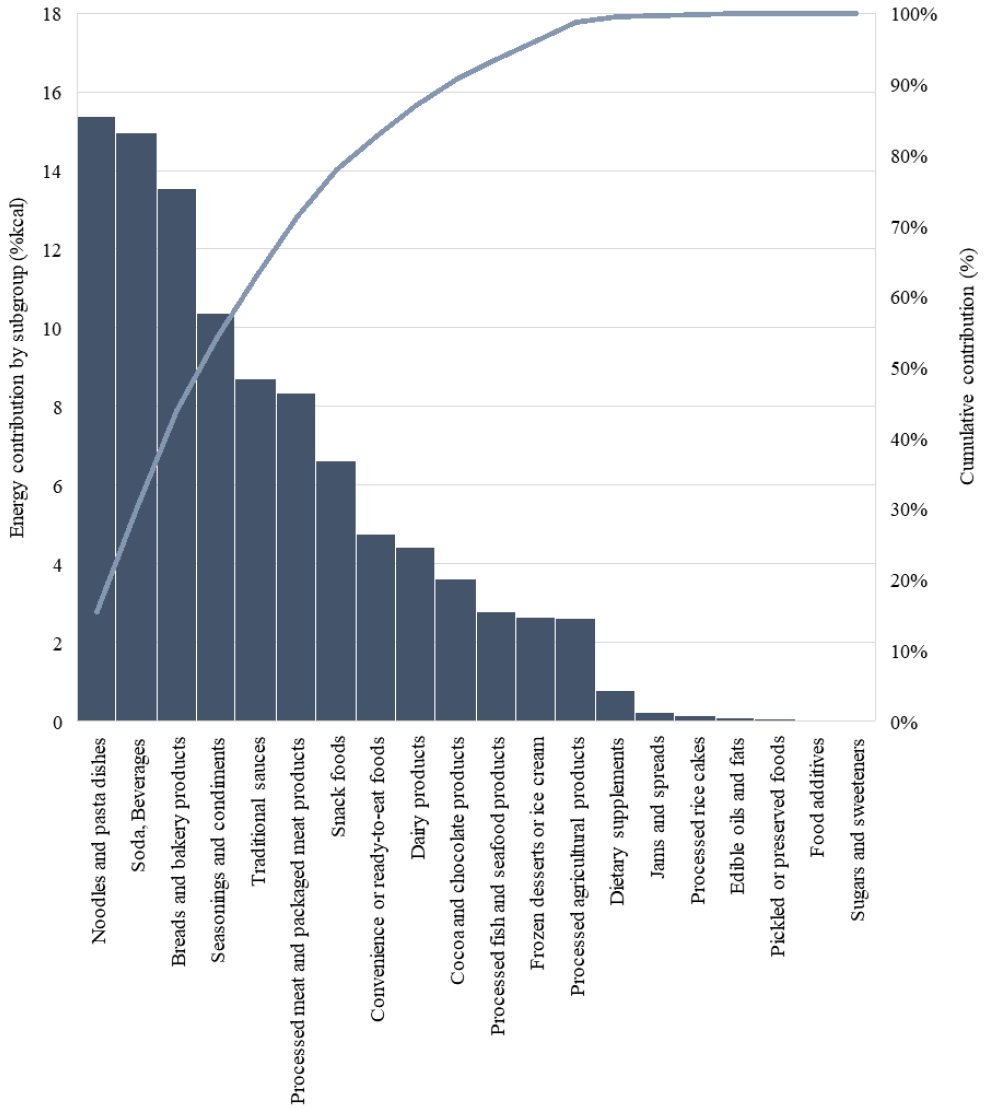
Fig. 2 illustrates the cumulative contribution of detailed UPF subgroups to total UPF energy intake based on 24-hour recall data. The major contributing subgroups included noodles and pasta (15.4%), beverages (14.9%), and breads and baked goods (13.6%), which together accounted for approximately 44% of total UPF energy intake. Seasoning products (10.3%), traditional sauces (8.7%), processed meats (8.3%), and snack foods (6.6%) followed, all of which demonstrated relatively high contributions.
Conversely, chocolate products (3.6%), frozen desserts and ice cream (2.7%), processed seafood (2.8%), and dairy products (4.4%) contributed smaller proportions. Dietary supplements, jams, processed rice cakes, fats and oils, pickled products, food additives, and sugars each accounted for < 1% of total UPF energy intake. Overall, the top eight UPF subgroups contributed > 80% of total UPF-derived energy.
3. Scoring criteria for NOVA–UPF items according to consumption frequency
Table 2 shows the scoring criteria for each item included in the NOVA–UPF scoring tool. The consumption frequency for each food group was categorized into six levels, scored from 0 (“rarely or never”) to 5 (“≥ 1 time per day”). The same scoring criteria were applied to all 10 major UPF food groups, including noodles and pasta, beverages, breads and baked goods, seasoning products, processed sauces/pastes, processed meats, snack foods, ready-to-eat or convenience foods, dairy products, and chocolate products. An individual’s total NOVA–UPF score was calculated by summing the scores across all food groups, with a possible total score ranging from 0 to 50. Higher total scores indicate more frequent UPF consumption.
4. General characteristics of study participants in terms of gender based on the FFQ among adults aged 20–49 years from the GOMS cohort study in 2022–2024
Table 3 shows the characteristics of the 237 participants, comprising 27.4% (n = 65) men and 72.6% (n = 172) women. Significant gender differences were observed in education level and smoking status (P = 0.011 and P < 0.001, respectively). Among men, 81.5% had a college-level education or higher, compared with 61.6% of women. Further, the proportion of current smokers was significantly higher among men (35.9%) than among women (8.8%).
Conversely, no significant gender differences were observed in marital status, household income, household type, alcohol consumption, or physical activity level (P > 0.05). Overall, 82.7% of participants were married or living with a partner, and 67.1% had attained a college education or higher. Further, 60.3% reported a monthly household income exceeding 4 million KRW. Current drinkers accounted for 76.8% of the sample, whereas current smokers represented 16.2%. Regarding physical activity, 35.4% met the recommended activity level, whereas 43.9% reported no physical activity and 20.7% reported insufficient activity.
5. Mean NOVA–UPF scores according to general characteristics of participants aged 20–49 years from the GOMS cohort study, 2022–2024
Table 4 shows the NOVA–UPF scores according to participants’ general characteristics. The mean NOVA–UPF score for all participants was 22.9 ± 8.3 (range: 0–50), and no significant difference was observed between men and women (P = 0.500). Similarly, NOVA–UPF scores did not significantly differ according to age, marital status, education level, household income, household type, smoking status, drinking status, or physical activity level (P > 0.05). Overall, the distribution of NOVA–UPF scores remained relatively consistent across all subgroups.
6. Cross-classification of participants by tertiles of UPF energy intake (%) and NOVA–UPF scores using the FFQ from the GOMS cohort study in 2022–2024
Table 5 presents the cross-classification of participants by tertiles of the NOVA–UPF scores and FFQ-based UPF energy intake (%kcal). Overall, 51.9% of participants were classified into the same tertile, and 94.9% were classified into the same or adjacent tertiles, while 5.1% were classified into opposite tertiles. The weighted kappa coefficient was 0.279 (standard error = 0.046). In addition, a positive correlation was observed between the NOVA–UPF score and FFQ-based UPF energy intake (Spearman’s ρ = 0.629, P < 0.001).
This study examined the performance of a Korean NOVA-based UPF scoring tool developed to rapidly assess UPF intake among Korean adults. Analysis of 24-hour dietary recall data from the KNHANES identified noodles, beverages, breads, seasoning products, and processed sauces/pastes as major contributors to UPF energy intake, which were subsequently used to construct the scoring components. The NOVA–UPF score was positively correlated with the proportion of energy intake from UPFs (%kcal) derived from the FFQ (Spearman’s ρ = 0.629, P < 0.001). Cross-classification of tertiles showed that the largest proportion of participants was classified into the same tertile for both measures.
A notable strength of this study is that the development of the scoring components accounted for the unique characteristics of Korean dietary culture. Foods such as seasoning products and fermented sauces are widely consumed in Korea and traditionally classified as minimally processed. However, modern commercial production frequently incorporates added sugars, flavor enhancers, and stabilizers, thereby complicating classification according to NOVA criteria [27, 28]. These characteristics are not fully captured in Western-developed assessment tools [14-17], highlighting the importance of incorporating Korea-specific dietary features into tool development.
Previous international studies have reported positive correlations between NOVA-based UPF scores and reference indicators of UPF intake [14, 15]. In Senegal, a validation study demonstrated a positive linear relationship between score categories and mean UPF intake from repeated 24-hour recalls (P < 0.001) [15]. Similarly, a study of young women in Colombia reported a positive linear association between NOVA–UPF scores and the percentage of energy from UPFs (P < 0.001) [16]. Although those studies used repeated 24-hour recalls as reference measures and the present study used FFQ-based indicators, the consistent positive associations across different dietary assessment methods suggest that NOVA-based scoring approaches may have potential for ranking individuals according to relative UPF intake. The present findings provide preliminary support for the use of a simplified NOVA-based scoring tool within FFQ-based research contexts.
International UPF assessment tools generally emphasize Western-typical UPFs, including breads, fast foods, chocolate, and sugary beverages [14-16]. In contrast, our analysis showed that Korean adults derive substantial UPF energy not only from noodles, beverages, and breads but also from seasoning products and processed sauces/pastes. These differences reflect culturally distinct dietary patterns and contribute to structural variation in tool design between Korean and Western contexts. Direct comparisons across tools should therefore be interpreted with caution.
In Korea, UPF consumption has been increasing, particularly among young adults [11, 12]. The rise of single-person households has increased demand for convenience and ready-to-eat foods [12, 29], and exposure to food-related content and marketing through social media may further influence UPF consumption [12, 30-32]. Considering these trends, systematic approaches for monitoring UPF intake are needed. The observed association between the NOVA–UPF score and FFQ-based UPF energy intake suggests that this scoring tool may have potential as a preliminary assessment approach in FFQ-based epidemiologic studies. The tool should be interpreted as an FFQ-derived summary score rather than an independently administered dietary assessment instrument.
Limitations
This study has several limitations. First, both the NOVA–UPF score and the reference indicator were derived from FFQ data, indicating that the evaluation reflects internal consistency rather than true external validation. This may have contributed to a modest overestimation of the observed association, and validation against quantitative dietary assessment methods such as repeated 24-hour recalls was not performed. In addition, the weighted kappa coefficient indicated only fair agreement between the score-based classification and FFQ-derived UPF intake tertiles, suggesting limited exact concordance between the 2 measures. However, the relatively low proportion of extreme misclassification indicates that the tool may still have potential for ranking individuals according to relative UPF intake rather than for precise classification. Second, the study sample primarily comprised young adults, limiting generalizability to middle-aged or older populations. Third, participants were recruited from a specific geographic region, and caution is warranted when extrapolating the findings to the broader Korean adult population. Finally, scoring components were derived from UPF food groups identified using national 24-hour recall data; however, the ongoing diversification of UPF products in Korea suggests that the tool may not fully capture all relevant UPF categories. Further refinement and validation may be needed as food consumption patterns evolve.
Conclusion
This study evaluated the performance of a Korean NOVA-based scoring tool developed to assess UPF consumption among Korean adults. The tool was constructed by identifying major UPF-contributing food groups from national 24-hour dietary recall data and incorporating food categories reflecting Korean dietary characteristics. The positive association observed between the NOVA–UPF score and FFQ-based UPF energy intake suggests that the score may capture relative differences in UPF consumption among individuals. This study represents a preliminary analysis to explore the feasibility of applying a structured NOVA-based scoring approach within existing FFQ-based cohort data. These findings indicate that the tool should be considered a preliminary assessment approach. Further refinement and rigorous validation using quantitative dietary assessment methods and more diverse populations are required before broader application.

CONFLICT OF INTEREST

There are no financial or other issues that might lead to a conflict of interest.

FUNDING

This research was supported by Basic Science Research Program through the National Research Foundation of Korea (NRF) funded by the Ministry of Education (RS-2021-NR060133). This study was supported by NRF grant funded by the Korean government (MSIT) (RS-2024-00343922). This study was supported by Research Grant (Grant No. KSSO-D-2025002) from Korean Society for the Study of Obesity. The funder had no role in the study design, data collection and analysis, decision to publish, or preparation of the manuscript.

ACKNOWLEDGEMENTS

The authors would like to express their sincere gratitude to all participants who took part in the GOMS cohort study.

This article is based on the master’s thesis of Jinhyun Kim submitted to the Graduate School of Hallym University, Department of Food Science and Nutrition.

DATA AVAILABILITY

The datasets generated and analyzed during the current study are not publicly available due to confidentiality agreements and the lack of explicit participant consent for data sharing.

Supplementary Table 1.
Categorization of food and beverage items from the semiquantitative FFQ according to the NOVA classification system
kjcn-2026-00059-Supplementary-Table-1.pdf
Supplementary Table 2.
General characteristics of study participants according to tertiles of energy intake (%) from UPF based on 24-hour dietary recall data among adults aged 19–40 years in the KNHANES (2021–2023) (n = 3,859)
kjcn-2026-00059-Supplementary-Table-2.pdf
Fig. 1.
Diagram of data analysis employed in the development and performance evaluation of the NOVA–UPF scoring tool. KNHANES, Korea National Health and Nutrition Examination Survey; FFQ, food frequency questionnaire; GOMS, Gangwon Obesity and Metabolic Syndrome; UPF, ultra-processed food.
kjcn-2026-00059f1.jpg
Fig. 2.
Cumulative contribution of UPF subgroups based on 24-hour dietary recall data among adults aged 19–40 years in the KNHANES (2021–2023) (n = 3,859). UPF, ultra-processed food; KNHANES, Korea National Health and Nutrition Examination Survey.
kjcn-2026-00059f2.jpg
Table 1.
Comparison of energy intake (%) from UPF subgroups according to gender among adults aged 19–40 years in the KNHANES (2021–2023) (n = 3,859)
UPF subgroups (%kcal) Total (n = 3,859) Men (n = 1,726) Women (n = 2,133) P-value
Noodles and pasta dishes 16.0 ± 0.5 17.1 ± 0.7 14.1 ± 0.6 < 0.001
Soda, beverages 15.0 ± 0.4 15.7 ± 0.6 14.2 ± 0.5 0.060
Breads and bakery products 13.4 ± 0.4 11.3 ± 0.6 15.7 ± 0.6 < 0.001
Seasonings and condiments 10.2 ± 0.3 10.3 ± 0.4 10.1 ± 0.4 0.705
Traditional sauces 9.0 ± 0.3 9.8 ± 0.5 8.1 ± 0.4 0.013
Processed meat and packaged meat products 8.6 ± 0.3 10.1 ± 0.5 7.1 ± 0.4 < 0.001
Snack foods 6.3 ± 0.3 4.7 ± 0.4 8.0 ± 0.4 < 0.001
Convenience or ready-to-eat foods 4.9 ± 0.3 5.5 ± 0.4 4.2 ± 0.3 0.011
Dairy products 4.2 ± 0.2 3.0 ± 0.3 5.4 ± 0.3 < 0.001
Cocoa and chocolate products 3.5 ± 0.2 3.4 ± 0.4 3.6 ± 0.3 0.581
Processed fish and seafood products 2.8 ± 0.2 2.7 ± 0.2 2.8 ± 0.2 0.772
Frozen desserts or ice cream 2.5 ± 0.2 2.0 ± 0.2 3.1 ± 0.3 0.001
Processed agricultural products 2.6 ± 0.2 2.8 ± 0.3 2.4 ± 0.2 0.285
Dietary supplements 0.8 ± 0.1 1.0 ± 0.2 0.5 ± 0.1 0.059
Jams and spreads 0.2 ± 0.0 0.2 ± 0.0 0.3 ± 0.0 0.131
Processed rice cakes 0.2 ± 0.0 0.2 ± 0.1 0.2 ± 0.1 0.783
Edible oils and fats 0.2 ± 0.1 0.1 ± 0.0 0.1 ± 0.0 0.980
Pickled or preserved foods 0.1 ± 0.0 0.1 ± 0.0 0.0 ± 0.0 0.459
Food additives 0.0 ± 0.0 0.0 ± 0.0 0.0 ± 0.0 0.361
Sugars and sweeteners 0.0 ± 0.0 0.0 ± 0.0 0.0 ± 0.0 0.318

Adjusted mean ± SE from multivariate regression models.

All values, except for the total energy intake, are expressed as %kcal/day.

All estimates were calculated using sampling weights to account for the complex survey design of KNHANES.

P-values indicate overall differences according to gender.

UPF, ultra-processed food; KNHANES, Korea National Health and Nutrition Examination Survey.

Table 2.
Scoring criteria for NOVA–UPF items according to consumption frequency
Food group NOVA–UPF score
Rarely or never 1–3 times/month 1 time/week 2–4 times/week 5–6 times/week ≥ 1 time/day NOVA–UPF score range
Noodles and pasta dishes 0 1 2 3 4 5 0–5
Soda, beverages 0 1 2 3 4 5 0–5
Breads and bakery products 0 1 2 3 4 5 0–5
Seasonings and condiments 0 1 2 3 4 5 0–5
Traditional sauces 0 1 2 3 4 5 0–5
Processed meat and packaged meat products 0 1 2 3 4 5 0–5
Snack foods 0 1 2 3 4 5 0–5
Convenience or ready-to-eat foods 0 1 2 3 4 5 0–5
Dairy products 0 1 2 3 4 5 0–5
Cocoa and chocolate products 0 1 2 3 4 5 0–5
Total possible score Total possible NOVA–UPF score: 0–50

UPF, ultra-processed food.

Table 3.
General characteristics of study participants according to gender based on FFQ data among adults aged 20–49 years in the GOMS cohort study (2022–2024) (n = 237)
Variables Total (n = 237) Men (n = 65) Women (n = 172) P-value
Total 237 (100.0) 65 (27.4) 172 (72.6)
Marital status 0.925
 Spouse, including common-law partner 196 (82.7) 54 (83.1) 142 (82.6)
 Without a spouse1) 41 (17.3) 11 (16.9) 30 (17.4)
Education level 0.011
 ≤ Middle school 5 (2.1) 0 (0.0) 5 (2.9)
 High school 73 (30.8) 12 (18.5) 61 (35.5)
 ≥ College 159 (67.1) 53 (81.5) 106 (61.6)
Household income per month (million KRW) 0.913
 < 2 17 (7.2) 4 (6.2) 13 (7.6)
 2–4 77 (32.5) 22 (33.9) 55 (32.0)
 > 4 143 (60.3) 39 (60.0) 104 (60.5)
Household type (n = 236) 0.976
 Single member 22 (9.3) 6 (9.2) 16 (9.4)
 Non-single 214 (90.7) 59 (90.8) 155 (90.6)
Smoking status (n = 234) < 0.001
 Never smoker2) 171 (73.1) 29 (45.3) 142 (83.5)
 Former smoker 25 (10.7) 12 (18.8) 13 (7.7)
 Current smoker 38 (16.2) 23 (35.9) 15 (8.8)
Drinking status 0.287
 Current drinking 182 (76.8) 53 (81.5) 129 (75.0)
 Current abstainer3) 55 (23.2) 12 (18.5) 43 (25.0)
Recommended PA levels4) 0.160
 No PA Level 104 (43.9) 23 (35.4) 81 (47.1)
 Insufficient or inactive PA levels 49 (20.7) 18 (27.7) 31 (18.0)
 Recommended PA level 84 (35.4) 24 (36.9) 60 (34.9)

n (%).

P-values between groups were identified using chi-squared tests.

Sample sizes vary depending on the variables.

FFQ, food frequency questionnaire; GOMS, Gangwon Obesity and Metabolic Syndrome; PA, physical activity.

1)Without a spouse: individuals who are separated, divorced, widowed, or never married.

2)Never smokers: those who have smoked < 100 cigarettes over their lifetime.

3)Current abstainer: no lifetime experience of alcohol consumption or no alcohol intake during the past year.

4)Recommended PA level: engaging in at least 150 minutes per week of moderate-intensity physical activity or 75 minutes per week of vigorous-intensity physical activity.

Table 4.
Mean NOVA–UPF scores according to general characteristics of participants in the GOMS cohort study (2022–2024) (n = 237)
Variables NOVA–UPF score P-value
Age (year) 0.610
 20–29 21.3 ± 7.1
 30–39 23.6 ± 8.7
 40–49 22.8 ± 8.3
Gender 0.500
 Men 23.5 ± 8.6
 Women 22.6 ± 8.2
Marital status 0.907
 Spouse, including common-law partner 22.9 ± 8.2
 Without a spouse1) 22.7 ± 8.7
Education level 0.259
 ≤ Middle school 24.8 ± 8.7
 High school 21.6 ± 8.2
 ≥ College 23.4 ± 8.3
Household income per month (million KRW) 0.373
 < 2 22.1 ± 10.0
 2–4 21.9 ± 7.8
 > 4 23.5 ± 8.3
Household type 0.388
 Single member 21.5 ± 10.0
 Non-single 23.1 ± 8.1
Smoking status 0.343
 Never smoker2) 22.8 ± 8.3
 Former smoker 25.0 ± 9.4
 Current smoker 22.0 ± 7.6
Drinking status 0.959
 Current drinking 22.9 ± 8.2
 Current abstainer3) 22.8 ± 8.7
Recommended PA levels4) 0.584
 No PA Level 22.7 ± 8.7
 Insufficient or inactive PA levels 24.0 ± 7.4
 Recommended PA level 22.5 ± 8.3

Mean ± SD.

P-values were obtained from an independent t-test or one-way ANOVA.

UPF, ultra-processed food; GOMS, Gangwon Obesity and Metabolic Syndrome; PA, physical activity.

1)Without a spouse: individuals who are separated, divorced, widowed, or never married.

2)Never smokers: those who have smoked < 100 cigarettes over their lifetime.

3)Current abstainer: no lifetime experience of alcohol consumption or no alcohol intake during the past year.

4)Recommended PA level: engaging in at least 150 minutes per week of moderate-intensity physical activity or 75 minutes per week of vigorous-intensity physical activity.

Table 5.
Cross-classification of participants by tertiles of UPF energy intake (%) and NOVA–UPF scores based on FFQ data in the GOMS cohort study (2022–2024) (n = 237)
UPF consumption (%kcal) NOVA–UPF score Total
T1 (lowest) T2 (middle) T3 (highest)
T1 (lowest) 53 (67.1) 20 (25.3) 6 (7.6) 79 (100)
T2 (middle) 23 (29.1) 32 (40.5) 24 (30.4) 79 (100)
T3 (highest) 6 (7.6) 27 (34.2) 46 (58.2) 79 (100)
Total 82 (34.6) 79 (33.3) 76 (32.1) 237 (100)

n (%).

The weighted kappa coefficient for agreement across tertiles was 0.279.

Spearman’s correlation coefficient = 0.629, P < 0.001.

UPF, ultra-processed food; FFQ, food frequency questionnaire; GOMS, Gangwon Obesity and Metabolic Syndrome.

  • 1. Monteiro CA, Cannon G, Levy RB, Moubarac JC, Louzada ML, Rauber F, et al. Ultra-processed foods: what they are and how to identify them. Public Health Nutr 2019; 22(5): 936-941. ArticlePubMedPMC
  • 2. Louzada ML, Baraldi LG, Steele EM, Martins AP, Canella DS, Moubarac JC, et al. Consumption of ultra-processed foods and obesity in Brazilian adolescents and adults. Prev Med 2015; 81: 9-15. ArticlePubMedPMC
  • 3. Rauber F, Campagnolo PD, Hoffman DJ, Vitolo MR. Consumption of ultra-processed food products and its effects on children's lipid profiles: a longitudinal study. Nutr Metab Cardiovasc Dis 2015; 25(1): 116-122. ArticlePubMed
  • 4. Lavigne-Robichaud M, Moubarac JC, Lantagne-Lopez S, Johnson-Down L, Batal M, Laouan Sidi EA, et al. Diet quality indices in relation to metabolic syndrome in an Indigenous Cree (Eeyouch) population in northern Québec, Canada. Public Health Nutr 2018; 21(1): 172-180. ArticlePubMedPMC
  • 5. Park H, Lee Y, Hwang J, Lee Y. Ultra-processed food consumption and increased risk of metabolic syndrome in Korean adults: a cross-sectional analysis of the KNHANES 2016-2020. Nutrition 2024; 122: 112374.ArticlePubMed
  • 6. Srour B, Fezeu LK, Kesse-Guyot E, Allès B, Méjean C, Andrianasolo RM, et al. [Consumption of ultra-processed foods and risk of cardiovascular disease in the NutriNet-Santé cohort]. Nutr Clin Métab 2019; 33(1): 29. French.
  • 7. Moubarac JC, Batal M, Louzada ML, Martinez Steele E, Monteiro CA. Consumption of ultra-processed foods predicts diet quality in Canada. Appetite 2017; 108: 512-520. ArticlePubMedPMC
  • 8. Louzada MLDC, Ricardo CZ, Steele EM, Levy RB, Cannon G, Monteiro CA. The share of ultra-processed foods determines the overall nutritional quality of diets in Brazil. Public Health Nutr 2018; 21(1): 94-102. ArticlePubMedPMC
  • 9. Moubarac JC, Parra DC, Cannon G, Monteiro CA. Food classification systems based on food processing: significance and implications for policies and actions: a systematic literature review and assessment. Curr Obes Rep 2014; 3(2): 256-272. ArticlePubMedPMCPDF
  • 10. Jung S, Kim JY, Park S. Eating patterns in Korean adults, 1998-2018: increased energy contribution of ultra-processed foods in main meals and snacks. Eur J Nutr 2024; 63(1): 279-289. ArticlePubMedPMCPDF
  • 11. Shim JS, Shim SY, Cha HJ, Kim J, Kim HC. Socioeconomic characteristics and trends in the consumption of ultra-processed foods in Korea from 2010 to 2018. Nutrients 2021; 13(4): 1120.ArticlePubMedPMC
  • 12. Lee H, Yim Y, Cho Y, Oh J, Kim S, Son Y, et al. Long-term trends and patterns in ultra-processed food consumption among Korean adults from 1998 to 2022. Sci Rep 2025; 15(1): 4131.ArticlePubMedPMCPDF
  • 13. Poobalan AS, Aucott LS, Clarke A, Smith WC. Diet behaviour among young people in transition to adulthood (18-25 year olds): a mixed method study. Health Psychol Behav Med 2014; 2(1): 909-928. ArticlePubMedPMC
  • 14. Costa CDS, Faria FR, Gabe KT, Sattamini IF, Khandpur N, Leite FHM, et al. Nova score for the consumption of ultra-processed foods: description and performance evaluation in Brazil. Rev Saude Publica 2021; 55: 13.ArticlePubMedPMC
  • 15. Kébé SD, Diouf A, Sylla PMDD, Kane K, Dos Santos Costa C, Leite FHM, et al. Assessment of ultra processed foods consumption in Senegal: validation of the Nova-UPF screener. Arch Public Health 2024; 82(1): 4.ArticlePubMedPMC
  • 16. Correa-Madrid MC, Correa Guzmán N, Bergeron G, Restrepo-Mesa SL, Cediel G. Validation of the NOVA score for the consumption of ultra-processed foods by young women of Medellín, Colombia. Ann N Y Acad Sci 2023; 1528(1): 69-76. ArticlePubMed
  • 17. Ghosh-Jerath S, Mediratta S, Kumar G, Kohli S, Marrocos-Leite FH, Khandpur N, et al. Validation of a screener to assess ultra-processed food consumption in the adult Indian population: the Nova-UPF Screener (for India). Br J Nutr 2025; 134(9): 743-754. ArticlePubMedPMC
  • 18. Park HJ, Park S, Kim JY. Development of Korean NOVA food classification and estimation of ultra-processed food intake among adults: using 2018 Korea National Health and Nutrition Examination Survey. Korean J Community Nutr 2022; 27(6): 455-467. ArticleLink
  • 19. Jung S, Park S, Kim JY. Comparison of dietary share of ultra-processed foods assessed with a FFQ against a 24-h dietary recall in adults: results from KNHANES 2016. Public Health Nutr 2022; 25(5): 1166-1175. ArticlePubMedPMC
  • 20. Cho YJ, Park S, Kim SS, Park HJ, Son JW, Lee TK, et al. The Gangwon obesity and metabolic syndrome study: methods and initial baseline data. J Obes Metab Syndr 2022; 31(4): 303-312. ArticlePubMedPMC
  • 21. Yun SH, Shim J, Kweon S, Oh K. Development of a food frequency questionnaire for the Korea National Health and Nutrition Examination Survey: data from the Fourth Korea National Health and Nutrition Examination Survey (KNHANES IV). Korean J Nutr 2013; 46(2): 186-196. Article
  • 22. Baranowski T. 24-Hour recall and diet record methods. In: Willett W, editor. Nutritional epidemiology. 3rd ed. Oxford Academic; 2013. p. 49-69. Article
  • 23. Monteiro CA, Cannon G, Lawrence M, da Costa Louzada ML, Machado PP. Ultra-processed foods, diet quality, and health using the NOVA classification system. Food and Agriculture Organization of the United Nations; 2019; 3-12. Link
  • 24. Willett WC. Reproducibility and validity of food-frequency questionnaires. In: Willett W, editor. Nutritional epidemiology. 3rd ed. Oxford University Press; 2013. p. 80-87.
  • 25. Bull FC, Al-Ansari SS, Biddle S, Borodulin K, Buman MP, Cardon G, et al. World Health Organization 2020 guidelines on physical activity and sedentary behaviour. Br J Sports Med 2020; 54(24): 1451-1462. ArticlePubMedPMC
  • 26. Kim Y, Yang Y, Park H, Kim J. Development of physical activity guidelines and self-prescription guides for Koreans. Korea Health Promotion Institute; 2012 Nov. Report No. TRKO201500007063. Link
  • 27. Jung SJ, Shin DH. Gochujang, a Korean traditional fermented soybean product: history, preparation and functionality. J Ethn Food 2024; 11(1): 43.ArticlePDF
  • 28. Sung H, Park JM, Oh SU, Ha K, Joung H. Consumption of ultra-processed foods increases the likelihood of having obesity in Korean women. Nutrients 2021; 13(2): 698.ArticlePubMedPMC
  • 29. Song HJ, Park S, Kwon JW. Quality of life of middle-aged adults in single households in South Korea. Qual Life Res 2018; 27(8): 2117-2125. ArticlePubMedPDF
  • 30. Gugliucci V, Machín L, Alcaire F, Otterbring T, de León C, Natero V, et al. The content of Instagram posts featuring ultra-processed products through the lens of the heuristic-systematic model. Appetite 2023; 181: 106393.ArticlePubMed
  • 31. Gascoyne C, Scully M, Wakefield M, Morley B. Food and drink marketing on social media and dietary intake in Australian adolescents: findings from a cross-sectional survey. Appetite 2021; 166: 105431.ArticlePubMed
  • 32. Kucharczuk AJ, Oliver TL, Dowdell EB. Social media’s influence on adolescents’ food choices: a mixed studies systematic literature review. Appetite 2022; 168: 105765.ArticlePubMed

Figure & Data

REFERENCES

    Citations

    Citations to this article as recorded by  

      • Cite
        CITE
        export Copy Download
        Close
        Download Citation
        Download a citation file in RIS format that can be imported by all major citation management software, including EndNote, ProCite, RefWorks, and Reference Manager.

        Format:
        • RIS — For EndNote, ProCite, RefWorks, and most other reference management software
        • BibTeX — For JabRef, BibDesk, and other BibTeX-specific software
        Include:
        • Citation for the content below
        Development of a simplified NOVA-based scoring tool for assessing ultra-processed food consumption among Korean young adults: a cross-sectional study
        Korean J Community Nutr. 2026;31(2):140-152.   Published online April 30, 2026
        Close
      • XML DownloadXML Download
      Figure
      • 0
      • 1
      We recommend
      Related articles
      Development of a simplified NOVA-based scoring tool for assessing ultra-processed food consumption among Korean young adults: a cross-sectional study
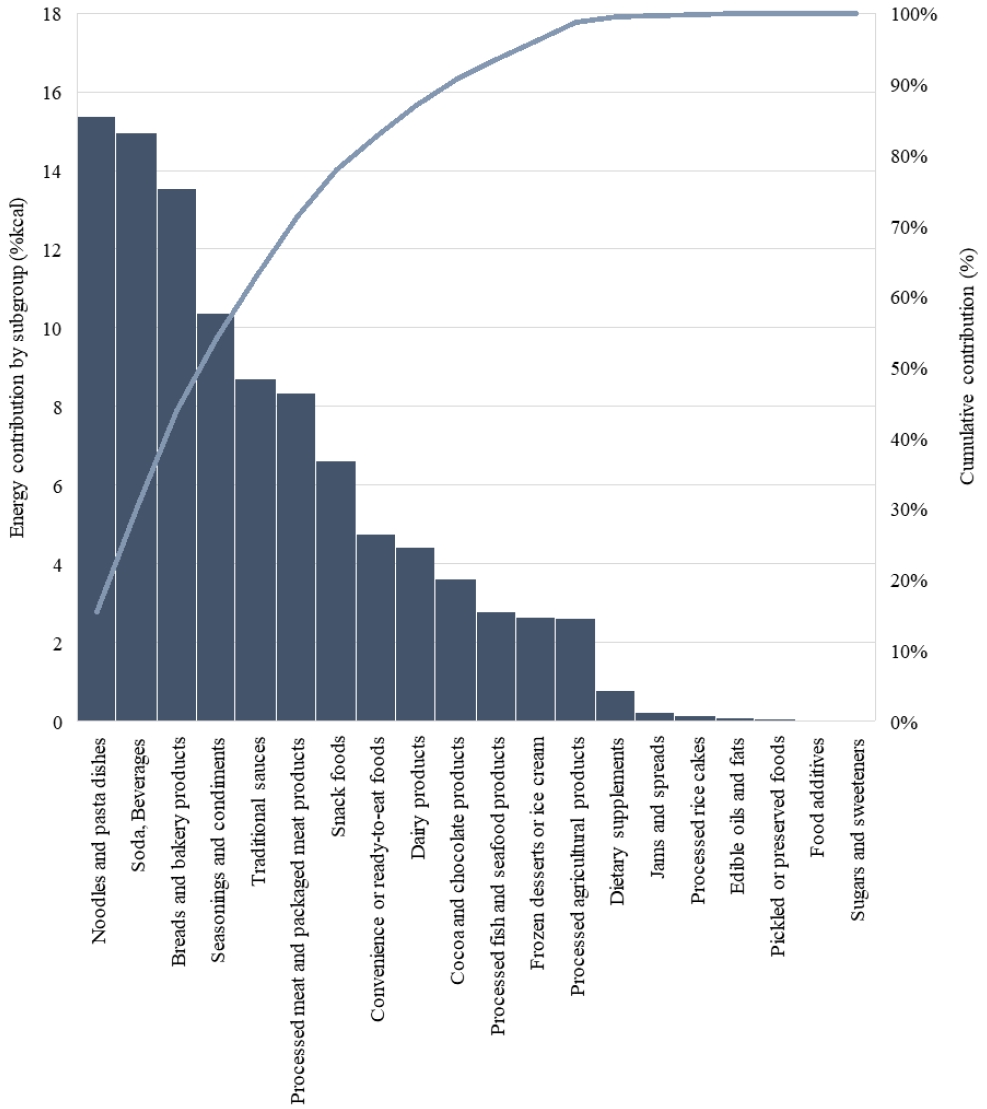
      Image Image
      Fig. 1. Diagram of data analysis employed in the development and performance evaluation of the NOVA–UPF scoring tool. KNHANES, Korea National Health and Nutrition Examination Survey; FFQ, food frequency questionnaire; GOMS, Gangwon Obesity and Metabolic Syndrome; UPF, ultra-processed food.
      Fig. 2. Cumulative contribution of UPF subgroups based on 24-hour dietary recall data among adults aged 19–40 years in the KNHANES (2021–2023) (n = 3,859). UPF, ultra-processed food; KNHANES, Korea National Health and Nutrition Examination Survey.
      Development of a simplified NOVA-based scoring tool for assessing ultra-processed food consumption among Korean young adults: a cross-sectional study
      UPF subgroups (%kcal) Total (n = 3,859) Men (n = 1,726) Women (n = 2,133) P-value
      Noodles and pasta dishes 16.0 ± 0.5 17.1 ± 0.7 14.1 ± 0.6 < 0.001
      Soda, beverages 15.0 ± 0.4 15.7 ± 0.6 14.2 ± 0.5 0.060
      Breads and bakery products 13.4 ± 0.4 11.3 ± 0.6 15.7 ± 0.6 < 0.001
      Seasonings and condiments 10.2 ± 0.3 10.3 ± 0.4 10.1 ± 0.4 0.705
      Traditional sauces 9.0 ± 0.3 9.8 ± 0.5 8.1 ± 0.4 0.013
      Processed meat and packaged meat products 8.6 ± 0.3 10.1 ± 0.5 7.1 ± 0.4 < 0.001
      Snack foods 6.3 ± 0.3 4.7 ± 0.4 8.0 ± 0.4 < 0.001
      Convenience or ready-to-eat foods 4.9 ± 0.3 5.5 ± 0.4 4.2 ± 0.3 0.011
      Dairy products 4.2 ± 0.2 3.0 ± 0.3 5.4 ± 0.3 < 0.001
      Cocoa and chocolate products 3.5 ± 0.2 3.4 ± 0.4 3.6 ± 0.3 0.581
      Processed fish and seafood products 2.8 ± 0.2 2.7 ± 0.2 2.8 ± 0.2 0.772
      Frozen desserts or ice cream 2.5 ± 0.2 2.0 ± 0.2 3.1 ± 0.3 0.001
      Processed agricultural products 2.6 ± 0.2 2.8 ± 0.3 2.4 ± 0.2 0.285
      Dietary supplements 0.8 ± 0.1 1.0 ± 0.2 0.5 ± 0.1 0.059
      Jams and spreads 0.2 ± 0.0 0.2 ± 0.0 0.3 ± 0.0 0.131
      Processed rice cakes 0.2 ± 0.0 0.2 ± 0.1 0.2 ± 0.1 0.783
      Edible oils and fats 0.2 ± 0.1 0.1 ± 0.0 0.1 ± 0.0 0.980
      Pickled or preserved foods 0.1 ± 0.0 0.1 ± 0.0 0.0 ± 0.0 0.459
      Food additives 0.0 ± 0.0 0.0 ± 0.0 0.0 ± 0.0 0.361
      Sugars and sweeteners 0.0 ± 0.0 0.0 ± 0.0 0.0 ± 0.0 0.318
      Food group NOVA–UPF score
      Rarely or never 1–3 times/month 1 time/week 2–4 times/week 5–6 times/week ≥ 1 time/day NOVA–UPF score range
      Noodles and pasta dishes 0 1 2 3 4 5 0–5
      Soda, beverages 0 1 2 3 4 5 0–5
      Breads and bakery products 0 1 2 3 4 5 0–5
      Seasonings and condiments 0 1 2 3 4 5 0–5
      Traditional sauces 0 1 2 3 4 5 0–5
      Processed meat and packaged meat products 0 1 2 3 4 5 0–5
      Snack foods 0 1 2 3 4 5 0–5
      Convenience or ready-to-eat foods 0 1 2 3 4 5 0–5
      Dairy products 0 1 2 3 4 5 0–5
      Cocoa and chocolate products 0 1 2 3 4 5 0–5
      Total possible score Total possible NOVA–UPF score: 0–50
      Variables Total (n = 237) Men (n = 65) Women (n = 172) P-value
      Total 237 (100.0) 65 (27.4) 172 (72.6)
      Marital status 0.925
       Spouse, including common-law partner 196 (82.7) 54 (83.1) 142 (82.6)
       Without a spouse1) 41 (17.3) 11 (16.9) 30 (17.4)
      Education level 0.011
       ≤ Middle school 5 (2.1) 0 (0.0) 5 (2.9)
       High school 73 (30.8) 12 (18.5) 61 (35.5)
       ≥ College 159 (67.1) 53 (81.5) 106 (61.6)
      Household income per month (million KRW) 0.913
       < 2 17 (7.2) 4 (6.2) 13 (7.6)
       2–4 77 (32.5) 22 (33.9) 55 (32.0)
       > 4 143 (60.3) 39 (60.0) 104 (60.5)
      Household type (n = 236) 0.976
       Single member 22 (9.3) 6 (9.2) 16 (9.4)
       Non-single 214 (90.7) 59 (90.8) 155 (90.6)
      Smoking status (n = 234) < 0.001
       Never smoker2) 171 (73.1) 29 (45.3) 142 (83.5)
       Former smoker 25 (10.7) 12 (18.8) 13 (7.7)
       Current smoker 38 (16.2) 23 (35.9) 15 (8.8)
      Drinking status 0.287
       Current drinking 182 (76.8) 53 (81.5) 129 (75.0)
       Current abstainer3) 55 (23.2) 12 (18.5) 43 (25.0)
      Recommended PA levels4) 0.160
       No PA Level 104 (43.9) 23 (35.4) 81 (47.1)
       Insufficient or inactive PA levels 49 (20.7) 18 (27.7) 31 (18.0)
       Recommended PA level 84 (35.4) 24 (36.9) 60 (34.9)
      Variables NOVA–UPF score P-value
      Age (year) 0.610
       20–29 21.3 ± 7.1
       30–39 23.6 ± 8.7
       40–49 22.8 ± 8.3
      Gender 0.500
       Men 23.5 ± 8.6
       Women 22.6 ± 8.2
      Marital status 0.907
       Spouse, including common-law partner 22.9 ± 8.2
       Without a spouse1) 22.7 ± 8.7
      Education level 0.259
       ≤ Middle school 24.8 ± 8.7
       High school 21.6 ± 8.2
       ≥ College 23.4 ± 8.3
      Household income per month (million KRW) 0.373
       < 2 22.1 ± 10.0
       2–4 21.9 ± 7.8
       > 4 23.5 ± 8.3
      Household type 0.388
       Single member 21.5 ± 10.0
       Non-single 23.1 ± 8.1
      Smoking status 0.343
       Never smoker2) 22.8 ± 8.3
       Former smoker 25.0 ± 9.4
       Current smoker 22.0 ± 7.6
      Drinking status 0.959
       Current drinking 22.9 ± 8.2
       Current abstainer3) 22.8 ± 8.7
      Recommended PA levels4) 0.584
       No PA Level 22.7 ± 8.7
       Insufficient or inactive PA levels 24.0 ± 7.4
       Recommended PA level 22.5 ± 8.3
      UPF consumption (%kcal) NOVA–UPF score Total
      T1 (lowest) T2 (middle) T3 (highest)
      T1 (lowest) 53 (67.1) 20 (25.3) 6 (7.6) 79 (100)
      T2 (middle) 23 (29.1) 32 (40.5) 24 (30.4) 79 (100)
      T3 (highest) 6 (7.6) 27 (34.2) 46 (58.2) 79 (100)
      Total 82 (34.6) 79 (33.3) 76 (32.1) 237 (100)
      Table 1. Comparison of energy intake (%) from UPF subgroups according to gender among adults aged 19–40 years in the KNHANES (2021–2023) (n = 3,859)

      Adjusted mean ± SE from multivariate regression models.

      All values, except for the total energy intake, are expressed as %kcal/day.

      All estimates were calculated using sampling weights to account for the complex survey design of KNHANES.

      P-values indicate overall differences according to gender.

      UPF, ultra-processed food; KNHANES, Korea National Health and Nutrition Examination Survey.

      Table 2. Scoring criteria for NOVA–UPF items according to consumption frequency

      UPF, ultra-processed food.

      Table 3. General characteristics of study participants according to gender based on FFQ data among adults aged 20–49 years in the GOMS cohort study (2022–2024) (n = 237)

      n (%).

      P-values between groups were identified using chi-squared tests.

      Sample sizes vary depending on the variables.

      FFQ, food frequency questionnaire; GOMS, Gangwon Obesity and Metabolic Syndrome; PA, physical activity.

      Without a spouse: individuals who are separated, divorced, widowed, or never married.

      Never smokers: those who have smoked < 100 cigarettes over their lifetime.

      Current abstainer: no lifetime experience of alcohol consumption or no alcohol intake during the past year.

      Recommended PA level: engaging in at least 150 minutes per week of moderate-intensity physical activity or 75 minutes per week of vigorous-intensity physical activity.

      Table 4. Mean NOVA–UPF scores according to general characteristics of participants in the GOMS cohort study (2022–2024) (n = 237)

      Mean ± SD.

      P-values were obtained from an independent t-test or one-way ANOVA.

      UPF, ultra-processed food; GOMS, Gangwon Obesity and Metabolic Syndrome; PA, physical activity.

      Without a spouse: individuals who are separated, divorced, widowed, or never married.

      Never smokers: those who have smoked < 100 cigarettes over their lifetime.

      Current abstainer: no lifetime experience of alcohol consumption or no alcohol intake during the past year.

      Recommended PA level: engaging in at least 150 minutes per week of moderate-intensity physical activity or 75 minutes per week of vigorous-intensity physical activity.

      Table 5. Cross-classification of participants by tertiles of UPF energy intake (%) and NOVA–UPF scores based on FFQ data in the GOMS cohort study (2022–2024) (n = 237)

      n (%).

      The weighted kappa coefficient for agreement across tertiles was 0.279.

      Spearman’s correlation coefficient = 0.629, P < 0.001.

      UPF, ultra-processed food; FFQ, food frequency questionnaire; GOMS, Gangwon Obesity and Metabolic Syndrome.


      Korean J Community Nutr : Korean Journal of Community Nutrition
      Close layer
      TOP