- [Korean]
-
Parents' needs and perceptions of dietary and nutrition education in early childhood education institutions in South Korea: a mixed methods study
-
Jounghee Lee, Sookyung Choi, Minseo Kim, Seonghyun Lim, Jeong-Weon Kim
-
Korean J Community Nutr 2025;30(6):441-456. Published online December 31, 2025
-
DOI: https://doi.org/10.5720/kjcn.2025.00304
-
-
 Abstract Abstract
 PDF PDF
- Objectives
This study aimed to clarify parental perceptions of dietary and nutritional education provided to young children, identify parental support needs, and suggest directions for improvement.
Methods
A mixed-method sequential explanatory design was followed. Quantitative data were collected through an online survey conducted nationwide that included 200 parents of children aged three to six years in South Korea. Qualitative data were subsequently obtained through focus group interviews with fifteen parents to explore their contextual insights and experiences.
Results
Needs ratings prioritized expanding activity-based/experiential education (3.65 ± 0.88), followed by strengthening home-school communication and connectivity (3.59 ± 0.84), diversifying topics and content (3.55 ± 0.88), and increasing instructional time (3.39 ± 0.94). Integrated with the focus group interview findings, multilevel barriers were revealed—individual level: strong preferences of children for sweet/processed foods; interpersonal level: strong parental modeling and peer effects counterbalancing limited teacher expertise/time; organizational level: insufficient effective event-based experiential activities, and resource gaps across institutions; community/policy level: infrequent external support, uneven access to local resources, lack of standardized guidance, and limited opportunities for parental participation. Parents favored short, interactive digital content and expressed concerns about overexposure. These convergent findings indicate needs to 1) formalize and extend experiential programs within the regular curriculum, 2) provide standardized guidelines and home resource kits, and 3) institutionalize parental involvement.
Conclusion
These findings reveal that dietary and nutritional education for young children should move beyond fragmented, event-based programs toward an integrated three-tiered model incorporating (1) a structured, experiential curriculum, (2) home-linked educational packages, and (3) safe and interactive digital content. Establishing standardized guidelines, enhancing educational infrastructure, and institutionalizing parental participation are essential for sustainable improvement of early childhood dietary education.
- [Korean]
-
Analysis of pork consumption attribute factors by consumer lifestyle in Korea: a cross-sectional study
-
Jounghee Lee, Juhyun Lee, Wookyoung Kim
-
Korean J Community Nutr 2025;30(1):75-88. Published online February 28, 2025
-
DOI: https://doi.org/10.5720/kjcn.2024.00332
-
-
Abstract
PDF
- Objectives
This study aims to identify and analyze how different South Korean lifestyles impact attitudes towards pork consumption.
Methods
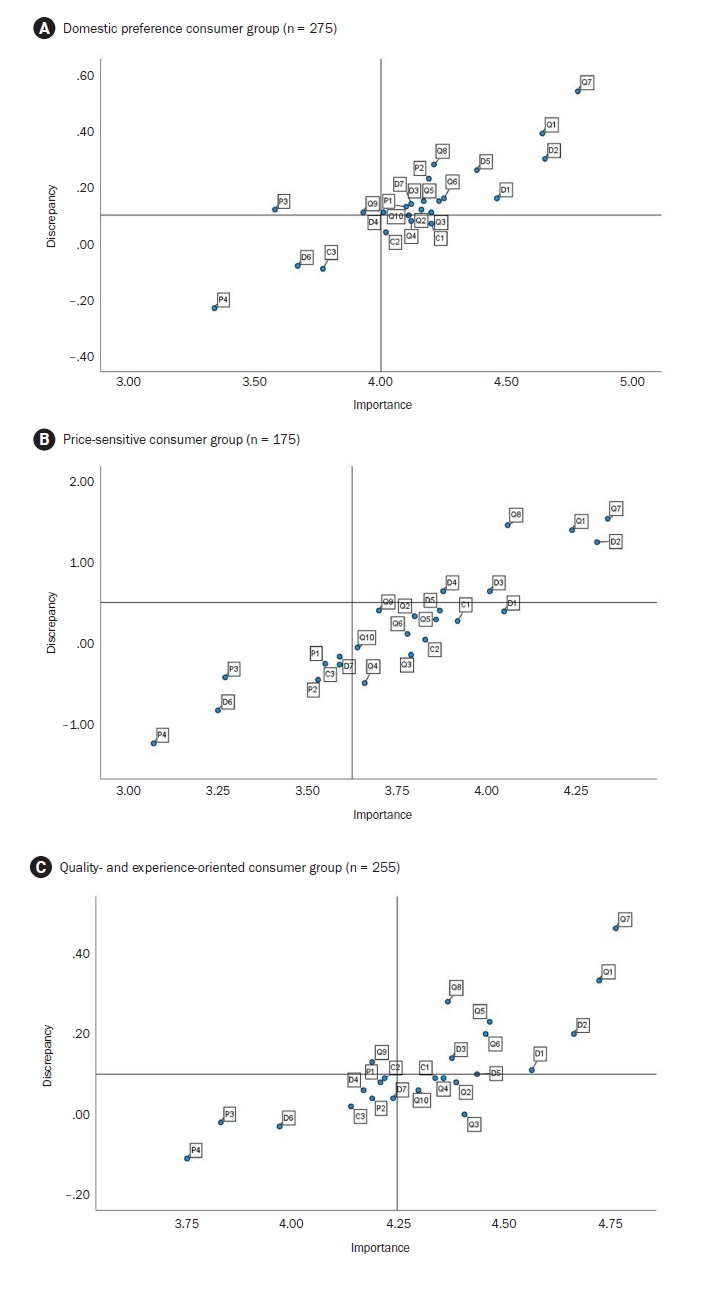
We implemented a cross-sectional survey targeting 705 adult consumers in South Korea using hierarchical and K-means cluster analyses. Respondents were classified into three relevant lifestyles: (1) domestic preference, (2) price-sensitive, and (3) quality-experience-oriented. The importance-performance analysis was employed to evaluate discrepancies between how they rated pork consumption using factors of “importance” and “satisfaction”. We employed Borich’s needs assessment and the Locus for Focus model to prioritize management areas.
Results
The research findings highlight that unpleasant odor/smell (Q7) and hygiene (Q1) were common key areas for management across all consumer groups, emphasizing their importance in enhancing pork consumption satisfaction. Among the groups, the domestic preference group showed high importance-performance discrepancies in attributes like expiry date (D2), suggesting a need for strengthened trust in domestic pork distribution and information transparency. The price-sensitive group prioritized economic factors, with fat thickness (Q8) identified as an essential management area. The quality-experience-oriented group emphasized sensory qualities such as juiciness (Q6) and meat color (Q5), with off-flavors (Q7) displaying the largest discrepancy. These results show the significant role of sensory attributes in consumer satisfaction.
Conclusion
This study demonstrated the multidimensional nature of pork consumption behavior, emphasizing the need for tailored strategies across consumer groups. Managing hygiene (Q1) and reducing off-flavors (Q7) are critical for all segments, while group-specific strategies include managing sensory quality for the quality-experience-oriented group, providing product information (D2) to increase trust for the domestic preference group, and emphasizing value for money for the price-sensitive group.
- [Korean]
-
Development and Effectiveness Evaluation of the STEAM Education Program on Food Groups for Kindergarteners
-
Jinkyeong Ahn, Seyoen Kim, Donghyuk Kim, Jounghee Lee
-
Korean J Community Nutr 2022;27(5):361-372. Published online October 31, 2022
-
DOI: https://doi.org/10.5720/kjcn.2022.27.5.361
-
-
Abstract
PDF
- Objectives
The purpose of this study was to explore the effectiveness of the STEAM (Science, Technology, Engineering, Arts, and Mathematics) education program on the use of specific food groups in improving nutrition-related knowledge and attitude, dietary behavior, creative problem solving, and STEAM attitude.
Methods
We selected two classes at a kindergarten in Jeollabuk-do, South Korea. A total of 44 kindergarteners from the two classrooms participated in this study. The experimental group and the control group were formed with 22 students each. The experimental group attended 11 STEAM classes on the use of the grain, fruit, and milk food groups. First, we performed the paired t-test to examine changes from pre-to-post classes for both groups.
Then, we used ANCOVA to compare post-test scores between the experimental and control groups with the adjustment of pre-test scores.
Results
The results demonstrate that the STEAM education program on the use of the food groups significantly improved (1) nutrition-related knowledge and attitude, and dietary behavior (P < 0.001), (2) creative problem solving (P < 0.001), and (3) STEAM attitude (P < 0.001) in the intervention group when compared with the control group.
Conclusions
The STEAM education program on the use of food groups is effective in enhancing nutrition knowledge and attitude, dietary behavior, creative problem solving, and STEAM attitudes among kindergarten students.
-
Citations
Citations to this article as recorded by  - Development and evaluation of play-based food and nutrition education materials for early childhood through sensory experiences: a pre-post observational study
Hyunjoo Ryou, Sohyun Park, Jieun Oh, Ji-Yun Hwang
Korean Journal of Community Nutrition.2025; 30(6): 471. CrossRef
-
2,073
View
-
55
Download
-
1
Crossref
|

 KSCN
KSCN