- [Korean]
-
Research trends in dietary behaviors and nutrition education among individuals with developmental disabilities in Korea: a scoping review (2015–2025)
-
Nakyung Kwak, Wonyeong Park, Yu-Ri Kim, Jieun Oh
-
Korean J Community Nutr 2026;31(1):1-20. Published online February 28, 2026
-
DOI: https://doi.org/10.5720/kjcn.2025.00374
-
-
 Abstract Abstract
 PDF PDF
- Objectives
We mapped trends in studies on dietary behaviors, nutritional status, and nutrition-related education among individuals with developmental disabilities in Korea over the past decade to identify research gaps and inform future research and policy development.
Methods
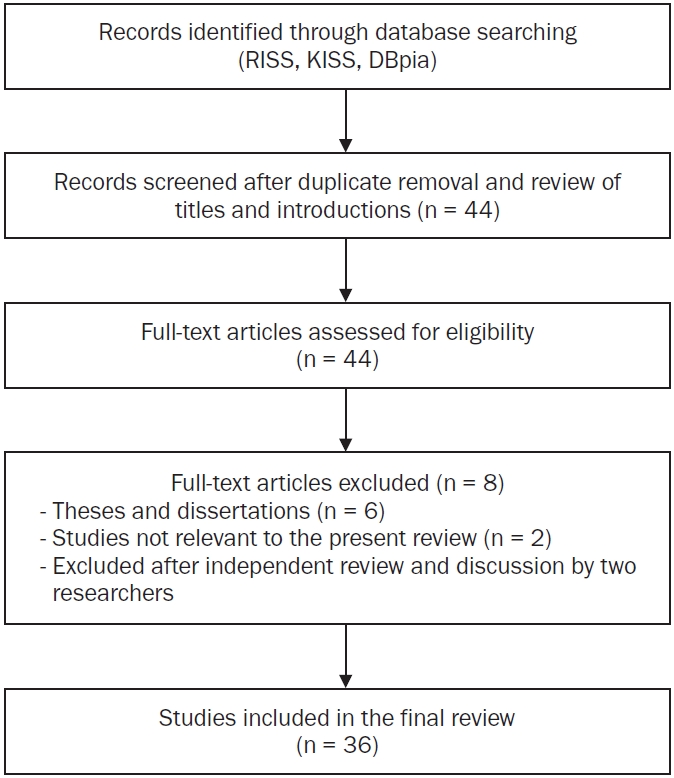
A scoping review was conducted using three major Korean academic databases (RISS, KISS, and DBpia). Studies published between 2015 and September 2025 were identified using combinations of keywords related to developmental disabilities, dietary behavior, nutrition, and health-related interventions. Eligible studies included empirical studies and secondary research (e.g., systematic or scoping reviews) conducted in Korea that focused on dietary behaviors, nutrition, health promotion, or nutrition-related education for individuals with developmental disabilities. Thirty-six studies met our inclusion criteria and were analyzed based on study design, study population, disability type, research topic, and publication period.
Results
Observational quantitative, qualitative, intervention-based experimental, and evidence synthesis accounted for 27.8%, 13.9%, 22.2%, and 36.1% of all included studies, respectively. Children and adolescents (27.8%) and adults (25.0%) were the most frequently studied populations, with limited studies focusing on professionals or teachers. Most studies targeted individuals with developmental disabilities as a combined group (61.1%), followed by those specifically targeting autism spectrum disorder. Research topics included dietary behaviors and nutritional status, nutrition-related education and interventions, health promotion, and medical or clinical issues, with many small-scale and shortterm intervention studies.
Conclusion
Although research on dietary and nutrition-related issues among individuals with developmental disabilities in Korea has expanded in scope and methodology, significant limitations remain. Future research should adopt longitudinal and community-based approaches, incorporate diverse populations, and strengthen policy-oriented nutrition support systems to promote sustainable health and quality of life for individuals with developmental disabilities.
- [Korean]
-
Development and evaluation of play-based food and nutrition education materials for early childhood through sensory experiences: a pre-post observational study
-
Hyunjoo Ryou, Sohyun Park, Jieun Oh, Ji-Yun Hwang
-
Korean J Community Nutr 2025;30(6):471-483. Published online December 31, 2025
-
DOI: https://doi.org/10.5720/kjcn.2025.00276
-
-
Abstract
PDF
- Objectives
This study aimed to develop play-based nutrition education (PBNE) materials for young children and to evaluate their applicability and effectiveness.
Methods
An online survey of 1,253 primary caregivers of preschool children was conducted, and the findings were used to develop age-specific utilization guides, slides, activity sheets, activity cards, posters, educational videos, and parent newsletters. Selected materials were implemented in child-care centers through the Children’s Foodservice Management Centers between October and November 2023. The effectiveness of the PBNE program was assessed by examining changes in mushroom consumption as well as food awareness and preferences, before and after the intervention.
Results
A total of eight media formats and 320 educational contents were developed, and mushrooms were as the pilot theme among the 12 possible food items. Following the intervention, children’s positive awareness of mushrooms increased, and > 96% of participants attempted to consume them. Teachers in child-care centers rated the appropriateness and applicability of the content, its contribution to behavioral improvement, and their overall satisfaction at > 4.9 out of 5 points.
Conclusion
This study developed experiential, PBNE materials aligned with the national standard child- and play-centered curriculum. The materials were effective in enhancing food awareness and promoting attempts at consumption. Future efforts should focus on developing additional experiential teaching tools that incorporate teacher feedback and on strengthening home-linked programs to support healthy seasonal food intake and positive dietary experiences in young children.
- [Korean]
-
Effects of primary caregivers’ food literacy, social support, food environment, and household income on the nutritional status of school-aged children: a cross-sectional study
-
Seyeon Park, Ji-Yun Hwang, Sohyun Park, Hyun Joo Ryou, Jieun Oh
-
Korean J Community Nutr 2025;30(5):352-363. Published online October 31, 2025
-
DOI: https://doi.org/10.5720/kjcn.2025.00248
-
-
Abstract
PDF
- Objectives
The dietary habits of school-aged children play a critical role in their growth and development, and are strongly influenced by the home environment. Household income is closely associated with caregivers’ food literacy, social support, and food environment. This directly affects the nutritional status of children. This study aimed to provide evidence to inform policies and educational programs for improving dietary habits in children, and to establish a foundation for tailored support strategies for low-income families.
Methods
This cross-sectional study included 846 primary caregivers of school-aged children from 17 regions across Korea, recruited through an online survey. Household income, caregivers’ food literacy, social support, and food environment were assessed. Nutritional status in children was measured using the Nutrition Quotient for Children (NQ-C). Statistical analyses included descriptive statistics, chi-square tests, one-way analysis of variance (ANOVA), analysis of covariance (ANCOVA), correlation analyses, and multiple linear regression.
Results
Caregivers from higher income households demonstrated significantly greater food literacy and social support (P < 0.001). Children from these households showed high balance scores and a large proportion of these children were in the “high” NQ-C grade. The NQ-C score in children was positively correlated with food literacy (r = 0.425), social support (r = 0.471), and the food environment (r = 0.235) (P < 0.001). Multiple regression analysis showed that food literacy (β = 0.256) and social support (β = 0.348) were significant predictors of nutritional status in children.
Conclusion
This study confirmed that the nutritional status in children is not only determined solely by household income but is also mediated by caregivers’ food literacy, social support, and food environment. These findings highlighted the limitations of providing only economic support. The findings underscore the need for multifaceted interventions such as strengthening parental nutrition education, expanding social support networks, and improving access to healthy foods.
- [Korean]
-
A study on the diet and nutrition management status and educational needs in elderly care facilities in Korea: focus group interviews with staff from children’s and social welfare meal management support centers and elderly care facilities
-
Seo Young Choi, Hyun joo Ryou, Jieun Oh
-
Korean J Community Nutr 2025;30(4):286-295. Published online August 29, 2025
-
DOI: https://doi.org/10.5720/kjcn.2025.00143
-
-
Abstract
PDF
- Objectives
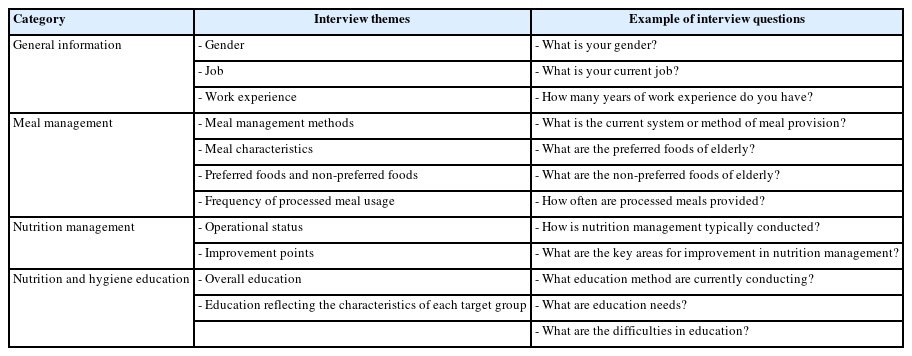
In this study, we identified the current status of meal and nutritional management in elderly care facilities and analyzed the educational needs of employees, with the goal of proposing effective support strategies for nutritional management and to suggest directions for developing customized educational content.
Methods
Between May and June 2024, we conducted nine focus group interviews with 22 participants recruited from 10 cities across four major regions of Korea, including 13 employees of children and social welfare meal management support centers and nine employees of elderly care facilities.
Results
Our findings revealed that supporting algorithm-based dietary planning, improving communication with caregivers, and providing flexible, practical education tailored to facility conditions, are key elements for enhancing nutritional management in elderly care facilities. To facilitate the translation of these insights into practice, it will be necessary to strengthen collaboration between centers and facilities, combined with efforts to improve the operational environment for applying the algorithm and providing continuous educational support.
Conclusion
The findings of this study emphasize the importance of on-site education and sustainable support strategies based on the diet and nutritional management status and education needs of elderly care facilities. Strengthening practical education, communication systems, and center–facility collaboration is required, and future research needs to verify the efficacy of these measures and define a sustainable support system based on quantitative analysis.
- [English]
-
Nutrition quotient for preschoolers and key impacting factors in Korea: a cross-sectional study on food literacy, social support, and the food environment of primary caregivers
-
Danbi Gwon, Ji-Yun Hwang, Jieun Oh
-
Korean J Community Nutr 2025;30(1):16-26. Published online February 28, 2025
-
DOI: https://doi.org/10.5720/kjcn.2024.00311
-
-
Abstract
PDF
- Objectives
This study evaluated the nutrition quotient for preschoolers (NQ-P) and analyzed the impact of key factors, such as caregivers’ food literacy, social support, and food environment, on the eating habits of preschool children in Korea. This study also sought to provide foundational data for developing tailored nutrition education programs by identifying the nutrition education needs of caregivers.
Methods
This study was conducted among caregivers of preschool children (aged 0–6 years) using an online self-administered survey conducted from August 22 to August 28, 2023. A total of 1,116 survey responses were analyzed. This study assessed children’s NQ-P score, caregivers’ food literacy, social support, food environment, and nutritional education needs. Data were analyzed using SPSS 29.0 (IBM Co.).
Results
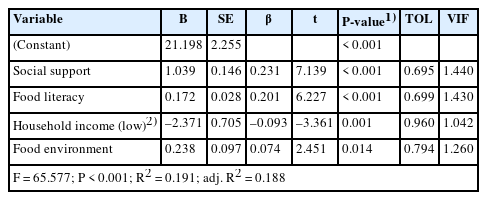
The average NQ-P score for preschool children was 52, showing a tendency for the balance score to decrease and the moderation score to increase with age. Children from rural and low-income areas exhibited significantly lower NQ-P scores. Caregivers’ food literacy was higher in urban and higher-income groups. Multiple regression analysis revealed that social support, food literacy, income, and food environment significantly affected children's NQ-P scores. The effectiveness of nutrition education varied based on the income level, with nutrition education on healthy eating being the most preferred topic for preschool children.
Conclusion
This study confirmed that caregivers’ food literacy and social support significantly affected preschool children’s nutritional status. This suggests a need for tailored nutritional education and dietary support policies, particularly for low-income and rural populations.
-
Citations
Citations to this article as recorded by  - Cluster-Based Evaluation of Dietary Guideline Adherence and Food Literacy Among Adolescents: Implications for Tailored Diets
Jimin Lim, Jieun Oh
Nutrients.2026; 18(2): 241. CrossRef - Development and usability evaluation of a web-based healthy eating practice questionnaire for Korean preschool children: a child–parent dyad approach
Young-Hee Han, Dawon Park, Dahyeon Kim, Saerom Shin, Eun Yeol Woo, Hye-Kyung Park, Taisun Hyun
Nutrition Research and Practice.2026; 20(1): 132. CrossRef - Nutrition literacy and socio-demographic determinants among Chinese women of childbearing age
Jing-Jing Meng, Jun Chen, Li Pu, Yan Zhu, Yan Zuo, Fang Wang, Li Chang, Yi-Ying He, Jian-Jun Zhang, Zhi-Lan Bai, Si-Qin Sun, Jie Liu, Jia Shi
Frontiers in Public Health.2026;[Epub] CrossRef - Dietary intake and eating behaviors by weight status among rural preschool children: NQ-P analysis
Ji-Sook Park, Hyojung Lee, Jaehee An, Jung-Eun Yim
Journal of Nutrition and Health.2026; 59(1): 63. CrossRef - The transition of nutritional status in infants, young children, and school-aged children in Korea and future-oriented nutritional strategies: a narrative review
Yoonna Lee
Korean Journal of Community Nutrition.2026; 31(2): 115. CrossRef - Exploring predictors of low nutritional literacy in maintenance hemodialysis patients: a machine learning and network analysis approach
Ling Yao, Yanling Liu, Xufeng Tan, Sisi Chen, Yanchun Fang
Frontiers in Public Health.2026;[Epub] CrossRef - Effects of primary caregivers’ food literacy, social support, food environment, and household income on the nutritional status of school-aged children: a cross-sectional study
Seyeon Park, Ji-Yun Hwang, Sohyun Park, Hyun Joo Ryou, Jieun Oh
Korean Journal of Community Nutrition.2025; 30(5): 352. CrossRef
-
4,271
View
-
81
Download
-
7
Crossref
- [Korean]
-
Foodservice Status and Perception regarding Foodservice Management in Kindergartens attached to Elementary Schools in Seoul
-
Ranmi Jung, Gun-Hee Kim, Jieun Oh, Sunny Ham, Seungmin Lee
-
Korean J Community Nutr 2022;27(6):492-502. Published online December 31, 2022
-
DOI: https://doi.org/10.5720/kjcn.2022.27.6.492
-
-
Abstract
PDF
- Objectives
This study examines the foodservice status of kindergartens attached to elementary schools in Seoul. We further determine the perception of elementary school principals and kindergarten assistant principals on the foodservice management for kindergartens.
Methods
This survey was conducted from July 17 to 23, 2019, enrolling 207 kindergartens attached to elementary schools in Seoul. Questionnaires were sent to principals of elementary schools and assistant principals of kindergartens, and the data obtained from 89 kindergartens were included in the analysis. The questionnaire consisted of four parts: general information on subjects, foodservice management status, foodservice management status during elementary school vacations, and the perception of principals of elementary schools and assistant principals of kindergartens on foodservice management. Data are presented as frequency and percentage or mean and standard deviation. Statistical comparison between principals of elementary schools and assistant principals of kindergartens was conducted by paired t-test, chi-square test, and Pearson's correlation analysis.
Results
A separate menu (10.1%) or recipe (20.2%) that considers preschooler characteristics was rarely used for foodservice at kindergartens attached to elementary schools. Most kindergartens did not have a separate dining space (3.4%) or a dedicated cook (93.3%). Although most kindergartens (92.1%) had operational foodservice during elementary school vacations, non-professional staff and non-nutrition teacher were mainly in charge of organizing the menu and purchasing ingredients (34.1% and 41.5%, respectively). The rate of using a contract catering company (28.0%, 23.2%) was also high. Both elementary school principals and assistant principals of kindergartens showed a high perception of the necessity for providing responsibility allowances for nutrition teachers and improving the cooking environment for kindergartens during elementary school vacations.
Conclusions
There is a need for policies and administrative support measures to improve the quality of foodservices for kindergartens attached to elementary schools.
-
Citations
Citations to this article as recorded by - Developing educational videos to inform rightly about school foodservice from kindergarten to high school: a case study
Gyoungok Gang, Chaewon Park, Haejin Kang, Wan Soo Hong, Yoo Kyoung Park, Sook Hee Choi, Seung Hye Kim, Jieun Choi, Jihyun Park, Hyeja Chang
Korean Journal of Community Nutrition.2024; 29(2): 97. CrossRef - A Study on the Menu Patterns and Menu Diversity of Bibimbap Meals Served by Elementary School Foodservices in the Jeonbuk Area
Sun A Choi, Chohee Mun, Jieun Go, Jeong Ok Rho
Journal of the East Asian Society of Dietary Life.2024; 34(6): 444. CrossRef
-
1,489
View
-
16
Download
-
2
Crossref
|

 KSCN
KSCN