
 KSCN
KSCN
Search
- Page Path
- HOME > Search
Research Article
- [Korean]
- Effect of a community-based nutrition intervention incorporating social cognitive theory constructs and transtheoretical model-based counseling among community-dwelling elderly in Korea: a quasi-experimental study
- Hyewon Shin, Seungmin Lee
- Korean J Community Nutr 2026;31(3):264-275. Published online June 30, 2026
- DOI: https://doi.org/10.5720/kjcn.2026.00073
-
 Abstract
 PDF
PDF - Objectives
This study evaluated the effects of a 7-week nutrition intervention based on the personal and environmental constructs of social cognitive theory (SCT) and the transtheoretical model (TTM) on dietary behavior-related factors, dietary behavior outcomes, and stages of dietary behavior change among community-dwelling older adults.
Methods
A quasi-experimental nonequivalent control group pretest–posttest design was conducted from May to December 2024 at seven senior facilities in Seoul and Gyeonggi, Korea. Older adults aged ≥ 65 years were assigned by facility to either an intervention group (n = 66; four facilities) or a control group (n = 65; three facilities). The intervention group completed a 7-week program consisting of baseline assessment, five weekly group education sessions, individualized nutrition counseling, and post-intervention assessment. The control group received one general nutrition education session. Outcomes included dietary knowledge, outcome expectations, value expectations, self-efficacy, environmental factors (food accessibility and household food availability and social support), dietary behavior outcomes assessed using the Nutrition Quotient for the Elderly (NQ-E), and stage of change. Program effects were analyzed using ANCOVA adjusted for age, family composition, education, baseline dietary knowledge, and value expectations.
Results
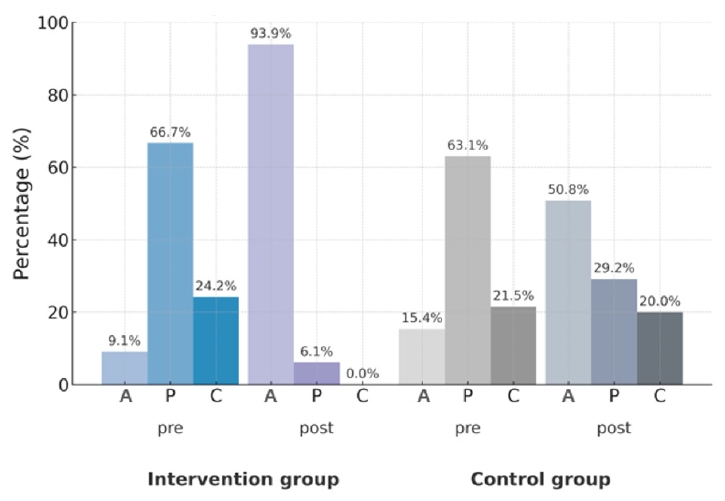
Compared with the control group, the intervention group demonstrated significantly greater improvements in dietary knowledge (P < 0.001), outcome expectations (P = 0.018), self-efficacy (P < 0.001), environmental factors (P < 0.001), and NQ-E total score (P = 0.011). No significant between-group difference was observed for value expectations. The proportion of participants in the action stage increased from 9.1% to 93.9% in the intervention group, and post-intervention stage distribution differed significantly between groups (P < 0.001). Program satisfaction was high (4.69 ± 0.41).
Conclusion
A 7-week nutrition intervention incorporating SCT-based personal and environmental constructs and TTM-based stage-matched counseling improved dietary behavior-related factors, dietary behavior outcomes, and stage distribution among community-dwelling older adults.
- 515 View
- 28 Download

Review
- [Korean]
- Current status of nutrition education media and its utilization in providing customized nutrition information for older adults in Korea: a scoping review based on the transtheoretical model and food literacy
- Seojin Yun, Jiwon An, Kirang Kim
- Korean J Community Nutr 2025;30(3):175-182. Published online June 30, 2025
- DOI: https://doi.org/10.5720/kjcn.2025.00094

-
Abstract
PDF
 Supplementary Material
 - Objectives
This study analyzes the status of nutrition education media among Korean older adults based on the transtheoretical model (TTM) and their food literacy to propose effective strategies for the development and utilization of educational media.
Methods
A literature review was conducted using The Joanna Briggs Institute (JBI) protocol. The literature search was performed using government and local government agency websites, as well as those of affiliated institutions, health and nutrition-related academic societies, and academic search engines. A total of 144 studies were identified, and after a cross-evaluation by two reviewers based on the literature selection criteria, 73 studies were included in the final analysis.
Results
Among the types of nutrition education media, card news had the highest proportion, followed by video media. The development and distribution of nutrition education media for older adults were primarily carried out by government and local government agencies, as well as related affiliated institutions, accounting for 80.8% (n = 59) of the total. When nutrition education topics in the media were categorized according to the stages of behavior change in the TTM, the largest proportion, 64.6% (n = 61), was applicable to the precontemplation and contemplation stages. When categorized by food literacy domains, all topics fell under the categories of nutrition and safety.
Conclusion
Nutrition education media for older adults were found to be primarily focused on knowledge acquisition and information delivery, making them mostly applicable to the precontemplation and contemplation stages of behavior change. The concept of food literacy addressed in the different types of media was limited to the domains of nutrition and safety, with no content covering the cultural and relational domains or the social and ecological domains. For tailored nutrition education, it is necessary to develop diverse educational materials that comprehensively reflect each stage of the TTM and all aspects of food literacy. -
Citations
Citations to this article as recorded by
- A needs assessment for the development of a digital-based self-nutrition management education program for older adults in Korea: a cross-sectional study
Hae-Song Yoo, Jin-Myung Lee, Min-Sun Jeon
Korean Journal of Community Nutrition.2026; 31(2): 178. CrossRef - Effect of a community-based nutrition intervention incorporating social cognitive theory constructs and transtheoretical model-based counseling among communitydwelling elderly in Korea: a quasi-experimental study
Hyewon Shin, Seungmin Lee
Korean Journal of Community Nutrition.2026; 31(3): 264. CrossRef - Toward the development of a digital self-nutrition management education program for elderly: findings from focus groups study
Hae-song Yoo, Jin-myong Lee, Min-sun Jeon
Korean Journal of Community Nutrition.2025; 30(6): 431. CrossRef
- A needs assessment for the development of a digital-based self-nutrition management education program for older adults in Korea: a cross-sectional study
- 2,778 View
- 124 Download
- 3 Crossref
Original Article
- [English]
- A Comparison of Food and Nutrient Intake Status of Aged Females in A Rural Long Life Community by the Stage Model of Dietary Behavior Change
- Mi Yeon Park, Byung Yeol Chun, Soon Jae Joo, Gu Beom Jeong, Chul Hyoi Huh, Geum Ran Kim, Phil Sook Park
- Korean J Community Nutr 2008;13(1):34-45. Published online February 29, 2008
-
Abstract
PDF
- For the correct dietary habit and balanced dietary intake of aged people, the nutrition management that fits to the dietary behavior change stage has to be accomplished. In order to do so, in this paper, we chose 175 women that are aged more than 65 years old who are rural long life community residents and surveyed the dietary intake for 2 days including a twice depth interview and the 24 hour recall method. Also, for the sake of our aim, using the transtheoretical model, the dietary behavior change stage group was divided into the contemplation stage group, the preparation stage group, the action stage group and the maintenance stage group. The results are as follows: In the intake amount of protein (p < 0.01), vitamin B1 (p < 0.05) and vitamin B6 (p < 0.05), the intake amount of these nutrients in the action stage group and the maintenance stage group were significantly larger than the intake amount in the contemplation stage group and the preparation stage group. The nutrition evaluation according to the dietary behavior change stage, the ratio of subjects who took insufficient amount of energy, protein, vitamin A, and vitamin C were low as the dietary behavior change stage was upgraded. The subjects of maintenance stage group were most likely to consume vegetables more than once a day, and consume fruits and milk and milk products more than 5 times/week. MAR [13], MAR [10] and MAR [4] of subjects in the action stage group and the maintenance stage roup were significantly higher than MAR [13], MAR [10] and MAR [4] of subjects in the contemplation stage group and the preparation stage group (p < 0.001). From the above results, there were differences of nutrient intakes according to the dietary behavior change stage. Therefore, it is considered that the intervention for the dietary behavior motivation induction has to be advanced before accomplishing the individually fitting intervention at the time of nutrient management intervention.
- 480 View
- 1 Download
 First
First Prev
Prev


