
 KSCN
KSCN
Search
- Page Path
- HOME > Search
Research Note
- [Korean]
- Sugar intake from processed foods among Koreans and levy on excessive sugar use: a cross-sectional study
- Sung Ok Kwon, Cho-il Kim
- Korean J Community Nutr 2026;31(3):287-296. Published online June 30, 2026
- DOI: https://doi.org/10.5720/kjcn.2026.00199
-
 Abstract
 PDF
PDF - Objectives
Although reduced mean sugar intakes have been reported recently, proportion changes in the Korean population with a sugar intake higher than the World Health Organization (WHO) sugar intake recommendation (WSIR) remain unknown. Therefore, in this study, we analyzed the sugar intake of Koreans to identify trends and prioritize target groups for relevant policy interventions.
Methods
We used dietary intake data from the 8th and 9th Korea National Health and Nutrition Examination Surveys (KNHANES VIII and IX) to derive sugar intake from processed foods (SIPF) in the Korean population. We classified, aggregated and calculated sugar intake from individual foods at the tertiary-level food codes, and assessed SIPF adequacy based on whether it met the WSIR of less than 10% of the total energy intake.
Results
The proportion of the Korean population with an SIPF exceeding the WSIR was 22.7% and 22.4% in KNHANES VIII and IX, respectively. Nevertheless, more than one-third of children, adolescents, and young adults (34.6%–39.1%) showed SIPF higher than the WSIR with the highest proportion of 41.4% registered among school-age girls in KNHANES IX.
Conclusion
While the mean sugar intake of Koreans has decreased slightly since 2019, the proportion of people with SIPF exceeding WSIR is on the rise in school-age children, adolescents, and young adults, implying the necessity of proactive policy responses. As the Korean government discusses fiscal policy design and implementation to moderate the sugar intake of the population in order to promote public health and prevent chronic diseases, it should bear in mind the point emphasized in the WHO guideline as follows: “Changes in health-related outcomes as a result of a fiscal policy are likely to occur in the long term and should therefore be evaluated over a longer term than outcomes such as purchasing and consumption of foods and beverages.” -
Citations
Citations to this article as recorded by
- Estimating added sugars intake among South Koreans: results from the 2023 Korea National Health and Nutrition Examination Survey
Youngmin Nam, Linxi Huang, Cho-il Kim, Jihyun Yoon
Clinical Nutrition Research.2026; 15(3): 139. CrossRef
- Estimating added sugars intake among South Koreans: results from the 2023 Korea National Health and Nutrition Examination Survey
- 707 View
- 46 Download
- 1 Crossref

Research Articles
- [English]
- Psychosocial factors related to the stages of change in reducing sugar intake among adults in Seoul, Korea: a cross-sectional study
- Ju Young Lee, Kyung Won Kim
- Korean J Community Nutr 2026;31(1):21-35. Published online February 28, 2026
- DOI: https://doi.org/10.5720/kjcn.2026.00024
-
Abstract
PDF
- Objectives
This study examined the factors associated with stages of change (SOC) in reducing sugar intake among adults, applying the theory of planned behavior.
Methods
An online survey was conducted among adults aged 19–49 years residing in Seoul, Korea. Based on their SOC in reducing sugar intake, participants (n = 380) were categorized into a pre-action group (45.3%) and an action group (54.7%). Statistical analysis was performed using χ2-test, analysis of covariance, and one-way analysis of variance with linear contrast.
Results
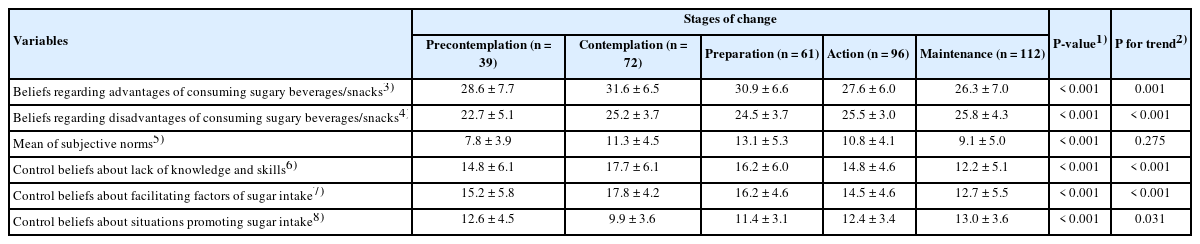
The consumption frequency of sugary foods was significantly higher in the pre-action group than in the action group (P < 0.001). Compared with the action group, participants in the pre-action group perceived the advantages of sugar intake more favorably (P < 0.001), perceived the disadvantages less strongly (P = 0.002), and reported greater influence from significant others (P = 0.004). In contrast, participants in the action group agreed less with insufficient knowledge/skills (P < 0.001), had greater control over the facilitating factors of sugar intake (P < 0.001), and had stronger control beliefs in situations promoting sugar intake (P < 0.001). Behavioral beliefs (P < 0.001) and control beliefs (P < 0.001) showed a significant linear trend across the five SOC, whereas subjective norms did not (P = 0.275).
Conclusion
Psychosocial factors related to sugar intake reduction clearly differed between the SOC groups. In the pre-action group, nutrition education should emphasize lowering the perceived benefits of sugar intake while increasing awareness of its adverse consequences. Strengthening the perception of control over sugar intake is important, despite the factors or situations promoting sugar intake. This can be achieved by providing practical tips and developing skills to reduce sugar intake. For the action group, it is necessary to maintain the reduced sugar intake through continual support and encouragement.
- 813 View
- 33 Download
- [Korean]
- Analysis of the relationship between sugar intake and cancer prevalence: a cross-sectional study using the 8th Korea National Health and Nutrition Examination Survey
- Hye-Ryun Kim, Soo-Kyung Lee
- Korean J Community Nutr 2025;30(1):89-102. Published online February 28, 2025
- DOI: https://doi.org/10.5720/kjcn.2024.00339
-
Abstract
PDF
 Supplementary Material
 - Objectives
This study aimed to analyze the association between sugar intake and cancer risk among Korean adults aged 19 years and older.
Methods
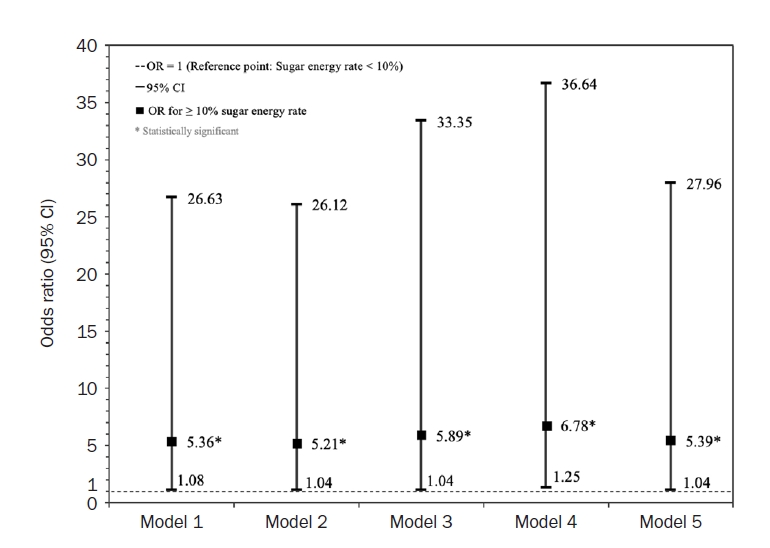
A total of 13,016 adults aged 19 years and older who participated in the 8th Korea National Health and Nutrition Examination Survey from 2019 to 2021 were included. Sugar intake was assessed in terms of both absolute intake and sugar energy rate. Sugar intake was divided into quartiles, while sugar energy rate was categorized into three groups (< 10%, 10%–20%, > 20%) based on the 2020 Dietary Reference Intakes for Koreans and into two groups (< 10%, ≥ 10%) based on WHO recommendations. Cancer prevalence was determined using cancer-related survey questions. The association between sugar intake and cancer prevalence was analyzed by sex and cancer type using logistic regression. All statistical analyses were performed using IBM SPSS statistics 29.0 (IBM Co.).
Results
From 2019 to 2021, sugar intake significantly declined with age in both men and women (P for trend < 0.001), with the highest intake observed in the 19–29 age group (61.38 g). Men consumed significantly more sugar than women across all age groups except for the 50–64 and 65–74 groups (P < 0.05). However, the sugar energy rate was significantly higher in women than in men (P < 0.05). While the association between sugar intake and cancer prevalence varied across regression models and cancer types, cervical cancer consistently showed a significant association with sugar intake (P < 0.05).
Conclusion
The association between sugar energy rate and the prevalence of premenopausal cervical cancer was consistent and significant. Given that women had a higher sugar energy rate than men, the relationship between sugar intake and cancer prevalence in women warrants further investigation. Longitudinal studies with more detailed sugar intake assessments are needed. -
Citations
Citations to this article as recorded by- Sugar rationing during the first 1000 days and early onset cancer: a natural experiment
Runhua Tang, Haoran Wang, Huimin Hou, Jianye Wang, Shuhang Luo, Jianyong Liu, Ming Liu
The American Journal of Clinical Nutrition.2026; 124(3): 101453. CrossRef - A study on hypertension relevant nutritional knowledge and dietary practices in Chinese college students studying in South Korea
Zhe Sun, Wookyoun Cho
Journal of Nutrition and Health.2015; 48(5): 441. CrossRef - Influence of the Size of the Spoon on the Eating rate, Energy Intake and the Satiety Levels of Female College Students
Yang Hee Hong, Young Suk Kim, Hyun Jung Kwon, Do Seok Chang, Dong Geon Kim, Un Jae Chang
Korean Journal of Community Nutrition.2015; 20(5): 375. CrossRef - Dietary behavior and nutritional status among Chinese female college students residing in Korea
Gaowei, Soyeon Kim, Namsoo Chang, Ki Nam Kim
Korean Journal of Nutrition.2013; 46(2): 177. CrossRef
- Sugar rationing during the first 1000 days and early onset cancer: a natural experiment
- 4,038 View
- 142 Download
- 4 Crossref
- [Korean]
- Development and application of a dietary program to reduce sugar intake using a living lab approach in Korea: an intervention study
- Jung-Hyun Kim, Min Sook Kyung, Seul Ki Choi
- Korean J Community Nutr 2024;29(6):504-513. Published online December 31, 2024
- DOI: https://doi.org/10.5720/kjcn.2024.00318
-
Abstract
PDF
- Objectives
This study aimed to develop and apply a dietary program to reduce sugar intake among community residents using a Living Lab approach.
Methods
We developed and applied a community-based dietary program to reduce sugar intake. Participants were recruited from community organizations, including a children’s food service management center, elementary to high schools, a university, a family center, a community health center, and an elderly welfare center. The dietary program was conducted in two phases; start and next levels. The start level included a pre-assessment of dietary behaviors and participation in educational platforms, whereas the next level included activities using educational platforms, tailored mission and feedback, and pre- and post-surveys. Extension educators at each community organization implemented the dietary program following organization-specific guidelines. Changes in participants’ nutrition knowledge, dietary behaviors and perceptions, self-efficacy, intention to reduce sugar intake, and participants’ program satisfaction were analyzed using paired t-tests.
Results
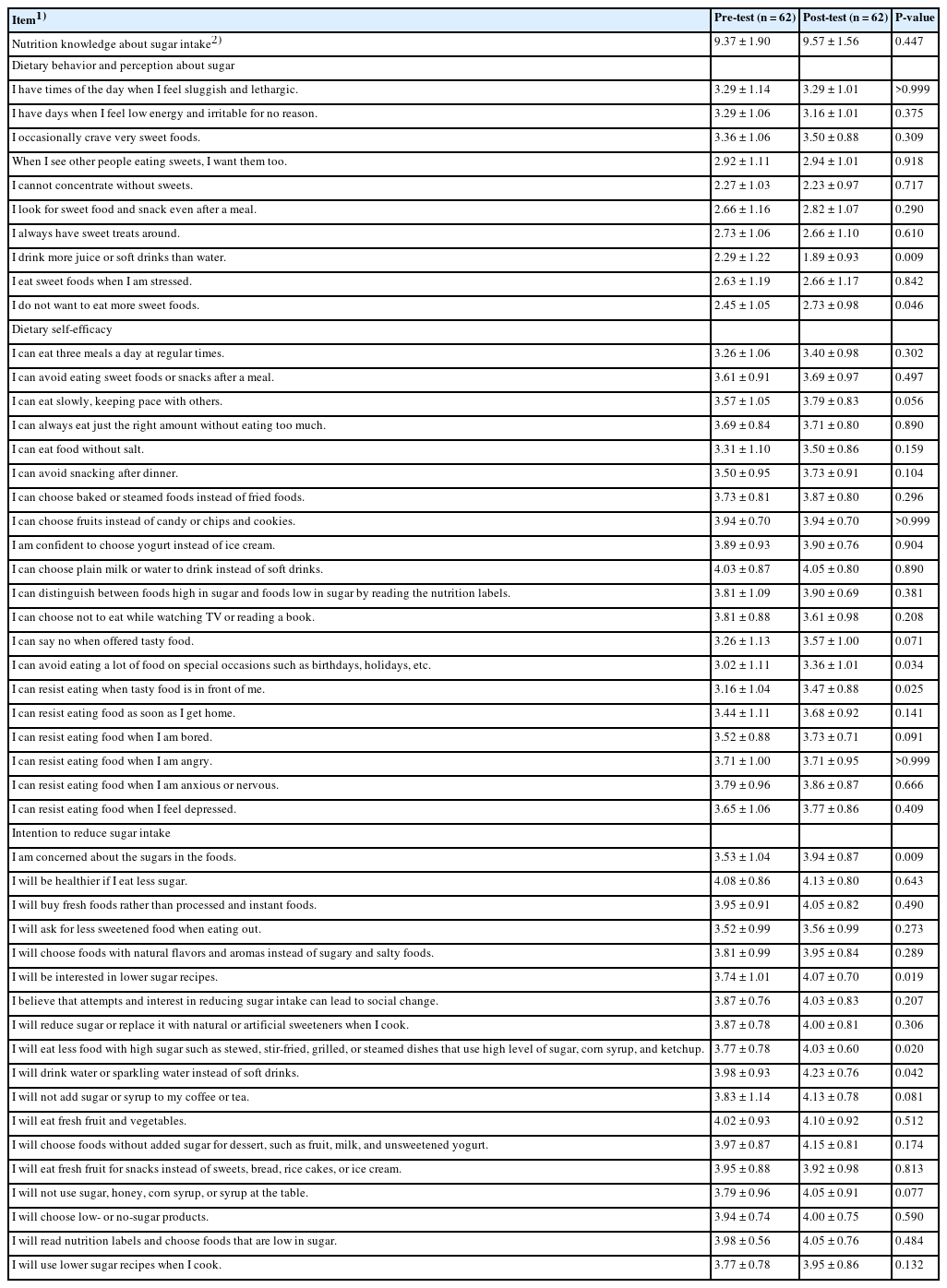
In total, 1,238 and 339 individuals participated in the start and next level, respectively. Participants reported significantly lower scores on dietary behavior items regarding drinking more juice or soft drinks after program participation (P = 0.009) and craving sweet foods (P = 0.046). They reported a higher intention to take interest in sugar content in food (P = 0.009) and lower-sugar recipes (P = 0.019), eat less food with high sugar content (P = 0.020), and drink water or sparkling water instead of soft drinks (P = 0.042). Nutrition knowledge did not significantly change after program participation. Program satisfaction significantly increased from the start level to the next level (P<0.050).
Conclusion
This study showed the potential of using a Living Lab approach to implement community-wide dietary interventions. Further research is required to evaluate the effectiveness of the Living Lab approach in various community settings.
- 2,646 View
- 76 Download
- [English]
- Total sugar intake and its contributed foods by age groups in Koreans using the 8th (2019–2021) Korea National Health and Nutrition Examination Survey: a cross-sectional study
- Hyejin Yu, Sang-Jin Chung
- Korean J Community Nutr 2024;29(3):222-233. Published online June 30, 2024
- DOI: https://doi.org/10.5720/kjcn.2024.29.3.222
-
Abstract
PDF
- Objectives
This study was conducted to investigate the status of total sugar intake and contributing foods in Korea according to age groups.
Methods
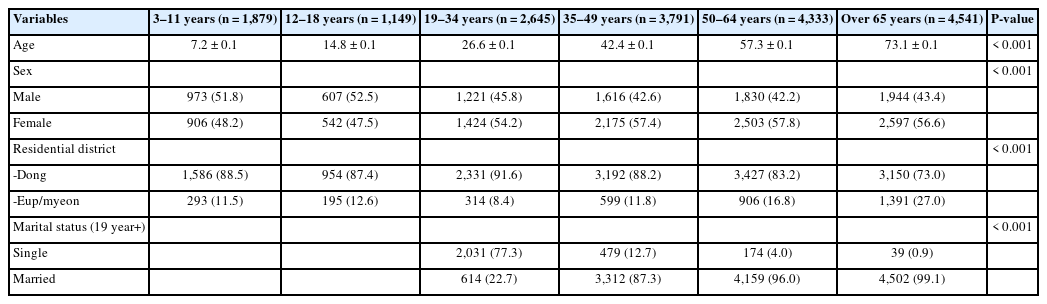
This study used 24-hour dietary recall data from the 8th Korea National Health and Nutrition Examination Survey (2019–2021) to investigate the nutritional and total sugar intake status among Koreans. A total of 18,338 research participants (≥3 years old) were included in this study. To analyze the types of foods contributing to total sugar intake, these foods were categorized into 15 types. Moreover, we examined the total sugar intake and ranked the most consumed foods by age groups (3–11 years, 12–18 years, 19–34 years, 35–49 years, 50–64 years, over 65 years). A survey procedure was employed for statistical analysis.
Results
The energy intake ratio from total sugars was approximately 12%–15%, which was within the recommended range. However, the proportion of individuals consuming total sugar exceeding 20% of their total caloric intake is nearly 20%, raising concerns about excessive sugar consumption. Furthermore, the percentage of participants whose intake of sugar from processed foods exceeded 10% of their total calories was highest in the 12–18 age group at 37.1%, followed by the 3–11 age group at 35.2%, and the 19–34 age group at 34.0%. Carbonated drinks, cola, and cider were the primary foods consumed by children and adolescents (3–18 years old) and young adults (19–34 years old). For middle-aged and older adults, mixed coffee with sugar and cream was a prominent contributor to sugar intake.
Conclusions
This study investigated sugar consumption patterns among Koreans, finding the principal foods contributing to this intake. Identifying these contributors is pivotal, given their potential impact on public health. -
Citations
Citations to this article as recorded by- Psychosocial factors related to the stages of change in reducing sugar intake among adults in Seoul, Korea: a cross-sectional study
Ju Young Lee, Kyung Won Kim
Korean Journal of Community Nutrition.2026; 31(1): 21. CrossRef - Associations of self-efficacy and perceived benefits and barriers with sugar-sweetened beverage consumption patterns: a secondary analysis of the 2017–2020 Nutrition and Health Survey in Taiwan (NAHSIT)
Chi-Hsuan Liu, Chyi-Huey Bai, Te-Chih Wong, Shu-Chen Lee, Yi-Chun Chen
Frontiers in Nutrition.2026;[Epub] CrossRef - Ten-year trends in sugar-sweetened beverages consumption among Koreans, 2014–2023
HyunJi Son, Khongorzul Ganbat, SuJin Song
Nutrition Research and Practice.2026; 20(4): 683. CrossRef
- Psychosocial factors related to the stages of change in reducing sugar intake among adults in Seoul, Korea: a cross-sectional study
- 18,903 View
- 185 Download
- 3 Crossref
 First
First Prev
Prev


