
 KSCN
KSCN
Search
- Page Path
- HOME > Search
Research Article
- [English]
- Association between nutrient intake and frailty status in Korean older adults: a cross-sectional study using the 9th (2022–2023) Korea National Health and Nutrition Examination Survey
- Hyejin Yu, Sang-Jin Chung
- Korean J Community Nutr 2026;31(2):153-164. Published online April 30, 2026
- DOI: https://doi.org/10.5720/kjcn.2026.00038
-
 Abstract
 PDF
PDF - Objectives
This study evaluated the intake status of key macronutrients and micronutrients (calcium, magnesium, iron, and vitamin D) among Korean older adults and investigated their associations with frailty and its individual components.
Methods
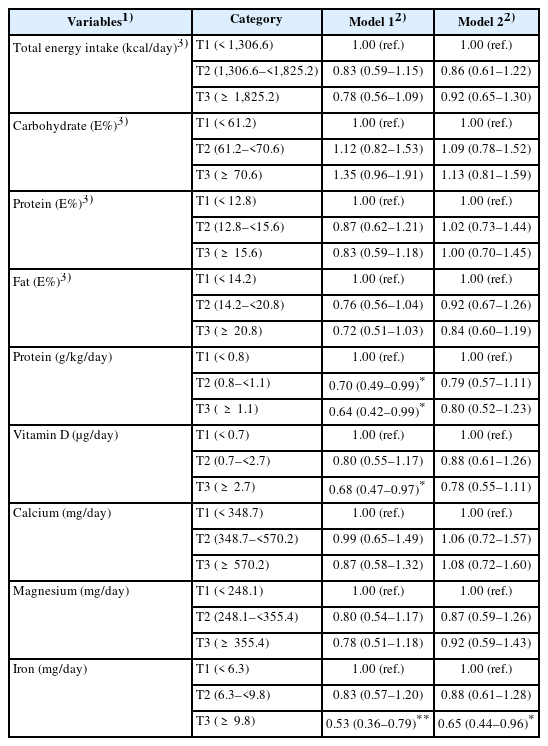
Data from 1,246 participants (aged ≥ 65 years) in the 9th Korea National Health and Nutrition Examination Survey (2022–2023) were analyzed. Participants were classified into Robust, Pre-frail, and Frail groups based on a modified version of the Fried frailty phenotype (unintentional weight loss, exhaustion/fatigue, muscle weakness, slow gait speed, and low physical activity). Nutrient intake levels were categorized into tertiles. Multivariable logistic regression was used to estimate odds ratios (ORs) for frailty. Model 1 was adjusted for age, sex, and total energy intake. Model 2 included additional adjustments for socioeconomic factors (household composition, household income) and function-related factors (aerobic physical activity, chewing difficulty, and disease status).
Results
Total energy intake differed significantly across frailty groups in both Model 1 (P = 0.011) and Model 2 (P = 0.043). In the fully adjusted model, participants in the highest tertile of iron intake (T3) had 35% lower odds of frailty compared to those in the lowest tertile (T1) (OR = 0.65; 95% confidence interval [CI], 0.44–0.96). Iron intake maintained the strongest independent association with reduced odds of muscle weakness (T3 vs. T1: OR = 0.45; 95% CI, 0.28–0.71). Furthermore, higher protein intake per kilogram of body weight (T3) was significantly associated with lower odds of slow gait speed (OR = 0.53; 95% CI, 0.33–0.87) in the minimally adjusted model. Vitamin D, calcium, and magnesium were not significantly associated with overall frailty after full adjustment.
Conclusion
Insufficient intake of protein and iron is associated with increased odds of frailty and its functional components in Korean older adults. These findings underscore the critical need for evidence-based nutritional interventions and policy development to prevent and manage frailty at the population level.
- 710 View
- 22 Download

Review
- [English]
- Dietary factors and nutritional guidelines for sarcopenia in older adults: a narrative review
- Sumin Heo, Soo Jin Yang
- Korean J Community Nutr 2025;30(6):389-396. Published online December 31, 2025
- DOI: https://doi.org/10.5720/kjcn.2025.00360

-
Abstract
PDF
- Objectives
Sarcopenia is a condition characterized by the loss of muscle mass and function and is often accompanied by aging and chronic diseases such as diabetes and obesity. It increases the risk of falls, frailty, disability, hospitalization, and mortality in older adults. Its global prevalence is estimated as approximately 10%–27% in adults aged > 60 years. This review analyzes evidence from research findings and recommendations to provide a comprehensive overview of dietary factors and nutritional strategies for preventing and managing sarcopenia in older adults.
Methods
Literatures were searched to integrate findings from observational studies, clinical trials, systematic reviews, and meta-analysis on dietary factors and nutritional guidelines for the prevention and management of sarcopenia. Particularly, points were emphasized on protein intake, micronutrient adequacy, dietary patterns, and combined lifestyle interventions relevant to older populations.
Results
Sarcopenia develops through multifactorial mechanisms such as dysfunction in muscle protein synthesis, chronic inflammation, mitochondrial dysfunction, and aging-related hormonal decline. Nutritional factors, particularly protein intake, play a central role in its development and management. Adequate protein intake is typically 1.0–1.2 g/kg/day for healthy older adults and more than 1.2 g/kg/day for individuals with sarcopenia or frailty. High-quality protein intake, sufficient leucine intake, and amino acids or β-hydroxy-β-methylbutyrate supplementation may help to counteract dysfunction in muscle protein synthesis. The adequacy of vitamin D supports musculoskeletal health. Dietary patterns, such as the Mediterranean and Dietary Approaches to Stop Hypertension diets have been consistently associated with better muscle mass, strength, and function. Strong evidence has demonstrated synergistic benefits when optimized nutrition is combined with resistance exercise.
Conclusion
The comprehensive management of sarcopenia in older adults requires an integrated strategy that prioritizes adequate protein and energy intake, vitamin D adequacy, healthy dietary patterns, and regular resistance exercise. -
Citations
Citations to this article as recorded by
- Sodium butyrate ameliorates muscle atrophy in type 2 diabetes-related sarcopenia via the PI3K/Akt/FoxO1 pathway
Cheng-Ya Song, Ying Yang, Kan Hong
Tissue and Cell.2026; 101: 103487. CrossRef - Dairy Foods Support Public Health Among Hispanic/Latino Americans
Kevin B. Comerford, Ashanda Saint Jean, Jennifer Vargas, Kimberly Avila Edwards
Journal of the National Hispanic Medical Association.2026;[Epub] CrossRef - Broccoli-Derived Peptides and Leucine in Combination Ameliorate D-Galactose-Induced Sarcopenia in Mice
Kexin Yuan, Wenbin Wu, Ning Su, Mingyang Cui, Jingyi Qi, Yang Zhang, Zhengyang Zhang, Peng An, Junjie Luo, Yongting Luo
Nutrients.2026; 18(12): 1997. CrossRef - Micronutrient risk with GLP-1 receptor and dual incretin agonists in obesity: Mechanistic pathways, clinical signals, and a monitoring framework
Daniel Simancas-Racines, Martín Campuzano-Donoso, Gianluca Rossetti, Luigi Cobellis, Vincenzo Pilone, Federica Fascì-Spurio, Dolores Jima Gavilanes, Carlos Soria, Claudia Reytor-González, Luigi Schiavo
Obesity Pillars.2026; 19: 100290. CrossRef - Vitamin D as a Modulator of Sarcopenia in Women: Interactions with Dietary Patterns and Physical Exercise
Ilaria Versari, Alberto Bavelloni, Camilla Sbrighi, Mirko Traversari, Irene Faenza, Sara Salucci
Nutrients.2026; 18(15): 2494. CrossRef - Associations Between Lifestyle Behaviors and Handgrip Strength in Community-Dwelling Older Women: A Cross-Sectional Study
Yuji Maruyama, Maho Ueda
Healthcare.2026; 14(15): 2269. CrossRef - Sarcopenia as chronic recovery failure: a constraint-accumulation hypothesis for the muscle mass–function gap
Jun Woo Kwon
Medical Hypotheses.2026; 215: 112116. CrossRef
- Sodium butyrate ameliorates muscle atrophy in type 2 diabetes-related sarcopenia via the PI3K/Akt/FoxO1 pathway
- 7,736 View
- 188 Download
- 7 Crossref
Original Article
- [English]
- The Associations of Percent Body Fat with Dietary Intake, Plasma Lipids, Lipoprotein(a), and PAI-1 in Middle Aged Korean Adults
- Jean Chinock Kim Rim, Soon Ah Kang, Hiojung Wee
- Korean J Community Nutr 1998;3(5):695-706. Published online November 30, 1998
-
Abstract
PDF
- This study was designed to investigate the associations of the percent body fat dietary intake, plasma lipoprotein profile, lipoprotein(a), and plasminogen activator inhibitor-1(PAI-1) concentrations of 1982 Korean subjects(men : 1000 and women : 982) between the ages of 40 and 59 years. The dietary assessment consisted of twenty-four hour dietary records and food frequency questionnaires. The subjects were identified into one of the five rating groups of % body fat : lean, underweight, normal, overweight and obese groups. The biochemical assessment included measurements of plasma total cholesterol(TC), HDL-cholesterol(HDL-C), LDL-cholesterol(LDL-C), triglyceride(TG), lipoprotin(a)(Lp(a)), and PAI-1. With respect to the ratio of percent energy intake of carbohydrate : protein : fat of the normal group of the women was 62% : 17% : 20%, respectively. Women apparently had a higher intake of carbohydrates than men(52% : 17 : 20%) did. There was a linear relationship between energy intake and % body fat in both mean and women(with the exception of the underweight group of women). The relationship of % body fat of men to the protein and fat intake was higher than that of the carbohydrate intake. Of the men in the study, intakes of energy, protein and alcohol were positively correlated to % body fat. In women, energy, carbohydrate and protein intake were positively correlated to % body fat, however, the fat, cholesterol and alcohol intake did not show any correlation to the % body fat in women. This study showed that % body fat was positively correlated with plasma TC, LDL-C, PAI-1 levels, and TG, but the % body fat was negatively correlated with plasma HDL-C level in both men and women. These results indicated that the high energy intake of obese or overweight subjects might contribute to several of the biochemical indices fo coronary heart disease(CHD) risk. In conclusion, increased energy intake is associated with overweight or obesity in middle aged Korean people. There was no relationship between % energy intake of fat and % body fat in the study, in middle-aged Korean men and women. The plasma lipid profile and PAI-1 level thought to be the risk factors of CHD were positively associated with percent body fat in middle aged Korean people.
- 495 View
- 1 Download
 First
First Prev
Prev


