
 KSCN
KSCN
Search
- Page Path
- HOME > Search
Research Article
- [Korean]
- Differences in lunch nutrient intake and nutritional adequacy among Korean older adults by meal site: a cross-sectional analysis of the 2018–2021 Korea National Health and Nutrition Examination Survey data
- Daeun Choi, Sunhee Seo
- Korean J Community Nutr 2026;31(2):205-213. Published online April 30, 2026
- DOI: https://doi.org/10.5720/kjcn.2026.00045
-
 Abstract
 PDF
PDF - Objectives
This study aimed to examine whether the dietary quality of congregate lunches differs according to meal location among older adults and to identify meal settings that may represent gaps in nutritional oversight. Specifically, this study compared lunchtime nutrient intake and adequacy among older adults eating at workplaces, welfare centers, and religious institutions.
Methods
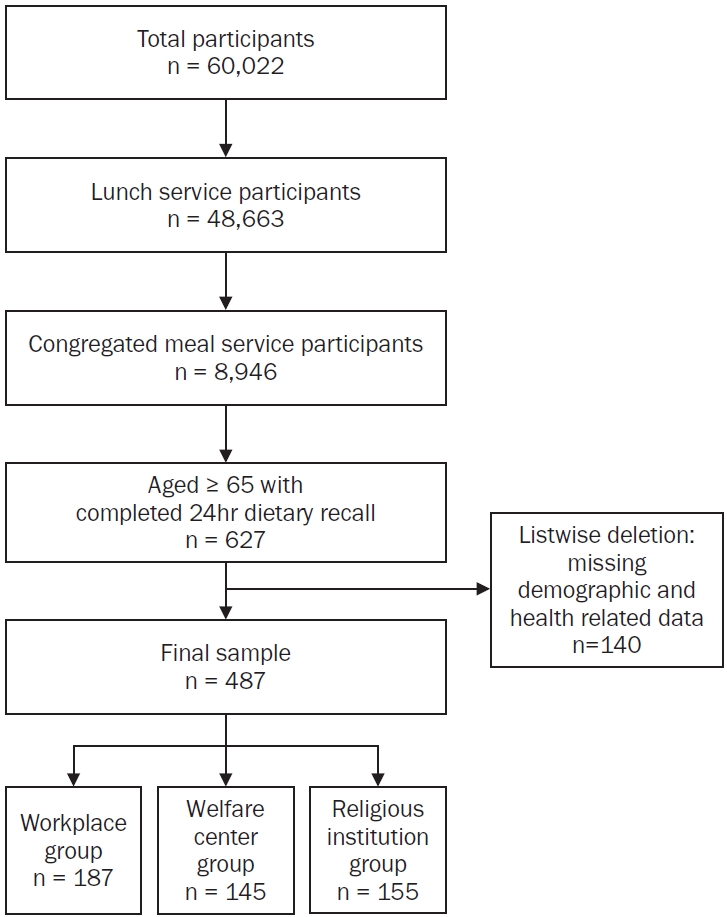
Data were obtained from the 2018–2021 Korea National Health and Nutrition Examination Survey. The participants included 487 adults aged ≥ 65 years who reported consuming lunch at institutional meal sites, including workplaces (n = 187), welfare centers (n = 145), and religious institutions (n = 155). Nutrient intakes, nutrient adequacy ratio (NARs), and the mean adequacy ratio were compared using complex-sample general linear models with Bonferroni post-hoc tests, adjusting for sex, age, and total energy intake.
Results
Socioeconomic characteristics were broadly comparable across groups, but nutrient intake and dietary quality differed according to meal location. In food-group analyses, meat intake was lowest among participants eating at religious institutions, and dairy intake also differed significantly across settings. In nutrient adequacy analyses, NAR for carbohydrate, thiamin, and niacin differed significantly by meal location. However, except for carbohydrate, most nutrient-specific NAR remained below 1.0 across all groups, indicating insufficient adequacy relative to one-third of the recommended intake from lunch alone.
Conclusion
The dietary quality of congregate lunches among older adults differed according to meal location. Although nutrient inadequacy was common across settings, older adults eating at religious institutions showed relatively lower adequacy for some nutrients, particularly thiamin and niacin. These findings suggest that nutritional support should be strengthened across congregate meal services, with particular attention to less structured community-based settings such as religious institutions. -
Citations
Citations to this article as recorded by
- Evaluation of the nutrition quality of meals served in small-scale public foodservice for the elderly in Korea by foodservice operation type–focused on proportion over chronic disease risk reduction intake and nutrient adequacy ratio: a cross-sectional st
Inhee Kang, Hyeongmo An, Gyoungok Gang, Hyeja Chang
Korean Journal of Community Nutrition.2026; 31(4): 348. CrossRef
- Evaluation of the nutrition quality of meals served in small-scale public foodservice for the elderly in Korea by foodservice operation type–focused on proportion over chronic disease risk reduction intake and nutrient adequacy ratio: a cross-sectional st
- 768 View
- 30 Download
- 1 Crossref

Original Article
- [English]
- Perception of Foodservice Quality Attributes of Older Adults: Compared by Lifestyle and Dining Frequency in Continuing Care Retirement Communities
- Sunhee Seo
- Korean J Community Nutr 2006;11(2):261-270. Published online April 30, 2006
-
Abstract
PDF
- The purpose of this study was to identify the differences of older adults' perceptions of foodservice quality attributes of current offerings in Continuing Care Retirement Communities (CCRCs) in terms of their lifestyles (length of residency, special diet, housing option, travel frequency, dine out frequency), dining frequency, and demographics in the dining room of CCRCs. The survey was administered to residents in three CCRCs. Data was analyzed for 140 surveys using t-test, ANOVA, and factor analysis. This study found female older adults perceived the following attributes were more important than male ones: presentation of food, color and garnish, texture of vegetables, taste and flavor of food, and respectful attitude of serving staff. Older adults who have a special diet perceived the seasoning and bite sized pieces were more important than those who have a general diet. Also, there were significant differences between frequent visitors and occasional visitors in the dining room of CCRCs. By knowing the differences by residents' demographics and residential characteristics, the foodservice manager can establish strategies to increase the dining frequency of residents in the dining rooms of CCRCs.
- 582 View
- 0 Download
 First
First Prev
Prev


