
 KSCN
KSCN
Search
- Page Path
- HOME > Search
Research Article
- [English]
- Psychosocial factors related to the stages of change in reducing sugar intake among adults in Seoul, Korea: a cross-sectional study
- Ju Young Lee, Kyung Won Kim
- Korean J Community Nutr 2026;31(1):21-35. Published online February 28, 2026
- DOI: https://doi.org/10.5720/kjcn.2026.00024
-
 Abstract
 PDF
PDF - Objectives
This study examined the factors associated with stages of change (SOC) in reducing sugar intake among adults, applying the theory of planned behavior.
Methods
An online survey was conducted among adults aged 19–49 years residing in Seoul, Korea. Based on their SOC in reducing sugar intake, participants (n = 380) were categorized into a pre-action group (45.3%) and an action group (54.7%). Statistical analysis was performed using χ2-test, analysis of covariance, and one-way analysis of variance with linear contrast.
Results
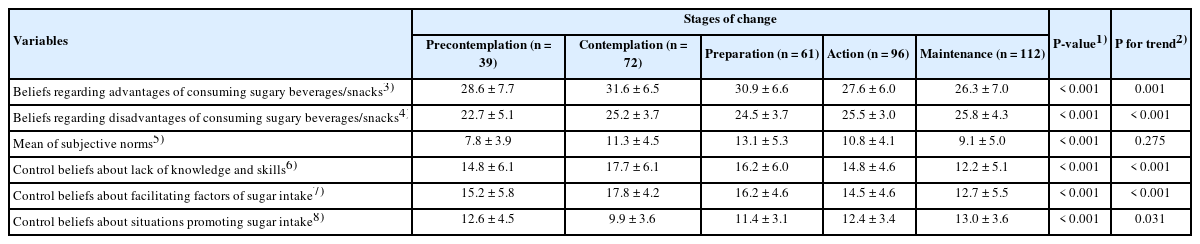
The consumption frequency of sugary foods was significantly higher in the pre-action group than in the action group (P < 0.001). Compared with the action group, participants in the pre-action group perceived the advantages of sugar intake more favorably (P < 0.001), perceived the disadvantages less strongly (P = 0.002), and reported greater influence from significant others (P = 0.004). In contrast, participants in the action group agreed less with insufficient knowledge/skills (P < 0.001), had greater control over the facilitating factors of sugar intake (P < 0.001), and had stronger control beliefs in situations promoting sugar intake (P < 0.001). Behavioral beliefs (P < 0.001) and control beliefs (P < 0.001) showed a significant linear trend across the five SOC, whereas subjective norms did not (P = 0.275).
Conclusion
Psychosocial factors related to sugar intake reduction clearly differed between the SOC groups. In the pre-action group, nutrition education should emphasize lowering the perceived benefits of sugar intake while increasing awareness of its adverse consequences. Strengthening the perception of control over sugar intake is important, despite the factors or situations promoting sugar intake. This can be achieved by providing practical tips and developing skills to reduce sugar intake. For the action group, it is necessary to maintain the reduced sugar intake through continual support and encouragement.
- 813 View
- 33 Download

 First
First Prev
Prev


